Nvidia’s internal investigation into allegations that a woman tied to a Chinese business network tried to spy on CEO Jensen Huang underscores how the battle for artificial intelligence hardware has moved far beyond semiconductors and into corporate security, diplomacy and statecraft.
Nvidia Faces Espionage Probe and AI Geopolitics
Nvidia Corp
For investors, the issue is not the tabloid-style intrigue. It is the degree to which the world’s most important AI chipmaker is now operating inside a geopolitical pressure cooker that can affect customer access, licensing, supply chains and ultimately demand for its highest-end processors. Nvidia has already warned in filings that export restrictions and licensing rules can make pre-sale and post-sale support more cumbersome and push customers in China, the Middle East and elsewhere to look for alternatives. That is the real economic risk: every new layer of political scrutiny makes the moat around Nvidia’s AI franchise a little harder to defend.
Sentiment Indicators
China has denied the espionage allegations, and the claims themselves have not been proven. But the episode lands at a sensitive moment for the sector. Washington is already tightening controls on advanced chips, Beijing is trying to reduce dependence on U.S. technology, and the competition for AI compute has become a strategic contest rather than a simple product cycle. When the CEO of the company most closely associated with that race becomes part of the story, it highlights how little separation remains between corporate execution and national security.
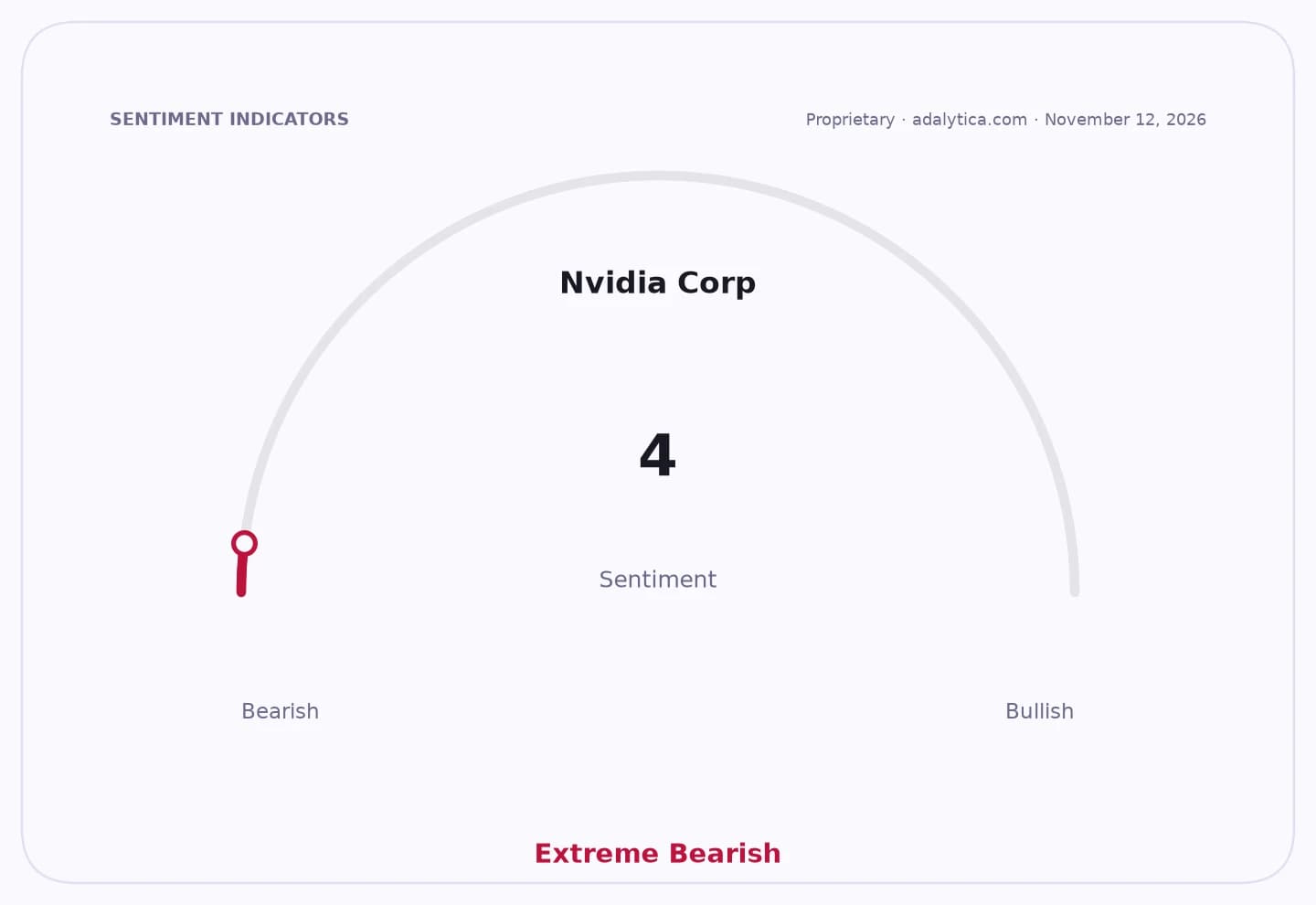
The market backdrop makes that even more important. Nvidia’s shares have been volatile, with the stock recently falling to $166.19 from levels above $220 just weeks earlier, while standard technical indicators show deeply oversold conditions, including an RSI reading of 24.5 and the price well below its 50-day moving average of $215.94. Adalytica’s proprietary NVIDIA earnings sentiment gauge is also at 4, labeled “Extreme Fear,” even as awareness sits at 100, a sign that attention remains intense despite the selloff. That combination tells me the market is no longer pricing Nvidia as a simple growth story; it is pricing a geopolitical premium and a trust discount.
Nvidia Corp — 30-day sentimentadalytica.com
Explore this data interactively — full history, time series and cross-market comparisons.

Still, the bigger investment thesis is unchanged. Nvidia remains the toll road for AI infrastructure, and episodes like this may actually deepen the case for the rest of the ecosystem. If the U.S.-China split keeps widening, the winners are likely to be the companies building the infrastructure around sovereign AI, domestic fabs, data-center power, networking and advanced packaging. TSMC, which is central to advanced chip manufacturing, has also come under pressure, but its role in the supply chain is exactly why it remains strategically indispensable. Microsoft, meanwhile, stays exposed to the same AI capex cycle, but with a more diversified software and cloud base.
The takeaway is straightforward: this is not just a scandal story, it is another reminder that AI investing is now a geopolitics trade. I believe the best opportunities remain in the picks-and-shovels names that benefit from rising AI capex and supply-chain fragmentation, while direct exposure to the chip war will stay volatile and headline-sensitive. Investors should buy the infrastructure, not the drama.
| Entity | Gains | Losses |
|---|---|---|
| Nvidia suppliers | ▲More AI capex demand | ▼Greater scrutiny and volatility |
| Nvidia competitors | ▲Any disruption to Nvidia | ▼U.S.-China tech tensions |
| TSMC | ▲Critical chipmaking role | ▼Export-policy uncertainty |
| Microsoft | ▲AI platform demand | ▼Higher compute costs |