Nvidia is trying to widen the AI market by turning the unused compute already sitting in homes into a distributed inference network, a move that could deepen demand for its GPUs while making local AI cheaper and easier to run.
Nvidia PAIR expands local AI inference network
The new free, open-source Personal AI Router, or PAIR, links compatible computers across Windows, Linux and macOS so they can share local AI inference workloads in parallel. That matters because the next phase of AI growth is shifting from training giant models in hyperscale data centers to running smaller agentic tasks everywhere, and Nvidia is positioning itself as the plumbing for that transition.
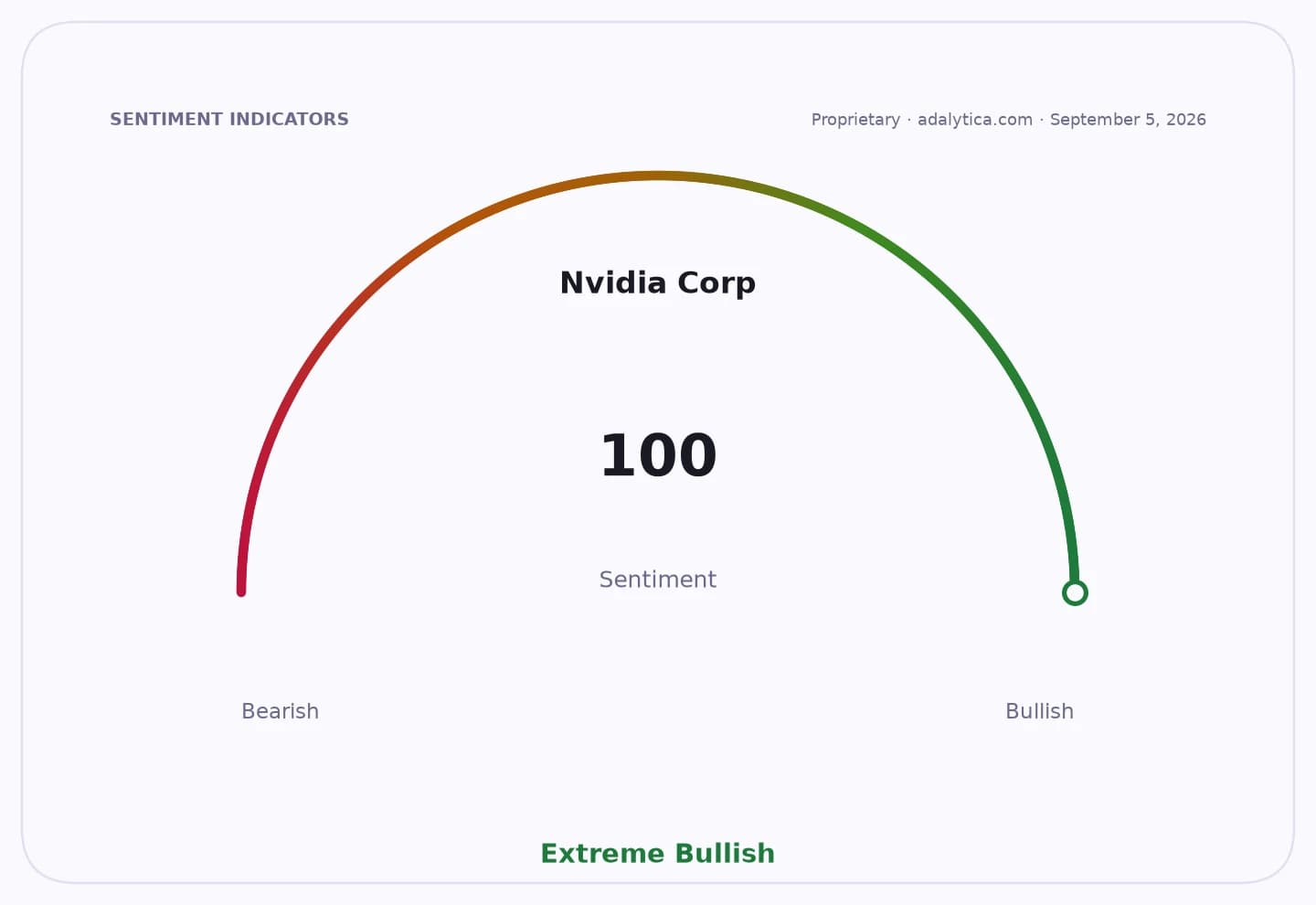
Sentiment IndicatorsⓘProprietary · adalytica.com · September 5, 2026
This is a snapshot — live sentiment, awareness and momentum for 130+ markets update continuously in the dashboard.Open AlphaPulse
For investors, the important point is not the novelty of a “personal AI data center” pitch. It is the strategic reach. Nvidia is extending its ecosystem beyond cloud operators and enterprises into consumer and prosumer workflows, where every incremental local deployment can reinforce GPU demand, developer lock-in and software dependence on Nvidia hardware. The company says PAIR supports RTX 20-series cards and newer, RTX Pro GPUs and DGX Spark systems, while also working with Apple’s M4 chips and newer Macs, broadening the pool of devices that can participate in local AI.
The thesis is straightforward: Nvidia is making it easier for households and small teams to monetize idle compute, which lowers friction for AI adoption at the edge and could accelerate a market the Street still underestimates. In a world where agentic applications split complex jobs into many smaller requests, a distributed setup can avoid bottlenecks on a single machine and scale up as devices join or leave the network. That is exactly the kind of architecture that favors Nvidia’s installed base.
The stock backdrop suggests the market is already treating Nvidia as a core AI infrastructure winner, but the opportunity may still be larger than consensus implies. Nvidia shares closed at $230.36 on Sept. 4, above both the 50-day moving average of $210.57 and the 200-day moving average of $196.53, with RSI readings in the low-50s, suggesting the rally is not yet stretched. Adalytica’s Nvidia earnings sentiment snapshot also shows “Extreme Greed,” reflecting strong momentum around the name as investors continue to price in AI capex durability.
The second-order beneficiaries are clear. Nvidia wins if local AI adoption creates more reasons to buy or keep its GPUs. Software partners such as Ollama, LM Studio, Perplexity Portable Computer, Hermes Agent and OpenClaw gain a simpler on-ramp for users. And small businesses, power users and AI enthusiasts get a cheaper path to inference without renting cloud capacity.
The losers are just as obvious: cloud-only inference providers, commodity PC makers with weaker AI differentiation, and any investor assuming AI compute demand will stay centralized inside hyperscale data centers. Nvidia is effectively telling the market that the AI buildout is not just about bigger warehouses of compute. It is also about federating idle capacity already paid for by consumers and prosumers.
That makes PAIR more than a product launch. It is a distribution strategy for the next leg of AI adoption, and a reminder that the best AI trade is still the picks-and-shovels layer that controls the infrastructure. If Nvidia can keep lowering the barrier to local agentic AI, the upside extends well beyond one more software release. Investors should stay positioned for a longer runway in Nvidia and in the broader AI compute stack.
| Entity | Gains | Losses |
|---|---|---|
| Nvidia | ▲More GPU demand | ▼None immediately |
| PC users with RTX/Mac hardware | ▲Cheaper local AI | ▼More setup complexity |
| AI software partners | ▲Easier deployment | ▼Cloud-only rivals |
| Cloud inference providers | ▲— | ▼Some workload share |