NVIDIA is pushing its artificial intelligence deeper into scientific discovery, teaming up with the SETI Institute to help astronomers scan for possible signals from extraterrestrial civilizations, in a project that also tests whether AI itself may be part of the search strategy.
NVIDIA and SETI test AI for radio astronomy
Artificial Intelligence
The collaboration matters because it extends NVIDIA’s core business beyond commercial computing into a new, high-complexity workload: real-time scientific inference. In practical terms, the project shows how the company’s GPUs can be used not just to train and run large language models, but to control instruments, sift through torrents of telescope data and flag anomalies fast enough to matter during an observation window.
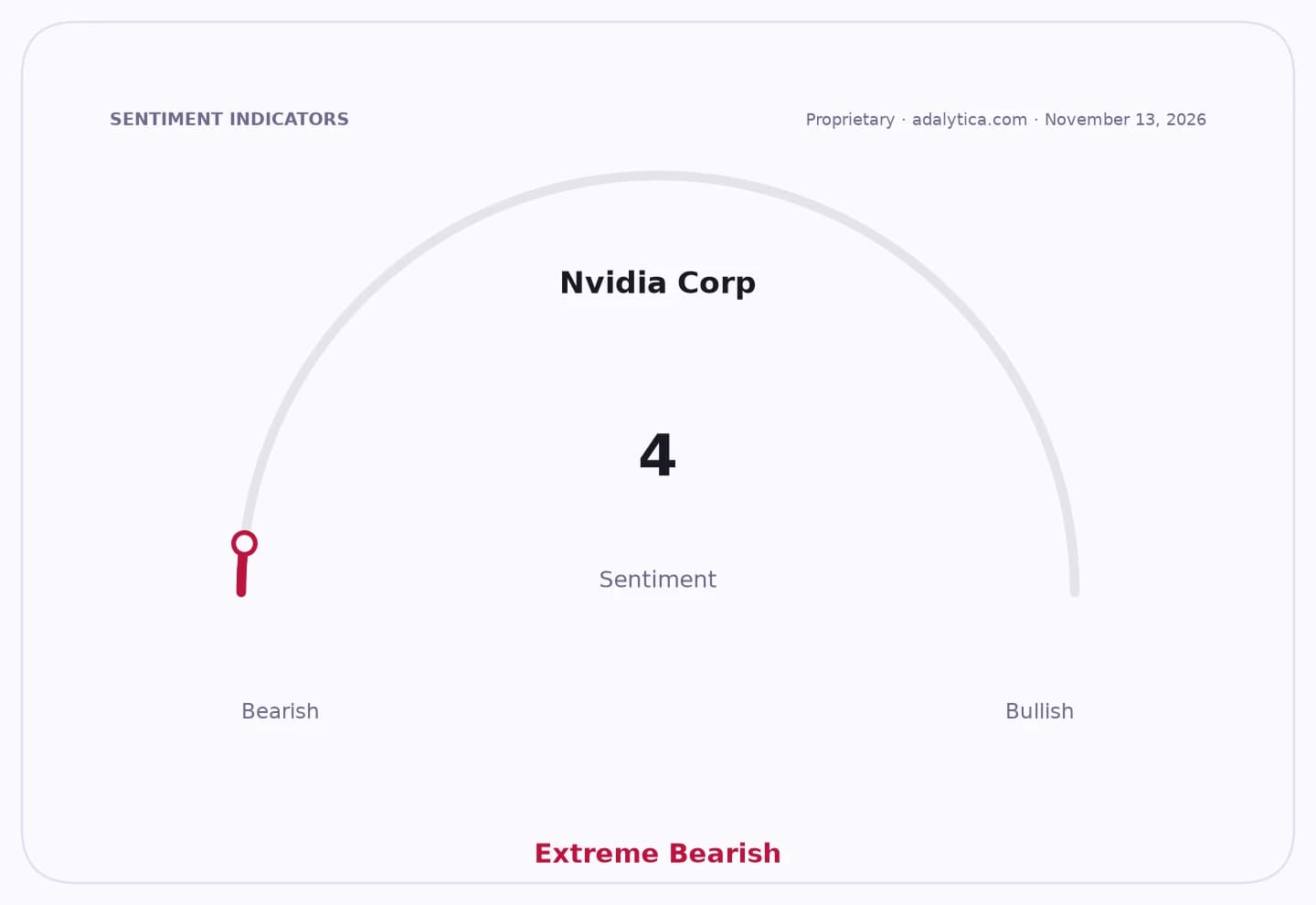
Sentiment Indicators
The system is being deployed at the Allen Telescope Array in California, where radio dishes continuously collect huge volumes of cosmic data that are difficult to inspect manually. NVIDIA says its setup can move telescope data directly into GPU processing and handle as much as 2.4 terabits a second, or about 300 gigabytes, allowing researchers to analyze signals almost immediately rather than waiting until the observing session ends.
That speed is the commercial and strategic point. AI infrastructure vendors have been trying to prove that the next leg of demand will not come only from chatbots and model training, but from “agentic” systems that coordinate software tools, interfaces and hardware in real time. A project that lets scientists issue plain-language commands while the AI runs telescope operations, data filtering and signal detection is a useful demonstration of that broader pitch.
NVIDIA said the system successfully identified a pulsar signal in the Crab Nebula during testing, a result that validated the software’s ability to recognize astronomical patterns even if it offered no evidence of extraterrestrial intelligence. That distinction matters: the near-term value is not in finding aliens, but in proving that AI can reduce the bottleneck between data capture and scientific interpretation.
The SETI angle also gives the effort a narrative edge. Andrew Siemion, a SETI researcher, has suggested that if alien civilizations exist, they may have developed AI long before humans did, raising the possibility that Earth’s own AI tools could help detect another civilization’s machine-based signals. It is speculative, but it underscores the broader scientific shift toward using machine learning to search for patterns too large and too noisy for humans to process alone.
For investors, the stock-market significance is more subdued than the headline suggests. NVIDIA shares have fallen sharply from recent highs, with the stock closing at $166.19 on Nov. 12 after trading above $220 in October, according to the price data provided. The shares are now well below the 50-day moving average and their RSI reading of 24.5 points to deeply oversold conditions, while the 200-day moving average remains above the current price. That backdrop means any story reinforcing the breadth of NVIDIA’s AI use cases may help sentiment, even if it does little to change near-term fundamentals by itself.
Microsoft, meanwhile, is relevant less as a direct counterpart than as part of the same AI infrastructure trade. Its shares remain far above their 200-day moving average, but the recent pullback from October highs shows that investors are still re-pricing the winners of the AI buildout as valuations and spending intensity come under scrutiny. In that environment, proof that AI workloads can expand into science, instrumentation and industrial applications supports the long-term bull case for the sector.
The broader message is that AI is moving from software-generated content to physical-world systems that observe, decide and act. If that trend holds, the addressable market for GPU compute expands beyond commercial cloud spending into astronomy, climate science, engineering and defense-adjacent research. For NVIDIA, that widens the story around its hardware moat. For investors, it reinforces the idea that the AI cycle is still early in finding new end markets — even if extraterrestrial life remains unproven.
| Entity | Gains | Losses |
|---|---|---|
| NVIDIA | ▲Broader AI use case narrative | ▼Short-term skeptics |
| SETI Institute | ▲Faster signal search | ▼Manual processing methods |
| Astronomers | ▲Real-time data analysis | ▼Time-consuming workflows |
| Shorts in NVDA | ▲None | ▼Rebound risk if AI breadth narrative improves |