Nvidia’s latest run-up looks increasingly tied to a circular AI economy in which partners use the chipmaker’s brand and balance-sheet strength to underwrite contracts that pad reported demand, even as the cash ultimately realising that revenue remains uncertain.
Nvidia shares at $211.94 face revenue-quality scrutiny
That matters because Nvidia has become the market’s central AI barometer, and any sign that a meaningful slice of its growth is being financed by counterparties rather than end demand raises the risk that earnings expectations are running ahead of sustainable consumption. Nvidia shares closed at $211.94 on Aug. 4, just under the upper end of the current Bollinger Band and above the 50-day moving average of $205.65, after a sharp rebound from a June trough. But the more important question for investors is not momentum — it is whether revenue quality is being diluted by financing structures, partner dependence and channel load-in.
Sentiment IndicatorsⓘProprietary · adalytica.com · August 5, 2026
This is a snapshot — live sentiment, awareness and momentum for 130+ markets update continuously in the dashboard.Open AlphaPulse
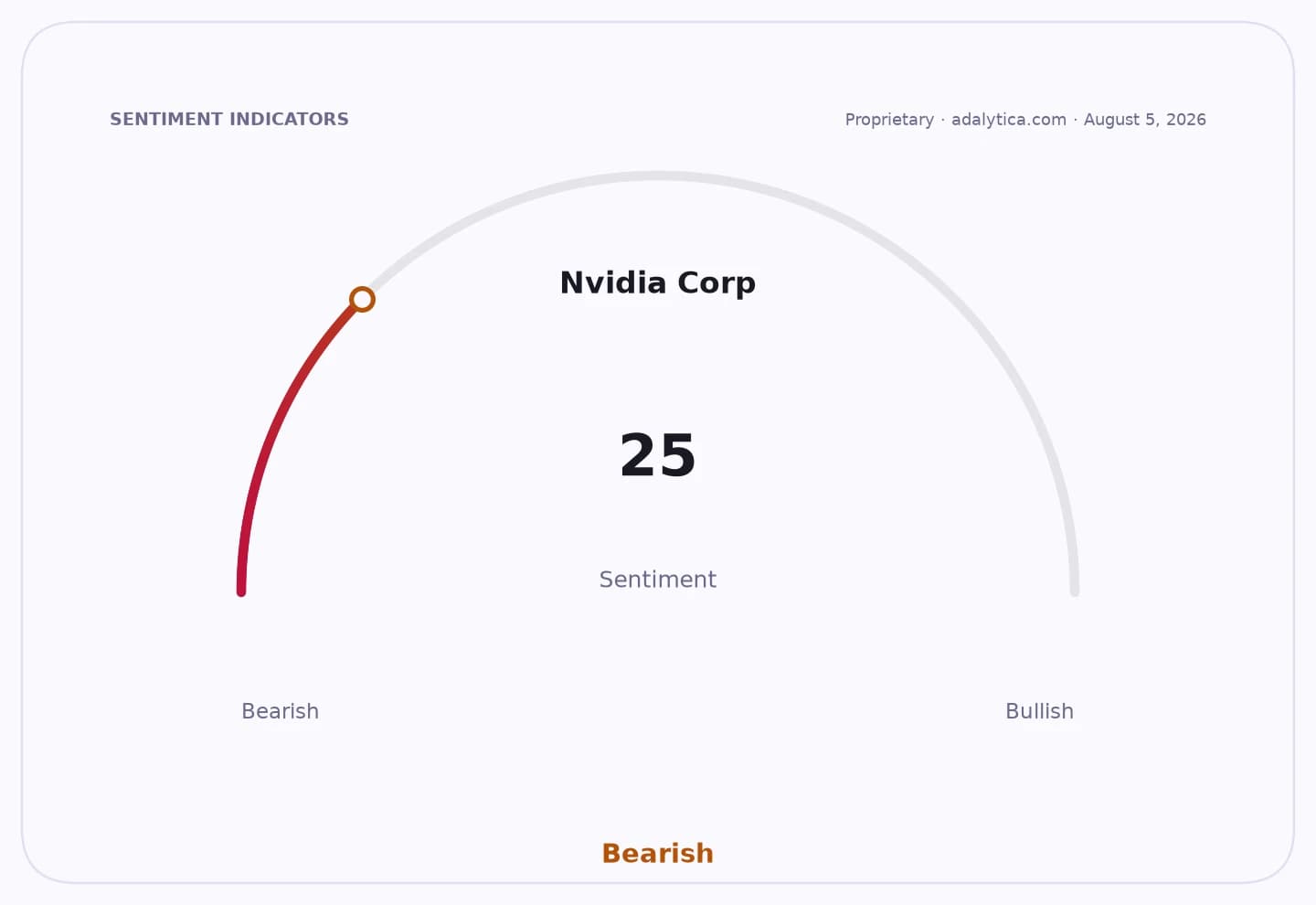
The broader AI trade has been vulnerable to this concern for months. Adalytica’s AI sentiment gauge sits at 11, or “Extreme Fear,” even though awareness is at 100, a combination that suggests high attention but deep unease about valuation and monetisation. Nvidia’s own sentiment reading is 25, firmly in “Fear,” and has fallen 39 points over the past week, underscoring how quickly confidence can reverse when investors start focusing on the durability of AI demand rather than the scale of AI spending.
The issue is not that Nvidia lacks real demand. It is that the ecosystem surrounding it increasingly relies on large strategic buyers, infrastructure partners and financing arrangements to keep growth rates elevated. That can be rational in the short term: hyperscalers, cloud vendors and systems partners all have incentives to secure supply, signal commitment to AI infrastructure and leverage the Nvidia brand to reassure their own investors. The bear case is that these arrangements can create an appearance of revenue acceleration without the same level of end-user consumption, leaving Nvidia exposed if the build-out slows or if customers digest capacity before taking the next order wave.
The market is already pricing Nvidia as if the AI capex cycle has further to run. The stock is up sharply from its March lows and has recovered to levels that imply investors are comfortable looking through near-term volatility. Technical indicators also show a market trying to stabilise: the RSI is near neutral at 49.6 after dipping into oversold territory in June, and the MACD has improved from deeply negative levels. But those signals can only carry the stock so far if investors start to believe the revenue base is being buttressed by circularity rather than organic adoption.
That is why the comparison with other AI-linked names matters. Microsoft, another major AI spender and Nvidia customer, has surged to $492.81, well above its 50-day moving average of $402.21, reflecting both enthusiasm around AI monetisation and continued willingness to fund the infrastructure build-out. TSMC, the critical foundry supplier, is also trading well above its long-term trend, with shares at $417.17 and a 50-day average of $425.37, showing that the supply chain is still benefiting from AI investment. But suppliers and partners are also the ones most likely to absorb the financing, inventory and contractual risk if AI demand cools.
Nvidia’s own filings show it has continued to raise capital on attractive terms, including a $10 billion note offering completed in June, reinforcing how central its balance sheet has become to the AI ecosystem. That financial strength is a support, not a cure: it gives Nvidia flexibility to fund growth, but it also makes the company an anchor around which the rest of the industry can structure demand. For investors, the key test over the next several quarters is whether Nvidia can keep converting partner-led bookings into repeatable, end-market orders — or whether the current revenue profile is being inflated by contracts that look like demand now and reveal themselves later as financing.
| Entity | Gains | Losses |
|---|---|---|
| Nvidia | ▲headline revenue growth | ▼revenue-quality scrutiny |
| AI partners | ▲branding and valuation support | ▼balance-sheet and contract risk |
| Hyperscalers / cloud buyers | ▲access to supply and leverage | ▼capex burden |
| Short sellers / skeptics | ▲potential validation if demand softens | ▼lost momentum if AI spending persists |