New York City’s plan to open city-run grocery stores offering core staples at a 30% discount may resonate with inflation-hit households, but it immediately raises the harder question for investors and taxpayers: who funds the margin gap?
NYC Grocery Plan Risks Retail Margins
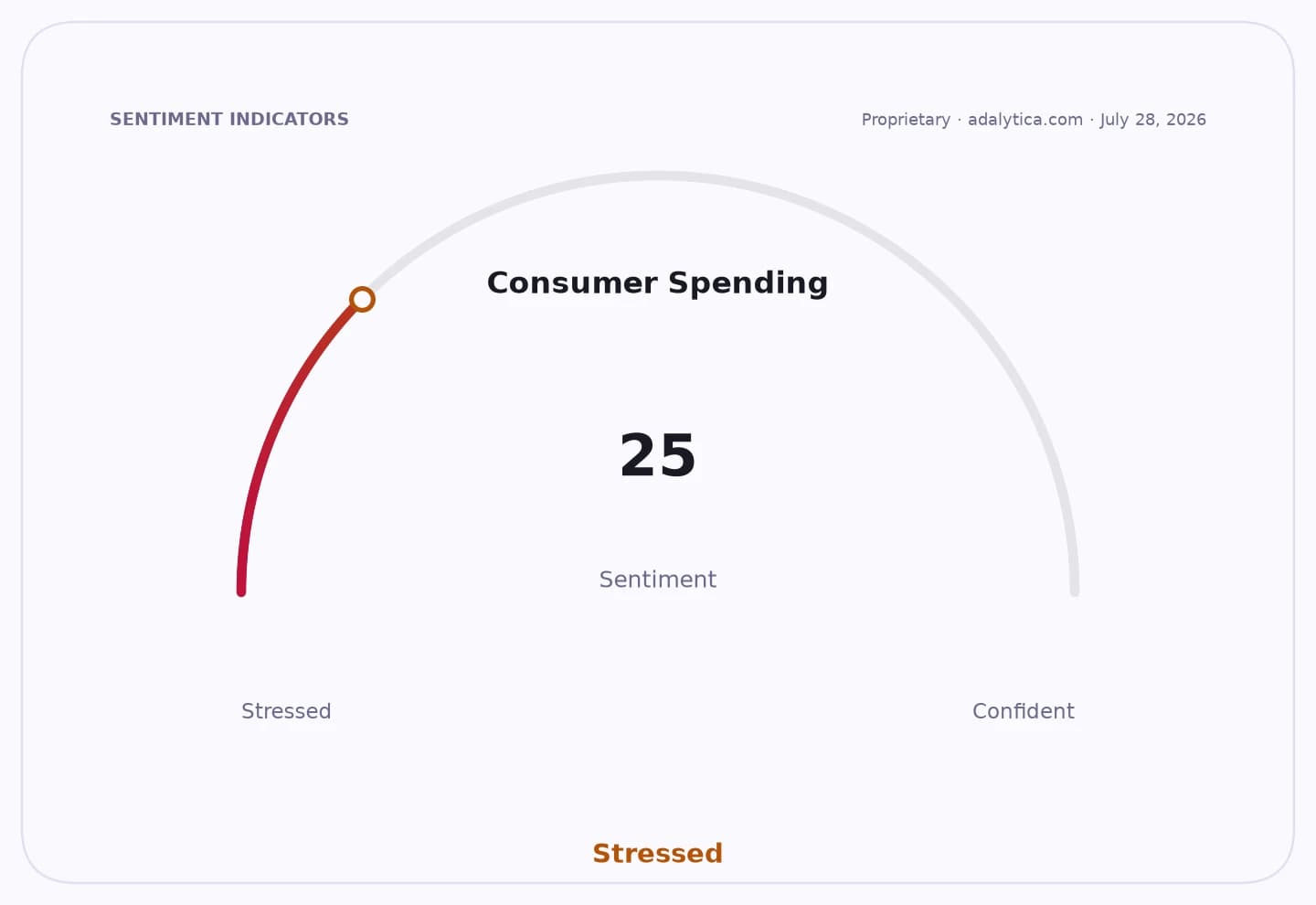
The economics matter because food remains one of the most sensitive household expenses, and the proposal lands at a time when consumer-staples pricing is still elevated even after the latest moderation in broader inflation. The CPI series for the New York region is still running far above pre-pandemic levels, while consumer spending sentiment in Adalytica’s gauge sits in “Fear,” underscoring how price relief can become a political asset even when the financing model is unclear.
Sentiment IndicatorsⓘProprietary · adalytica.com · July 28, 2026
This is a snapshot — live sentiment, awareness and momentum for 130+ markets update continuously in the dashboard.Open AlphaPulse
That makes the proposal less a niche municipal experiment than a test of whether local government can operate a grocery format at scale without either persistent subsidies or hidden cross-subsidies. A 30% discount on core goods implies someone must absorb lower gross margins, whether through the city budget, outside vendors, rent advantages, procurement power or losses tolerated for policy reasons. For a market already defined by razor-thin food retail margins, that is the central risk.
The move also lands in a retail landscape where discounting is already a competitive weapon. Conventional technical indicators on Kroger and Walmart show both stocks have recovered from recent pressure, but their business models remain tied to volume, sourcing leverage and disciplined pricing. Kroger’s latest filing pointed to increased price investment and transport costs weighing on margins, while Walmart has leaned on fuel, e-commerce and scale to protect traffic. A city-backed grocer selling below market rate would not merely compete on convenience; it would compete on price with public support behind it.
That matters for shareholders because even a limited rollout could pressure neighborhood grocers and national chains in targeted districts, especially on staple items where price transparency is high and customer switching costs are low. The bull case for the plan is political and social: if the city can use public procurement, simplified assortments and lower overhead to offer cheaper essentials, it could ease food insecurity and force private retailers to sharpen their value proposition. The bear case is operational: public retail has a long history of cost overruns, weak inventory discipline and thin accountability, especially when the goal is service rather than profit.
The broader backdrop is a consumer environment still tilted toward value-seeking. Discount stores and promotion-led retailing continue to expand because shoppers remain highly price sensitive. That makes Mamdani’s plan politically timely, but economically it is also a reminder that food inflation has not fully faded for lower-income households. If the city wants to keep prices 30% below market, it will need to show not just where the savings come from, but how they persist once real-world shrink, labor, logistics and spoilage are accounted for.
For investors, the key issue is whether this becomes a symbolic pilot or a policy template. If the former, the market impact may stay localized. If the latter, it could force New York’s grocers, landlords and suppliers to reprice risk around a taxpayer-backed competitor whose mandate is to undercut them, not to earn a return.
| Entity | Gains | Losses |
|---|---|---|
| Low-income shoppers | ▲Cheaper staples | ▼Limited assortment |
| New York City government | ▲Political support | ▼Budget risk |
| Kroger and Walmart | ▲Value-seeking traffic defense | ▼Price pressure in dense markets |
| Independent grocers | ▲Potentially higher awareness of pricing | ▼Loss of share to subsidized competition |