Inflation is moving back toward a double-digit pace in the key places investors care about most, and the market is still underpricing how quickly that can squeeze consumers, force central banks back on the defensive and revive volatility across rates, equities and commodities.
Oil rebound and inflation pressure in Europe

That matters because the latest data and market signals point to a second inflation wave driven not by one-off base effects, but by energy. Brent and WTI have rebounded sharply, with WTI jumping from $85.91 in mid-April to $97.89 in early October after touching $109.76 in May, a move that feeds through quickly to transport, utilities and factory-gate prices. Producer prices are already firming again: the broad U.S. producer-price gauge was up 0.96% in August and remains well above pre-shock levels, while consumer prices rose 0.4% that month and are forecast to stay elevated into September.
Sentiment IndicatorsⓘProprietary · adalytica.com · October 11, 2026
This is a snapshot — live sentiment, awareness and momentum for 130+ markets update continuously in the dashboard.Open AlphaPulse

In Europe, the problem is even more acute. Germany’s inflation has climbed to 3.3%, Italy’s business inflation is at 4.2% and France is running at 3%, all of it against a backdrop of renewed energy pressure. That is exactly how inflation becomes persistent: first at the pump and in wholesale prices, then in household budgets and wage demands. The economic consequence is slower real spending power, tighter margins for companies that cannot pass on costs and a renewed tightening bias at central banks that had hoped to pivot.
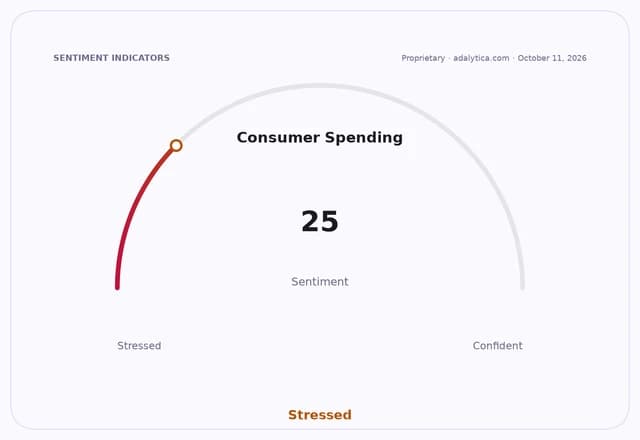
For investors, the message is straightforward: disinflation is no longer a clean trade. The Adalytica CPI sentiment gauge is flashing “Extreme Greed” at 97, while the consumer-spending sentiment reading has fallen to 25, or “Fear,” a combination that often shows up when markets are leaning too hard into the idea that inflation has been defeated. The S&P 500 trade-signal snapshot remains in “Extreme Greed” as well, suggesting equities are still positioned for a benign macro backdrop just as pricing pressure reasserts itself.
That creates opportunity, but not everywhere. Higher inflation and stronger energy prices tend to favor the obvious beneficiaries: oil producers, energy service firms, pipeline operators and select commodity-linked industrials. They hurt the long-duration parts of the market most exposed to higher discount rates, along with consumer discretionary names, airlines, transport, rate-sensitive real estate and the parts of tech that trade on far-off earnings. If inflation does push into double digits in the wrong geographies, the winners will be the companies with pricing power, hard assets and cash flow today.
The larger narrative is that inflation is not disappearing so much as mutating. The first wave was supply-chain driven; the next looks energy-led and geopolitically charged. That is why I believe investors should stop treating every pullback in oil as a short-lived spike and start viewing it as a structural input into margins, rates and asset prices. Positioning now for a stickier inflation regime — through energy exposure, inflation hedges and selective value — is the asymmetric trade while consensus is still chasing the old disinflation story.
| Entity | Gains | Losses |
|---|---|---|
| Oil producers | ▲Higher realized prices | ▼Margin pressure if costs rise faster |
| Energy consumers | ▲None | ▼Fuel and input-cost squeeze |
| Central banks | ▲Policy leverage if growth holds | ▼Credibility risk if inflation persists |
| Consumer discretionary stocks | ▲Pricing power niches | ▼Demand erosion from weaker real incomes |