Trust in AI is becoming a capital allocation question as much as a technical one, after Moonshot AI’s launch of the open-source Kimi K3 underscored how quickly model performance is converging across borders and business models.
Open AI Models Pressure Scarcity Premium

The significance for markets is not that one new model may beat another on benchmark tests, but that the economics of AI innovation are shifting. If open models can match or surpass the proprietary systems that have commanded the premium narrative in the sector, the moat moves away from pure model quality and toward distribution, compute access, data pipelines, enterprise integration and governance. That matters because those are the areas where large incumbents and cloud providers can still extract pricing power.
Sentiment IndicatorsⓘProprietary · adalytica.com · July 20, 2026
This is a snapshot — live sentiment, awareness and momentum for 130+ markets update continuously in the dashboard.Open AlphaPulse
Kimi K3, according to the context supplied, is poised to outperform Anthropic’s Claude Opus 4.8 on several key metrics. In practical terms, that narrows the visible gap between China’s leading AI labs and their U.S. rivals and reinforces a broader trend investors have been watching: frontier AI capability is no longer exclusively the preserve of a handful of closed systems. For companies pitching AI as a proprietary advantage, that raises the burden of proof. For customers, it increases optionality and may accelerate adoption because open models can be audited, adapted and deployed more flexibly.
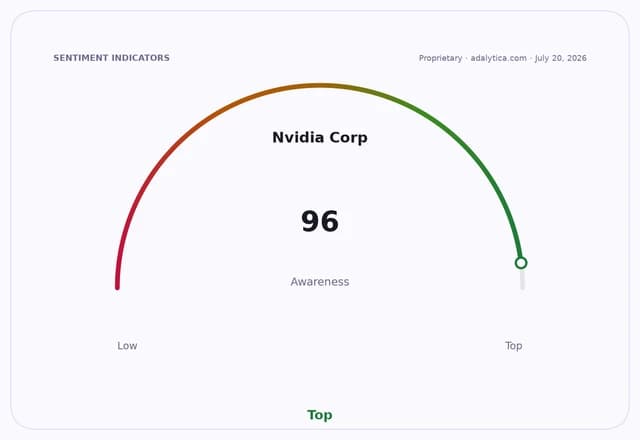
The market backdrop shows why the debate matters now. Nvidia, the market’s most direct proxy for the AI buildout, remains well above its longer-term averages, with the stock around 206 dollars and still above its 200-day moving average near 192 dollars. But the recent pullback from earlier highs, alongside a cooling in momentum indicators such as RSI and MACD, suggests investors are becoming more discriminating about what kinds of AI spending translate into durable earnings power. Microsoft, meanwhile, has seen a sharper reset from its highs, with its price still below its 200-day average and sentiment softer, reflecting the market’s growing scrutiny of whether AI spend will earn back capital fast enough.
That leaves two competing investor views. The bullish case is that open-source competition expands the total AI market by lowering barriers to experimentation, speeding deployment in enterprise workflows and creating more demand for chips, cloud capacity and services. On that reading, cheaper and more transparent models could increase overall usage even if individual model margins compress. The bearish case is that model commoditization erodes the scarcity premium that has supported the biggest AI names, especially if customers decide that enough performance is available from open systems and do not need to pay up for closed ones.
Transparency also cuts both ways. Open models may help regulators, enterprise buyers and public-sector users understand how systems behave, which can reduce adoption frictions. But it can also weaken the narrative around secrecy as a moat. If competitors can inspect, improve and replicate the architecture more quickly, innovation cycles shorten and the market starts to value execution and scale more than headline breakthroughs.
For investors, the key implication is that AI may be entering a second phase: less about who can build the smartest black box, more about who can turn AI into a dependable industrial stack. That favors firms with control over compute, software distribution and enterprise relationships, while making pure model leadership a less durable source of valuation support than it was a year ago. The next catalysts will be real-world deployment data, enterprise adoption rates and whether the next wave of benchmarks translates into pricing power rather than just more competition.
| Entity | Gains | Losses |
|---|---|---|
| Open-source AI developers | ▲Faster adoption and credibility | ▼Less scarcity premium |
| Big cloud and chip suppliers | ▲More training and inference demand | ▼Greater pricing scrutiny |
| Closed-model vendors | ▲Enterprise buyers seeking trust | ▼Benchmark lead as sole moat |
| End users and regulators | ▲More transparency and flexibility | ▼Fewer proprietary barriers |