China’s central bank is moving to drain dollar liquidity from the financial system, the clearest sign yet that policymakers want to slow the yuan’s climb and prevent a one-way market bet from building.
PBOC Raises FX Reserve Ratio to Tighten Dollar Liquidity

The People’s Bank of China said it will lift the foreign-exchange reserve requirement ratio to 6% from 4% starting Nov. 15, the first increase in nearly five years. The change forces banks to park a larger share of their foreign-currency deposits at the central bank, tightening dollar supply in the domestic market and reducing pressure for further yuan gains.
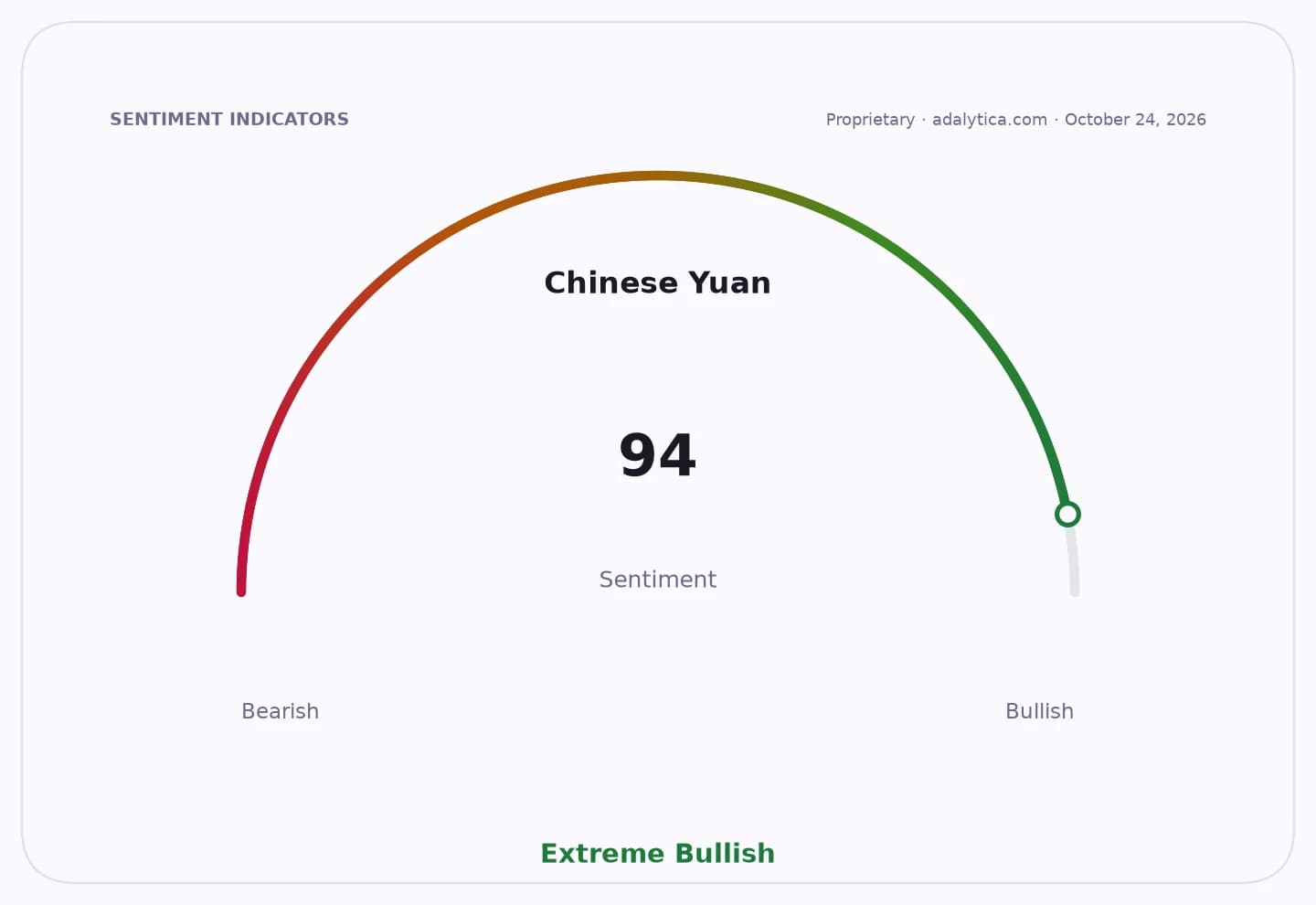
Sentiment Indicators
Chinese Yuan
The timing matters because the currency has already strengthened sharply this year. The yuan has risen 4.2% against the U.S. dollar in the first nine months, and its onshore rate has advanced for 14 straight trading days since Oct. 14. That kind of momentum can attract more speculative inflows and encourage corporates to delay dollar purchases, creating what economists describe as a self-reinforcing appreciation cycle.
For Beijing, that is a problem because a rapidly firmer currency can disrupt exporters, complicate trade planning and fuel expectations that the yuan will keep rising. China has spent much of the past two years leaning against disorderly moves in the foreign-exchange market, and the new step reinforces the message that authorities want stability, not a sustained revaluation.
Carry Trade
The policy tool is also notable because it is market-based rather than a direct target-setting exercise. Officials have repeatedly said they do not fix a specific exchange-rate level, but they will act if short-term moves become excessive or herd behavior takes hold. By tightening the reserve ratio, the PBOC can curb excess dollar liquidity without resorting to blunt capital controls or overt one-off intervention.
Banks and traders estimate the move could freeze roughly $20 billion to $25 billion of foreign-currency liquidity at the banking level, enough to matter in a market where funding conditions can amplify directional flows. The immediate reaction underscored the message: the offshore yuan weakened after the announcement, while the onshore rate closed at 6.6765 per dollar, down 307 pips on the day.
For investors, the implication is less about the one-day currency move than about the policy regime. The PBOC is signaling that it will not allow appreciation expectations to become entrenched, which may temper bullish yuan positioning and keep volatility low but contained. Exporters could gain some relief if the currency’s rise slows, while importers and firms with dollar liabilities may see less near-term downside from further yuan strength.
The broader market read-through extends beyond China. A less one-sided yuan reduces pressure on Asian peers and may alter carry-trade positioning in the near term, especially if traders had been leaning into a stronger renminbi theme. The move also suggests Beijing remains focused on financial stability as well as growth, using exchange-rate management as part of a wider effort to avoid disruptive swings in a year when the currency has already outperformed.
| Entity | Gains | Losses |
|---|---|---|
| PBOC / Chinese policymakers | ▲Greater yuan stability | ▼Less room for appreciation bets |
| Chinese exporters | ▲Less currency headwind | ▼Fewer gains from a stronger yuan |
| Chinese banks | ▲Clearer policy signal | ▼Tighter dollar liquidity |
| Yuan bulls / carry traders | ▲Little | ▼Reduced upside, lower momentum |