China is edging toward a calmer diplomatic stance just as global markets are trying to price whether a US election result could avert a sharper confrontation between the world’s two biggest economies.
China ETFs Rebound on US-China Thaw Hopes
CCP Policy Direction
That matters because the next phase of US-China relations is no longer just a geopolitical headline; it is a direct driver of rates, equities, supply chains and capital allocation. When investors sense a pause in escalation, they move quickly into the most levered beneficiaries of lower policy risk: China-linked equities, semiconductors, exporters and broader emerging-market assets. When the mood turns again, those same assets are usually first to sell off.
Sentiment Indicators
The market is already leaning that way. The China-focused FXI ETF has stabilized near $33.21 after sliding to $33.08, while the broader China internet gauge KWEB has recovered modestly to $23.26 from $22.74. Neither signal a full conviction rally yet — both remain below their 50-day moving averages, with FXI at $34.09 versus a 50-day average of $34.14 and KWEB at $24.55 versus $24.61 — but the rebound shows traders are beginning to price less geopolitical stress. MCHI, another broad China ETF, has also bounced to $49.42 from $49.07, though it remains well under its 200-day average.
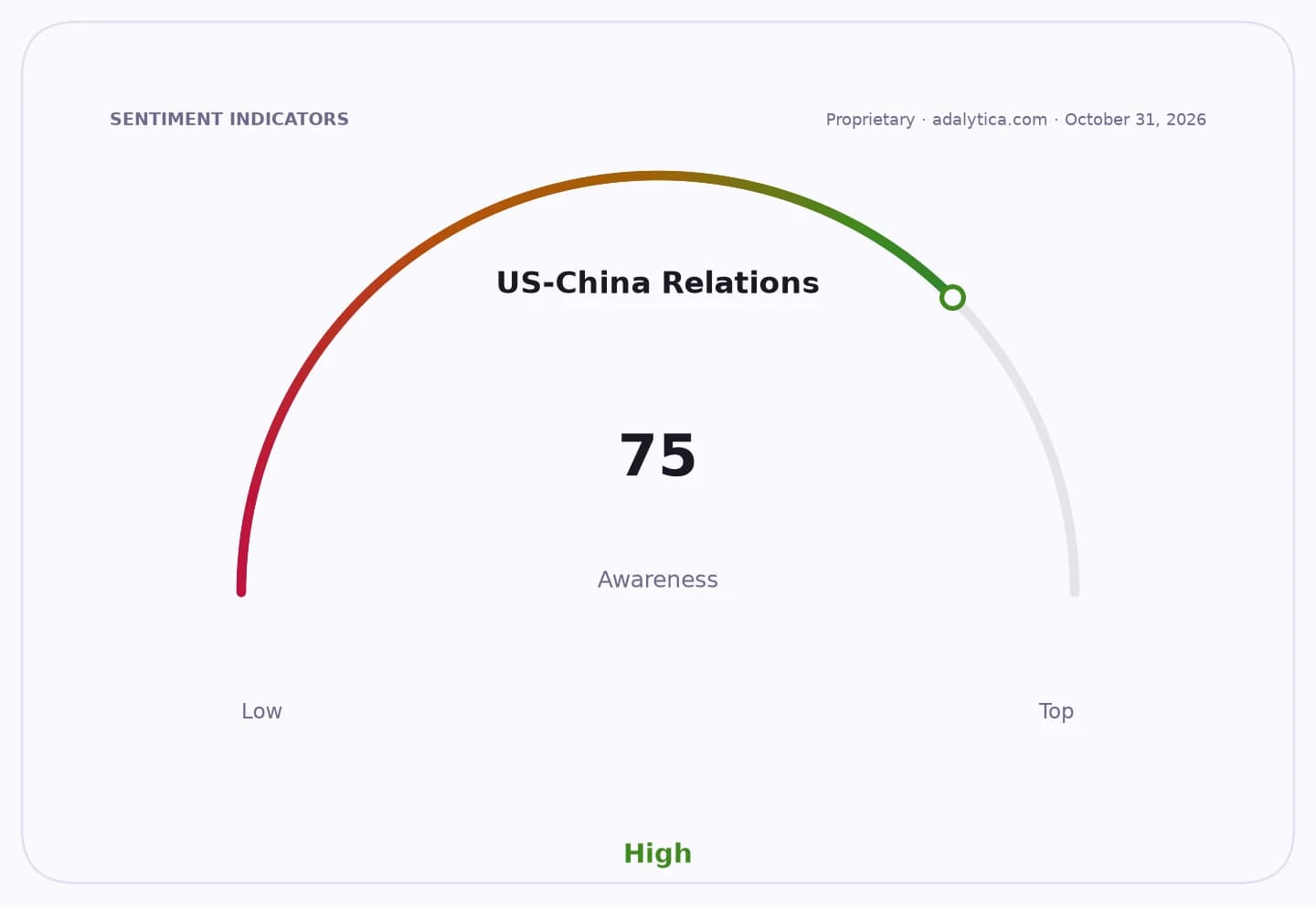
That fits a broader shift in sentiment data. Adalytica’s China CCP policy direction gauge sits at 79, in “Greed” territory, while its US-China relations sentiment has jumped to 71 even as awareness remains at an “Extreme Fear” reading of 4, underscoring how quickly market participants are reacting to the prospect of a diplomatic thaw. A separate global stability reading is at 100, or “Extreme Greed,” suggesting investors are searching for a less volatile macro path after months of elevated tension.
CCP Policy Direction — 30-day sentimentadalytica.com
Explore this data interactively — full history, time series and cross-market comparisons.
The economic logic is straightforward. A softer US-China backdrop lowers the odds of fresh tariff shocks, export controls and retaliatory measures that could hit everything from advanced chips to shipping, autos and consumer goods. That would ease pressure on supply chains and support risk assets tied to China’s domestic rebound narrative. It also matters for Treasury markets: the 10-year yield at about 4.94% and the 2-year at 4.56% point to a market still wrestling with growth and policy uncertainty, and any de-escalation could help stabilize global inflation expectations by reducing trade frictions.
For investors, the opportunity is not to chase every headline but to position for the second-order winners if diplomacy does, in fact, blunt escalation after the US elections. That argues for selective exposure to China risk assets, semiconductor names with Chinese demand exposure, and global industrials that would benefit from smoother trade flows. It also suggests that the real trade is not simply “long China,” but long the firms that monetize lower geopolitical risk without depending on a full policy reset.
The catch is that calm is not the same as resolution. China is still navigating strategic friction in the South China Sea, scrutiny over transnational repression and tighter economic policy at home, while the US remains in no mood to ease pressure on technology transfers or strategic industries. But the market rarely waits for perfect clarity. If diplomacy can hold the line after the election, the repricing could be swift — and the early winners will be those already closest to the trade and capital channels that benefit when Washington and Beijing stop escalating.
| Entity | Gains | Losses |
|---|---|---|
| China equities | ▲Lower risk premium | ▼Escalation hedges |
| US exporters | ▲Smoother trade flows | ▼Tariff shock exposure |
| Semiconductors | ▲Demand visibility | ▼Export-control fears |
| Geopolitical shorts | ▲Stability trade unwinds | ▼Volatility bets |