The government’s latest pension changes will put more money into the hands of working retirees and people over 80, but the bigger economic story is that eligibility rules are still too tight for the households that need help most.
Pension Rule Tightness May Limit Consumption Boost
That matters because the supplement is meant to cushion vulnerable pensioners against rising living costs, yet the current income cap can shut out couples with two modest pensions even when their combined income still leaves them stretched. Åke Jarlén’s warning goes to the heart of the policy problem: if the threshold is not adjusted, the measure risks looking generous on paper while missing a large share of the retirees it was designed to reach.
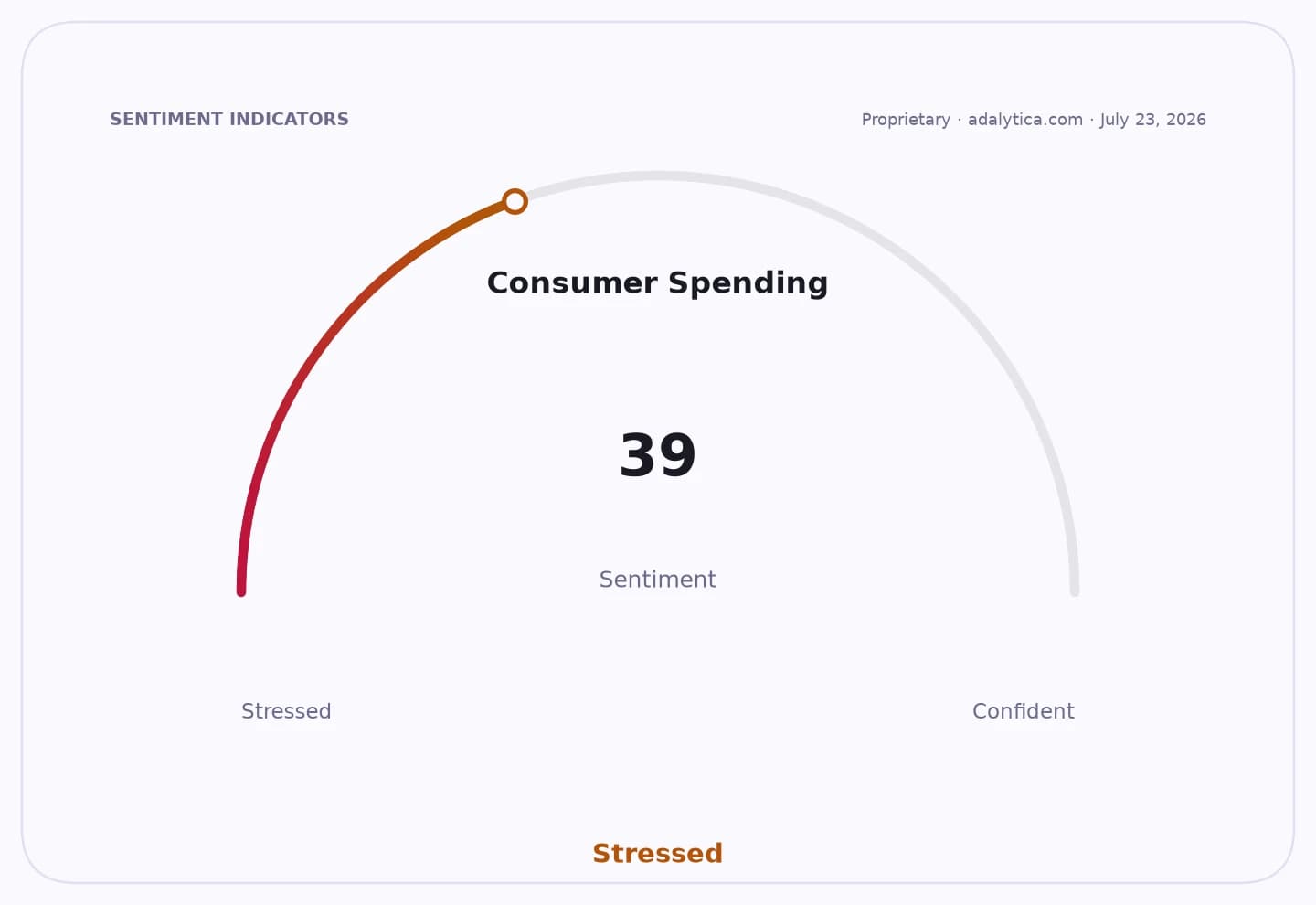
For the broader economy, that is not a trivial detail. Retiree spending is a steady, defensive source of demand for groceries, medicines, utilities and local services. When benefits are targeted too narrowly, the policy boost to consumption is weaker than policymakers expect, especially at a time when consumer confidence in spending remains fragile. Adalytica’s Consumer Spending Sentiment sits in neutral territory, while awareness has collapsed into extreme fear, underscoring how cautious households remain even as support payments are being recalibrated.
The pension overhaul also has a practical side that investors should not ignore. Moving retirement and disability payments exclusively to bank accounts will improve distribution efficiency and make the system easier to track, but it also forces some beneficiaries to adapt quickly. Banks with large retail reach stand to benefit from new account openings, while payment processors and financial infrastructure providers could see more recurring transaction flow. At the same time, smaller pensioners who fail to meet updated criteria will feel the squeeze, which keeps pressure on discretionary spending in lower-income segments.
The 2026 framework, including a minimum pension level and changes around the fourteenth pension benefit, points to a government trying to modernize the system without fully resolving the income cliff embedded in the rules. That is where the market may be underestimating the second-order effect: if policymakers eventually lift the income limit as Jarlén argues, the fiscal cost rises, but so does the likelihood of stronger, more durable consumption among pension-heavy households.
For investors, the clearest read-through is that the winners are institutions tied to pension administration and consumer staples, while the losers are households and merchants dependent on weak disposable income. The next catalyst will be whether eligibility is widened before the 2026 payment cycle, because that decision will determine whether this is a symbolic pension raise or a real lift to retirement spending.
| Entity | Gains | Losses |
|---|---|---|
| Working pensioners / over-80 recipients | ▲Higher payouts | ▼None |
| Banks / retail deposit accounts | ▲More account openings | ▼Cash-based payment inertia |
| Consumer staples / utilities | ▲Steadier retiree demand | ▼Low-income spending pressure |
| Low-income couples with two pensions | ▲Potentially wider eligibility if rules change | ▼Exclusion under current income cap |
