The National Bank of Poland has frozen payment instructions on Constitutional Tribunal accounts and set a deadline for the warring sides to seek a court ruling over who can legally control the money, escalating a constitutional power struggle into a direct operational risk for the state institution.
Poland NBP freezes tribunal accounts in legal dispute
The move matters because the issue is no longer just about competing claims to the presidency of the tribunal. It now affects the tribunal’s ability to use its bank accounts, making the dispute tangible for public finance governance and raising the prospect that court-ordered clarity will be needed before normal payments can resume.
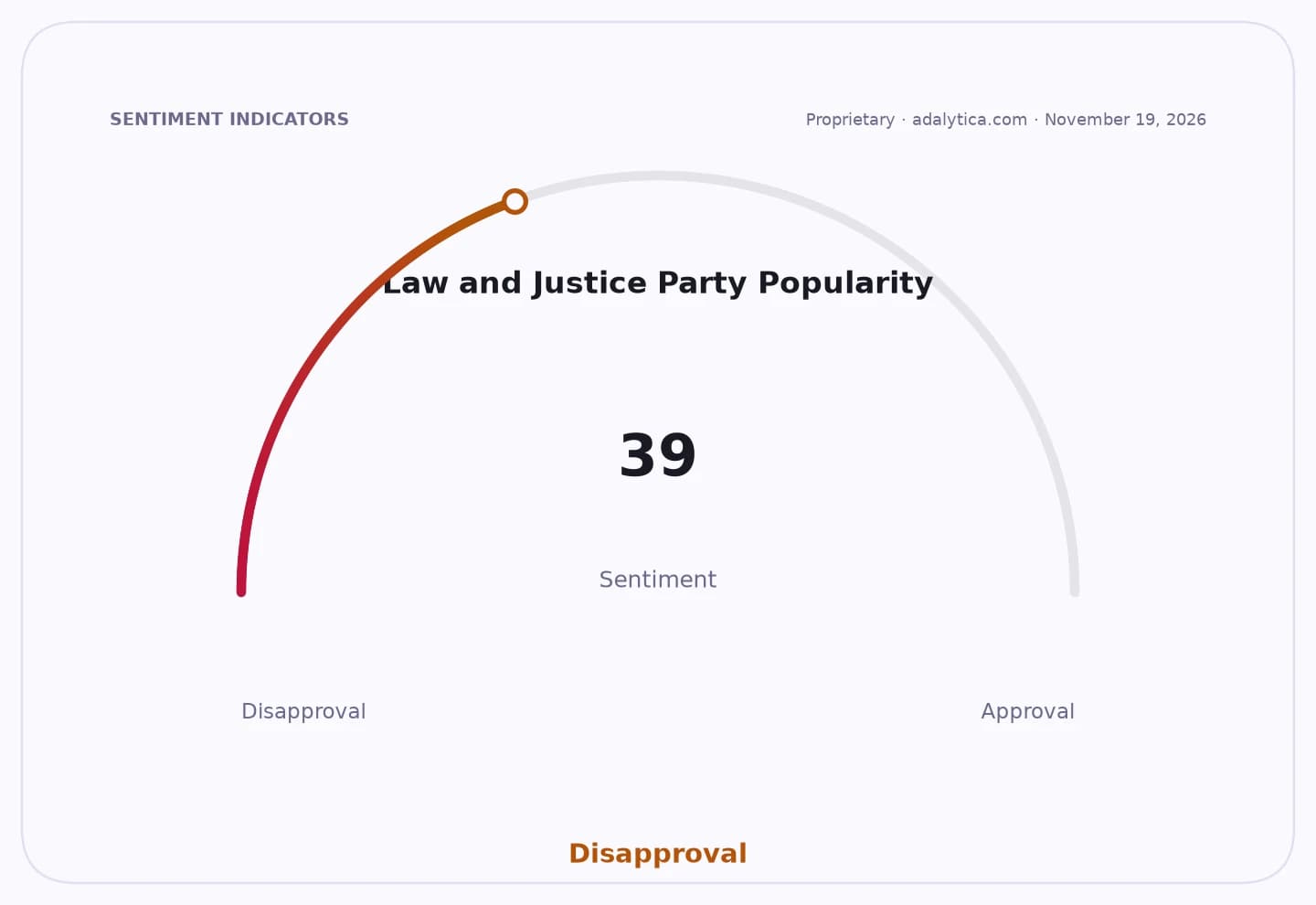
Sentiment Indicators
NBP said it received two contradictory sets of documents from the tribunal: one backed by Bogdan Święczkowski and another submitted by Anna Korwin-Piotrowska. Because the documents designate different people as authorized to dispose of the tribunal’s funds, the central bank said it cannot safely accept payment orders until a court determines who is properly empowered to represent the institution.
In letters sent on Friday, the central bank asked both Święczkowski and Korwin-Piotrowska to bring an action before the competent court and seek interim protection, then inform NBP of the steps taken. The deadline runs to Nov. 27, 2026. NBP said it wants the dispute resolved as quickly as possible, underscoring that it views the conflict as an account-control problem, not a political question it can arbitrate itself.
The standoff is rooted in a broader fight over the leadership of the Constitutional Tribunal. Representatives of the group elected by the current Sejm said on Oct. 30 that Korwin-Piotrowska, as the longest-serving judge, had taken over the tribunal and suspended Święczkowski and vice president Bartłomiej Sochański. Święczkowski called that an usurpation, while President Karol Nawrocki described it as a breach of constitutional order. Prime Minister Donald Tusk has argued the Sejm elected new judges but that some were blocked from taking office.
The legal conflict deepened after the Supreme Court on Nov. 10 overturned Święczkowski’s order suspending the two officials. Korwin-Piotrowska said that decision did not affect the suspensions, arguing only the tribunal’s disciplinary court could review them. That leaves NBP with no uncontested authority signature on file, a problem that can quickly spill from constitutional politics into payrolls, vendor payments and the tribunal’s day-to-day operations.
For investors, the immediate market impact is likely limited, but the episode adds to Poland’s broader institutional risk premium at a time of already heightened geopolitical tension and political fragmentation. It also highlights how disputes over the legitimacy of state bodies can create practical bottlenecks in payments and governance, even when the amounts involved are not disclosed.
The bigger question is whether the tribunal dispute stays contained as a legal battle or turns into a wider test of state institutional capacity. If the courts move quickly, NBP can resume normal account administration. If not, the episode could become another marker of prolonged constitutional uncertainty in Poland, with implications for the credibility of public institutions and the stability investors look for in rule-of-law environments.
| Entity | Gains | Losses |
|---|---|---|
| NBP | ▲legal clarity | ▼operational certainty |
| Constitutional Tribunal camp with court-backed mandate | ▲control over accounts | ▼delay in access |
| Bogdan Święczkowski camp | ▲chance to prove authority | ▼payment freeze risk |
| Investors in Poland | ▲eventual rule-of-law resolution | ▼higher governance premium |