Real estate investment trusts are still delivering one of the market’s cleanest routes to rental income, but the tradeoff is becoming more demanding as higher Treasury yields, softer housing conditions and investor nerves around property funds collide.
REITs Face Higher Rates and Softer Housing
Housing (Real Estate)
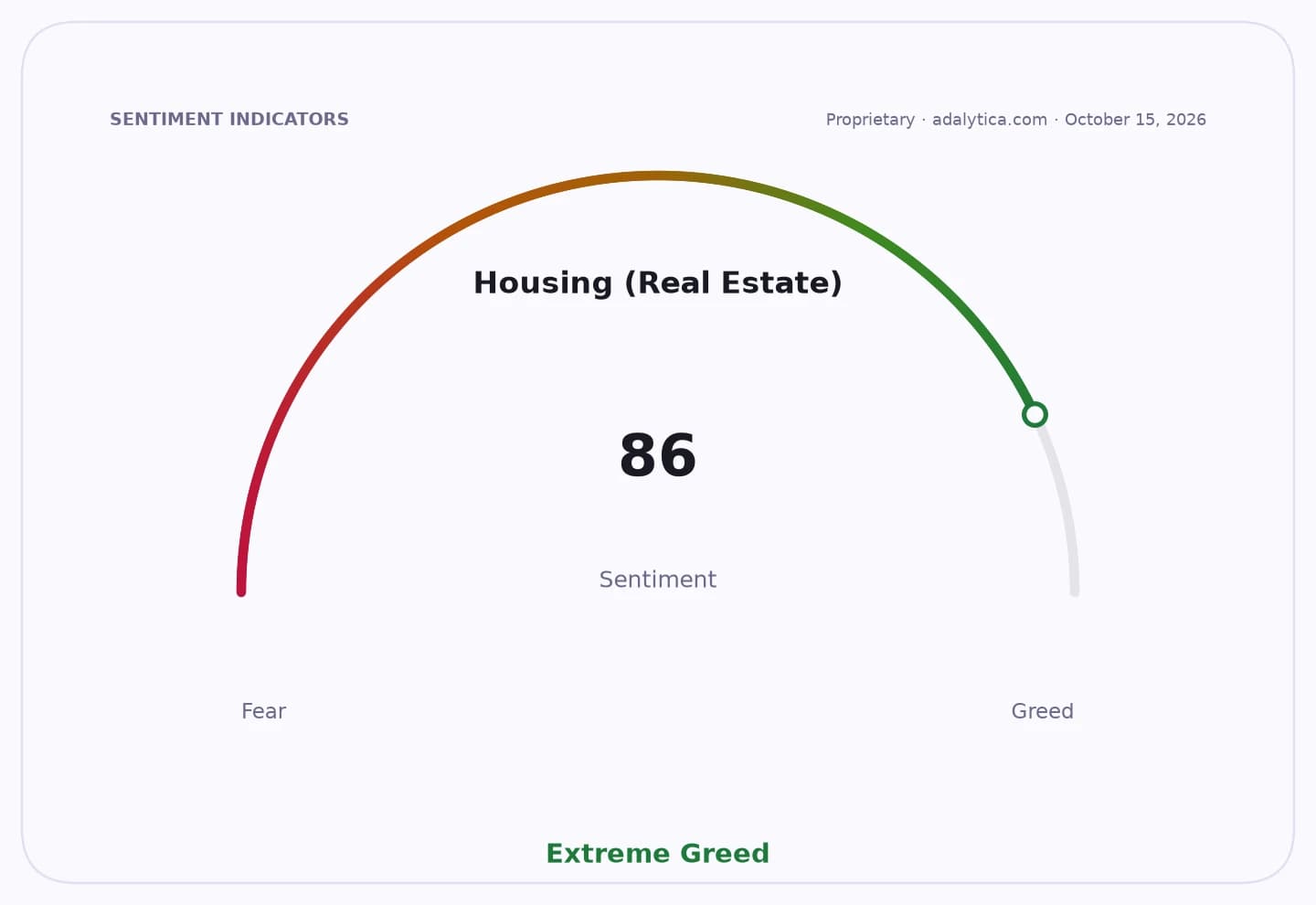
That matters because REITs sit at the intersection of income, financing costs and asset values. When the 10-year Treasury yield is near 5%, the spread investors demand from property cash flows widens, putting pressure on valuations even when operations remain stable. At the same time, the U.S. housing market is showing strain: the Housing Fear & Greed Index from Adalytica sits in “Greed” at 75, but its awareness reading remains at an “Extreme Fear” level of 4, while housing starts were forecast to fall to 1.2779 million in October from 1.221 million in September after a steep drop earlier in the year. That combination suggests the sector is not being priced as a simple bond proxy anymore.
Sentiment Indicators
For investors, the key question is whether REITs can still justify their income appeal against a more expensive capital market backdrop. Exchange-traded real estate funds have been volatile but resilient: VNQ was last around $91.57, roughly back to its 50-day moving average and slightly below its 200-day average, while IYR traded at $97.05, also near its long-term average. XLRE, the narrower property-focused ETF, closed at $41.97 and remained just above its 200-day moving average. Those levels suggest investors have not abandoned the asset class, but they also show conviction is limited.
The economics of REIT investing remain straightforward in theory and unforgiving in practice. Trusts are required to distribute at least 90% of taxable income, which is why they are bought for yield rather than retained earnings. But that income stream is only as attractive as the cost of debt and the durability of rents. A 10-year yield around 5% raises the hurdle rate for every new acquisition, refinancing and dividend comparison, especially for leveraged owners of apartments, offices, data centers and towers.
Housing (Real Estate) — 30-day sentimentadalytica.com
Explore this data interactively — full history, time series and cross-market comparisons.
The stress is clearest in parts of the broader real estate ecosystem. A major open-ended European real estate fund, DWS Grundbesitz Europa, is under pressure, underscoring how quickly property vehicles can come under strain when liquidity, valuation and investor sentiment move against them. In Asia, private equity inflows into Indian real estate fell 31% to $1.66 billion in the first nine months of 2026, even as domestic money played a larger role. That divergence suggests investors are still willing to own property exposure, but they are becoming more selective about vehicle structure, leverage and redemption terms.
For listed REITs, that can cut both ways. Bulls argue the sector offers an inflation-linked income stream, diversified tenant bases and a liquid alternative to direct ownership at a time when private real estate is less forgiving. Bears point to the obvious: cap rates are vulnerable if risk-free yields stay high, financing costs remain elevated and any weakening in housing or commercial demand starts to feed into rent growth.
The next phase for the sector will depend less on the idea of “owning property without owning property” and more on whether income can still outrun the market’s return hurdle. If rates ease and housing stabilizes, REITs could regain their defensive premium. If not, investors may keep demanding a wider yield cushion before treating rental income as a safe substitute for bonds.
| Entity | Gains | Losses |
|---|---|---|
| REIT investors | ▲Rental income exposure | ▼Rate-sensitive valuation risk |
| Tenants / renters | ▲More disciplined capital allocation | ▼Less easy financing for landlords |
| Listed REITs | ▲Liquid access to property cash flows | ▼Higher refinancing costs |
| Private real estate funds | ▲Long-duration capital | ▼Redemption and liquidity pressure |