Investment-grade real estate is looking like one of the market’s cleaner contrarian buys as Treasury yields stay elevated and fear still hangs over the sector.
Investment-grade REITs look cheap as yields stay high

That is the core message behind a fresh bullish case for selective REITs: the market has punished high-quality landlords for macro risk, but the combination of durable cash flow, borrowing costs that are stabilizing rather than exploding, and discounts to net asset value is creating an entry point investors often miss until the rebound is underway.
Sentiment IndicatorsⓘProprietary · adalytica.com · October 25, 2026
This is a snapshot — live sentiment, awareness and momentum for 130+ markets update continuously in the dashboard.Open AlphaPulse
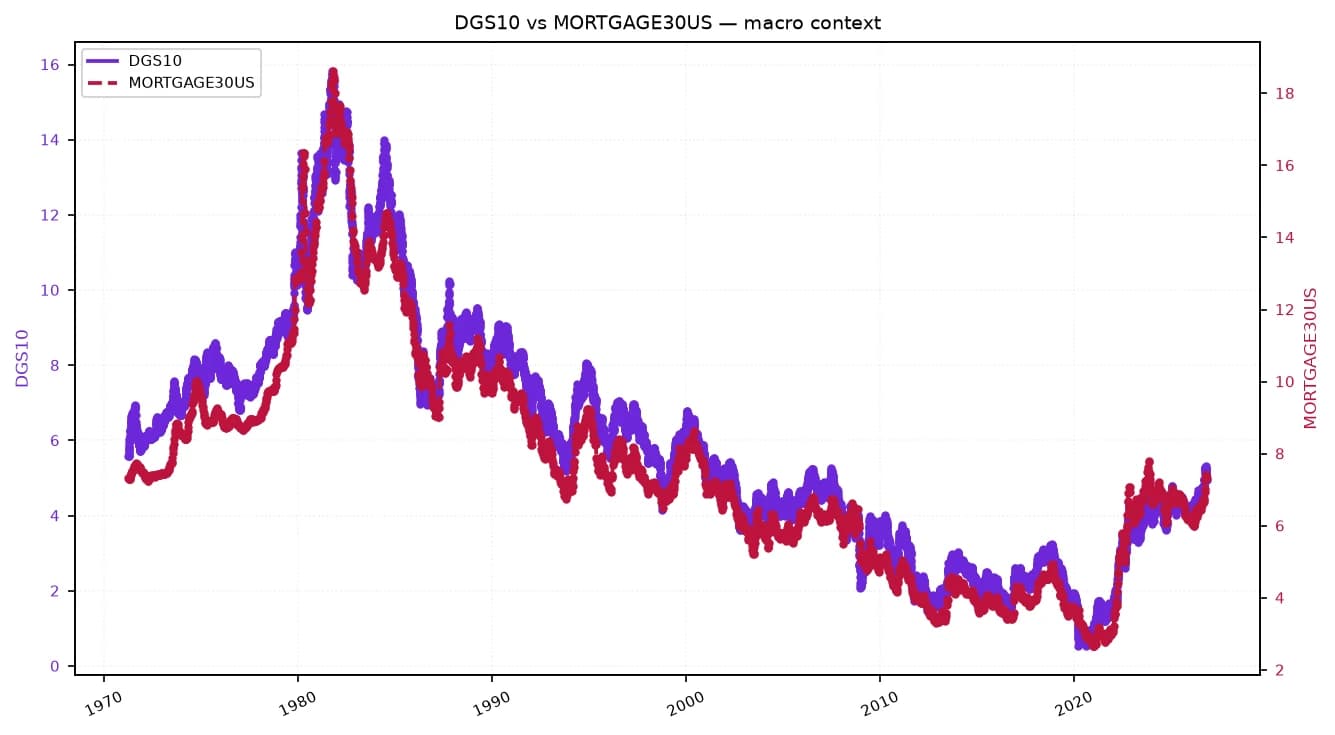
The 10-year Treasury was last around 5.006%, while the fed funds rate is forecast near 3.726%, a backdrop that keeps rate anxiety alive for income investors. Yet REITs are not being priced as a monolithic rate trade. The better names are now being judged on balance sheet quality, tenant strength and asset values, and that is where the opportunity is forming.
The setup matters because real estate is a capital-intensive asset class that gets hit hardest when investors extrapolate higher rates into permanently lower property values. But investment-grade REITs have a built-in defense: access to cheaper capital, longer lease profiles and assets that remain financeable even in a tighter lending environment. That is why the market can overshoot on the downside when it treats every REIT like a leveraged bond proxy.
DGS10 vs FEDFUNDS — macro contextadalytica.com
Explore this data interactively — full history, time series and cross-market comparisons.Open AlphaPulse
The price action shows the damage and the opening. Vanguard Real Estate ETF, VNQ, has fallen to 92.69 from a recent peak near 97.55, while iShares U.S. Real Estate ETF, IYR, is hovering around 98.40 after trading above 103 earlier in the year. Both funds are still roughly flat to their 200-day moving averages, suggesting a sector that has de-rated but has not fully broken. RNP, a REIT and preferred-stock fund, has slipped to 18.44 from above 20, with its 50-day moving average now below its 200-day average — a sign of stress, but also of the kind of washout that can create value if rates stop rising.
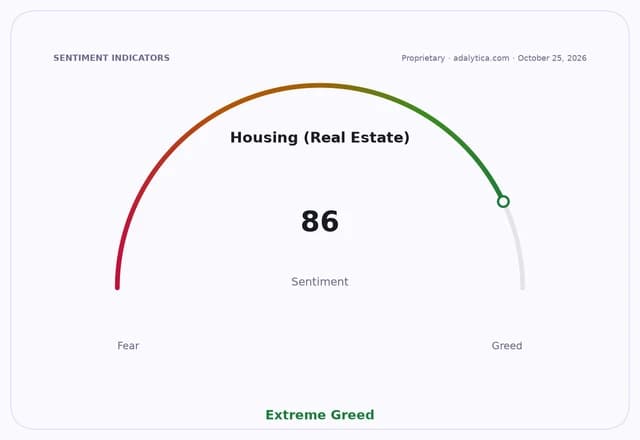
There is also evidence that the housing and property trade is not uniformly bearish. Adalytica’s Housing Fear & Greed Index shows extreme greed at 86, while its U.S. Treasury Bonds Trade Signals snapshot shows awareness at “extreme fear,” underscoring how quickly sentiment has detached from fundamentals in rate-sensitive assets. In other words, investors are still scared of rates, but they are already crowding back into areas tied to housing and property cash flows.
That is exactly the environment in which investment-grade REITs tend to outperform the market’s expectations. The sector does not need a dramatic rate cut to work. It needs rate volatility to ease, financing spreads to normalize and asset values to stop being marked down reflexively. Once that happens, discounted REITs can rerate quickly because the underlying income streams have not disappeared.
The investable implication is straightforward: do not chase the broad REIT index blindly, but look for the best-capitalized names with investment-grade balance sheets, fortress assets and NAV discounts. Those are the landlords most likely to survive the macro noise and benefit when capital flows rotate back into yield.
For investors, the asymmetry is attractive. If rates stay high but stable, the sector can still deliver income and modest appreciation. If rates drift lower, the upside from multiple expansion and NAV rerating could be substantial. Either way, the market may be underestimating how much bad news is already in REIT valuations.
The bigger lesson is that real estate is not a single trade. It is a barbell between fragile levered owners and durable investment-grade compounders. Right now, the latter look mispriced.
| Entity | Gains | Losses |
|---|---|---|
| Investment-grade REITs | ▲NAV discount rerating | ▼Broad-rate fear |
| Income investors | ▲Higher-yield entry points | ▼Further yield spikes |
| VNQ / IYR holders | ▲Sector rebound potential | ▼Prolonged volatility |
| Highly leveraged landlords | ▲— | ▼Refinancing pressure |