Revolut’s new Gibraltar crypto licence matters because it expands access to digital-asset trading for a giant consumer finance app with more than 80 million users, and that could bring fresh retail money back into a market already trading at depressed levels.
Revolut Gibraltar crypto licence boosts retail access

For investors, the significance is not Revolut alone but the second-order effect: a broader distribution channel can turn regulatory progress into actual flows. Revolut said more than 16 million customers already use crypto, and the Gibraltar approval adds to earlier regulatory wins, including a US bank regulator’s early approval in September and a stablecoin launch in August. In other words, one of Europe’s biggest fintechs is quietly building a larger crypto on-ramp just as sentiment remains washed out.
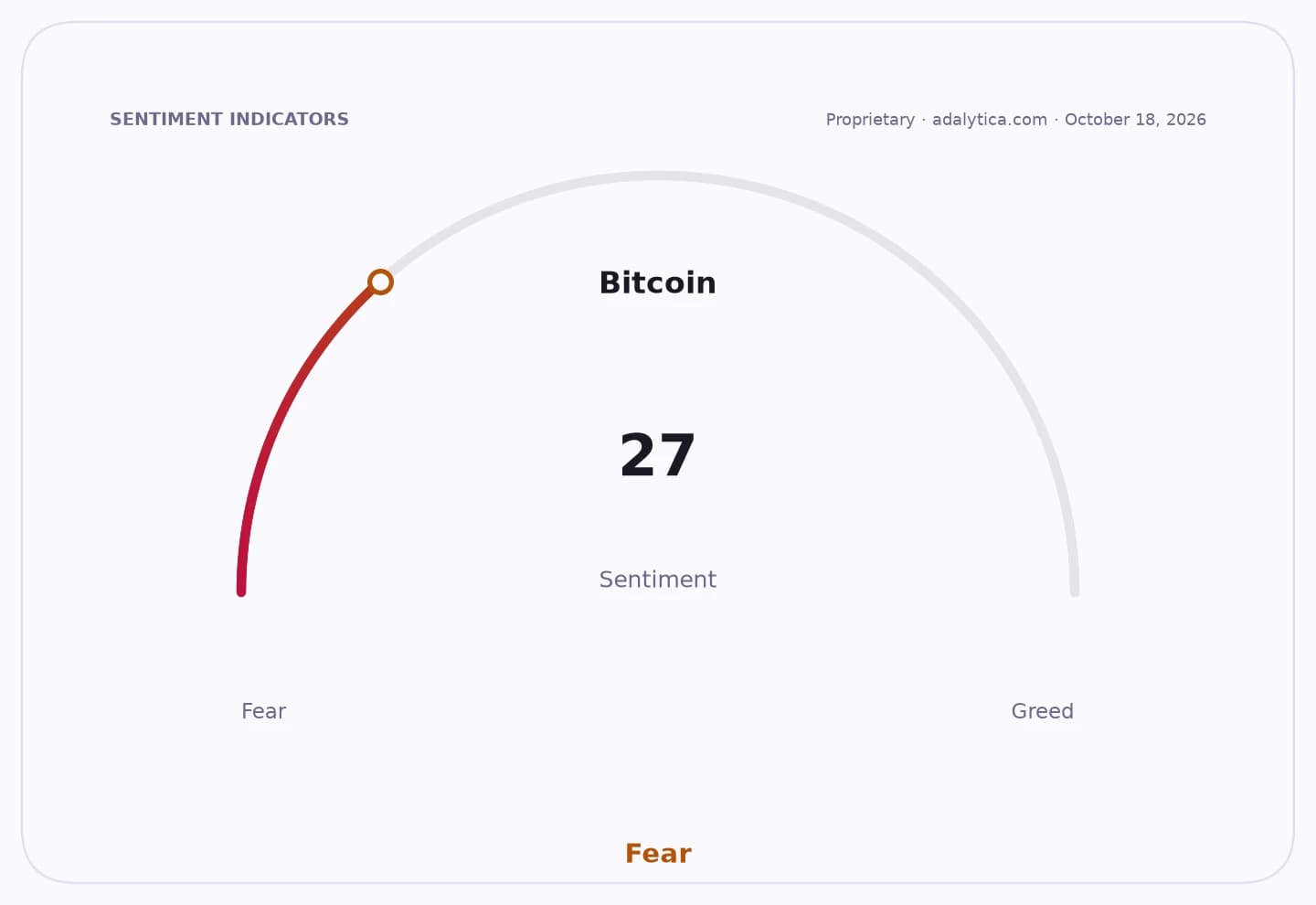
Sentiment Indicators
That is the backdrop for why speculative names are back in focus. Solana and Bittensor both offer established networks with room to recover, but the market is still pricing them far below prior highs. Solana trades around $101.78, roughly 64.6% below its $294.33 peak, while Bittensor’s TAO changes hands near $269.73, about 65.5% under its $767.68 record. Those are not broken stories; they are assets that would need a powerful risk-on turn to reclaim old valuations.
Solana’s near-term catalyst is its October 21 Alpenglow upgrade, which is designed to speed up transaction confirmation. Yet the bigger point is that SOL is still wrestling with a technical and fundamental reset: the token sits below its 50-day moving average and its relative strength index is near 28, a level that typically reflects heavy selling pressure. Bitcoin shows the same broader mood. The largest crypto trades near $80,564.78, just below its 50-day moving average, while Adalytica’s Bitcoin Fear & Greed Index sits at 0, or “Extreme Fear.” That is the sort of tape where early positioning can matter most.
Bittensor has its own case. The network’s Lium subnet reportedly bought back and burned nearly $2.7 million of TAO, a sign of real economic activity inside the ecosystem. Buybacks do not guarantee higher prices, but they do show that some capital is being recycled back into the token economy rather than extracted from it. For investors, that matters because it supports the thesis that infrastructure-grade crypto projects can still compound value even in a weak tape.
Pepeto is the more aggressive expression of that same thesis. The presale has raised more than $11.2 million, and its pitch is simple: pair a meme-coin narrative with utility tools that are already live, including a scanner and a zero-fee bridge. In a market where new users are most vulnerable to bad trades and trap tokens, a built-in scanner that checks contracts before execution is a stronger hook than the average presale promise. If Revolut helps funnel more first-time users into crypto, tools that emphasize safety and simplicity could benefit first.
The investable takeaway is clear: Revolut’s licence is not just a corporate milestone, it is a distribution event for the entire crypto ecosystem. That favours the platforms and tokens that can capture retail flow fastest, from Solana’s upgrade narrative to Bittensor’s network economics to Pepeto’s high-risk, high-upside presale. In this setup, the market underestimates how quickly accessibility can revive demand once fear starts to fade.
| Entity | Gains | Losses |
|---|---|---|
| Revolut | ▲Broader crypto reach | ▼Regulatory friction |
| Solana | ▲Upgrade-driven attention | ▼Weak price momentum |
| Bittensor (TAO) | ▲Buyback support | ▼Needs risk-on capital |
| Pepeto | ▲Presale demand | ▼Late buyers at higher stages |