Russia’s top court says more than 20 regions are already piloting artificial intelligence in judicial work, marking a concrete step toward wider automation in a legal system that has traditionally relied on heavy manual processing and human review.
Russia Courts Pilot AI in Judicial Work
The shift matters economically because courts are a core part of the infrastructure that underpins contracts, property rights and dispute resolution. If AI tools can reliably search case law, compare legal positions, flag contradictions in filings and automate court transcripts, they could reduce processing time and administrative costs in a system handling high volumes of civil, commercial and administrative disputes. That would be especially relevant in a country where the state is trying to modernize public services while keeping tight control over how sensitive technologies are deployed.
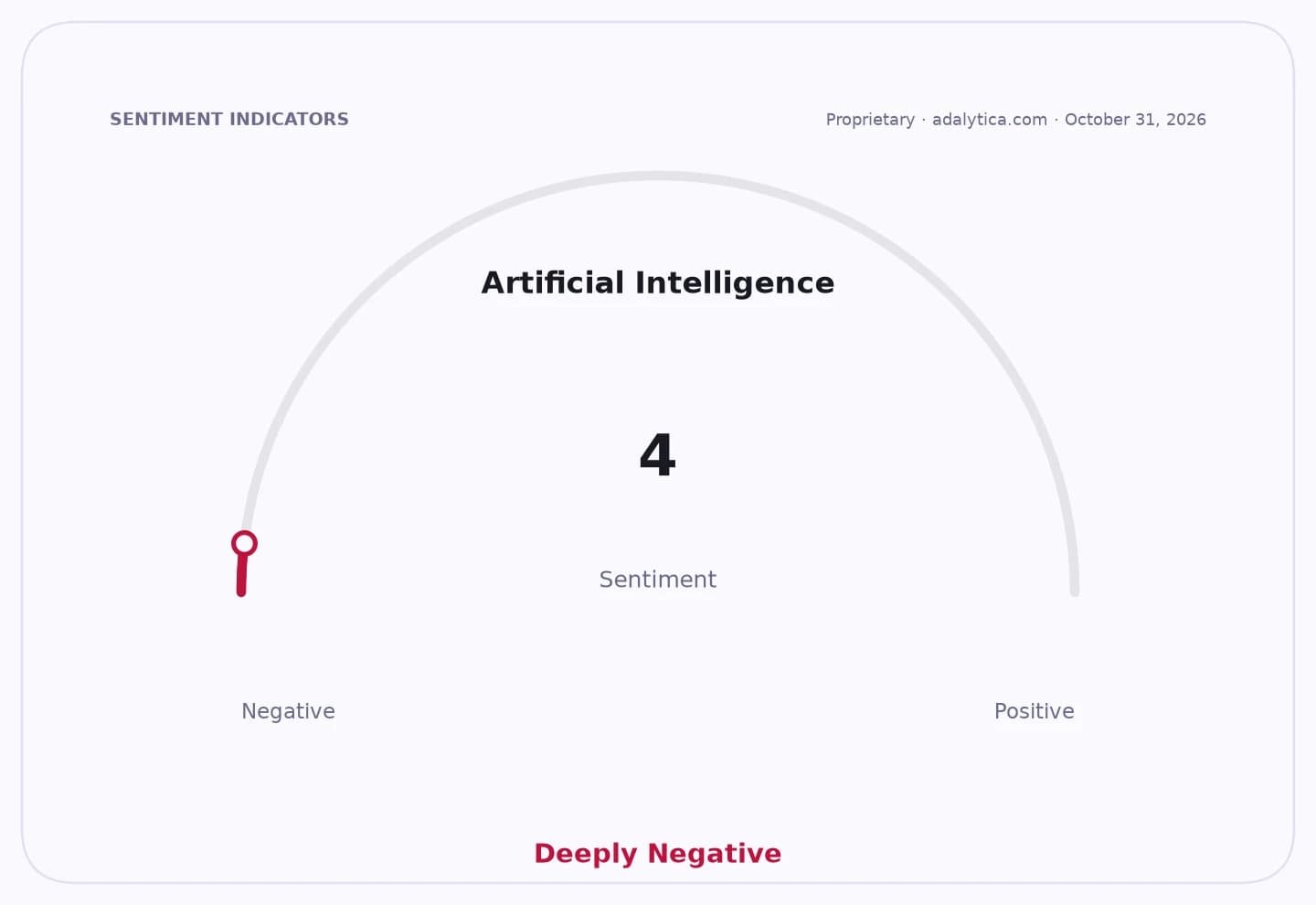
Sentiment Indicators
Supreme Court head Igor Krasnov, speaking during a trip to China, said the pilots are being rolled out gradually and first tested for reliability before wider use. He added that judges are being trained to work with the tools, underscoring that Moscow is not yet treating AI as a replacement for judicial judgment but as a back-office layer to speed up routine tasks. The current list of pilot regions includes Moscow, Amur, Moscow and Vologda regions, according to Krasnov.
The stated use cases are significant. AI will search and analyze court practice and Supreme Court legal positions, identify inconsistencies and errors in documents, and automate hearing records. Those are exactly the kinds of repetitive functions where software can improve throughput without directly affecting the substance of rulings. For the Kremlin, that makes the program politically safer than attempts to let algorithms influence outcomes. For the court system, it could help clear bottlenecks and improve consistency, at least at the margin.
For investors, the story is less about an immediate market trade than about the spread of AI into sovereign institutions and the regulatory framework around it. The move reinforces the broader theme that governments are becoming both users and referees of AI, raising the strategic importance of compliance, data security and model reliability for technology vendors. It also highlights how AI adoption is broadening beyond consumer software and enterprise productivity into public-sector workflows, a trend that can support demand for cloud, software and infrastructure services even as it invites tighter oversight.
That backdrop helps explain why major technology names remain highly sensitive to AI investment cycles and policy risk. Microsoft and Nvidia are still central beneficiaries of enterprise and infrastructure spending tied to AI deployment, while firms such as C3.ai remain dependent on the pace at which institutions, including government agencies, move from pilot projects to scaled adoption. At the same time, the legal and reputational risks flagged in company filings — from data privacy to regulatory action — become more relevant as AI moves into courts, where reliability standards are unforgiving.
The broader narrative is that Russia is testing AI not as a headline-grabbing substitute for judges, but as a state-managed efficiency tool. If the pilots expand smoothly, the next phase would be broader access across the court system, giving the judiciary a more digitized operating model. If reliability, transparency or bias concerns emerge, the rollout could slow quickly. For now, the key development is that the experiment has moved from theory to institutional practice across a sizable share of Russia’s regions.
| Entity | Gains | Losses |
|---|---|---|
| Russian courts | ▲Faster case handling | ▼Manual administrative load |
| Judges and staff | ▲Better research tools | ▼More oversight burden |
| AI vendors/cloud providers | ▲New public-sector demand | ▼Higher compliance scrutiny |
| Litigants and lawyers | ▲Faster document review | ▼Less room for procedural opacity |