Russia’s wage arrears remained limited in August even as unpaid salaries climbed 18.9% from July to 2.42 billion rubles, underscoring that the country’s labour market is still absorbing strain without a broad-based payment crisis.
Russia wage arrears rise in August to 2.42 billion rubles
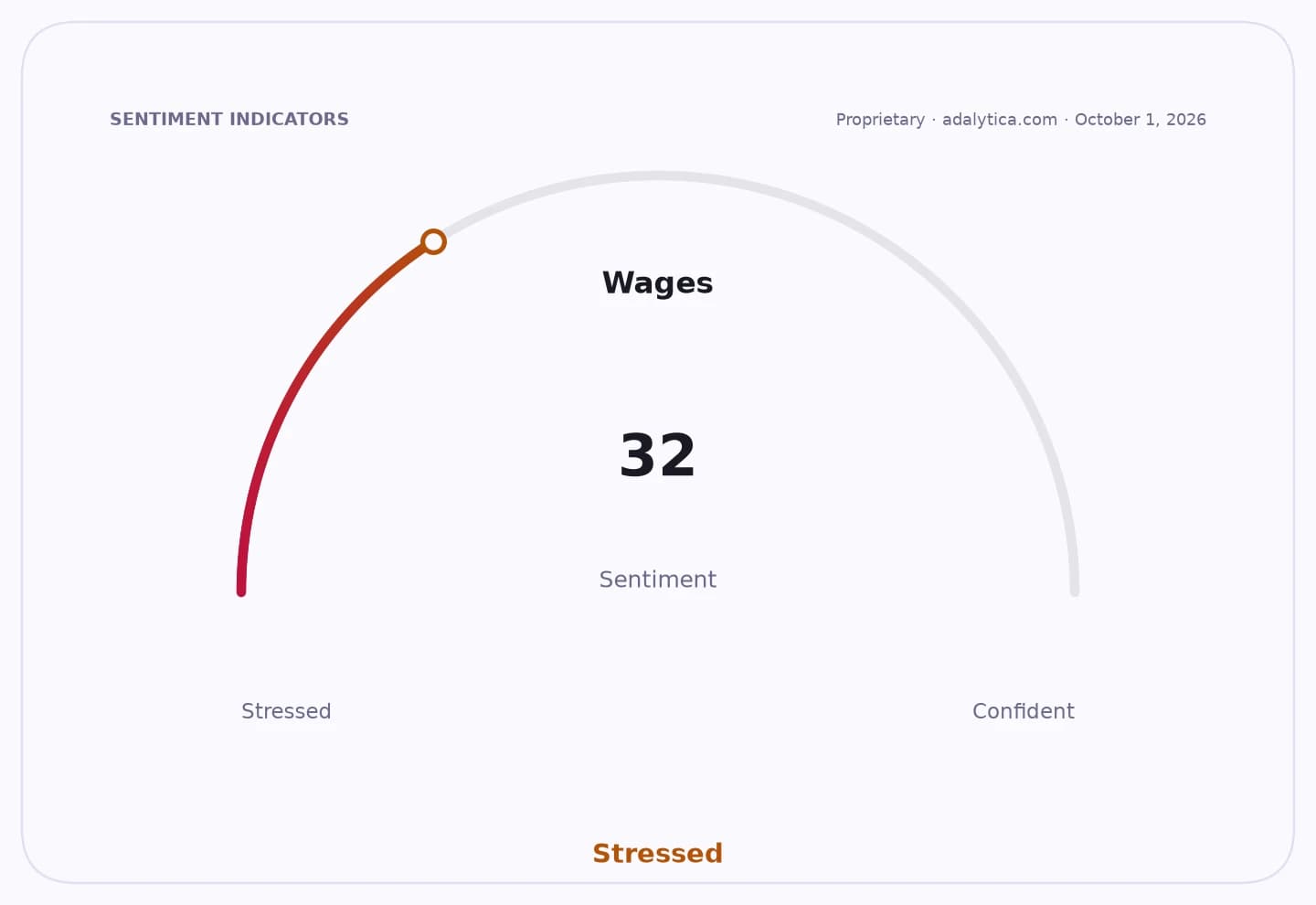
The key market-moving point is not the monthly increase, but the fact that less than 1% of workers were owed back wages at the end of August, according to Rosstat data cited by TASS. For employers, that suggests arrears are still a contained stress indicator rather than evidence of systemic wage non-payment. For the economy, it points to a labour market that remains tight enough to preserve wage transfers to most households, helping support consumption even as firms face higher financing costs and uneven cash flow.
Sentiment IndicatorsⓘProprietary · adalytica.com · October 1, 2026
This is a snapshot — live sentiment, awareness and momentum for 130+ markets update continuously in the dashboard.Open AlphaPulse
The August figure outside small businesses reached 2.424 billion rubles, up 385.3 million rubles from July. That is a meaningful monthly jump, but it remains small relative to Russia’s broader wage bill and employment base. The headline share of affected workers matters more for macro stability: if fewer than 1% of employees are waiting on wages, the issue is more consistent with localized balance-sheet pressure in specific sectors than with an economy-wide deterioration in labour conditions.
That distinction matters for policymakers because wage arrears are often an early sign of payment stress in industries under funding pressure, particularly where state-linked demand, export revenues or working-capital access have weakened. A sustained rise would imply faster transmission of financial stress into households, potentially feeding arrears in rent, loans and consumer spending. At current levels, however, the data suggest a labour market that is still functioning, even if pockets of strain are building.
For investors, the reading is broadly supportive for domestic demand and consumer credit quality, but not a clean positive for corporate health. Stable wage payments underpin spending and reduce the risk of a sharper slowdown in mass-market consumption. At the same time, an uptick in arrears can flag tighter liquidity among employers, especially in cyclical sectors and regions with weaker cash generation. That makes the August increase worth watching as a possible leading indicator of stress rather than a crisis signal.
Compared with a decade ago, the absolute amount of wage debt is also materially lower than the 3.8 billion rubles cited in earlier rankings of Russia’s largest arrears, reinforcing the view that wage non-payment is no longer the economy-wide problem it once was. The risk now is less about a return to 1990s-style arrears and more about a gradual rise in payment delays if profit margins, access to credit or government support weaken further.
The next test will be whether September data confirm August’s increase as a one-off or the start of a broader upturn. If arrears keep rising while the share of affected workers stays low, the story remains one of contained sectoral stress. If both measures deteriorate together, it would signal deeper pressure in corporate liquidity and a more fragile backdrop for household spending.
| Entity | Gains | Losses |
|---|---|---|
| Workers paid on time | ▲Income stability | ▼None |
| Russian consumers | ▲Household spending support | ▼If arrears spread |
| Strained employers | ▲Short-term cash conservation | ▼Reputation and labour retention |
| Policymakers | ▲Evidence of contained labour stress | ▼Risk if arrears broaden |