Sony and Taiwan Semiconductor Manufacturing Co. are forming a joint venture in Japan to develop and make next-generation image sensors, a move that ties one of the world’s biggest chip designers to the industry’s most important contract manufacturer at a time when governments and companies are racing to secure supply.
Sony and TSMC form Japan image sensor venture
The project, approved by TSMC’s board on Aug. 11, will involve a capital contribution of up to 282 billion yen from the Taiwanese foundry, according to filings. The wider Kumamoto investment plan is being framed as part of a roughly 1 trillion yen build-out, underscoring how far Sony is willing to go to protect a business where it already commands about half the global image-sensor market.
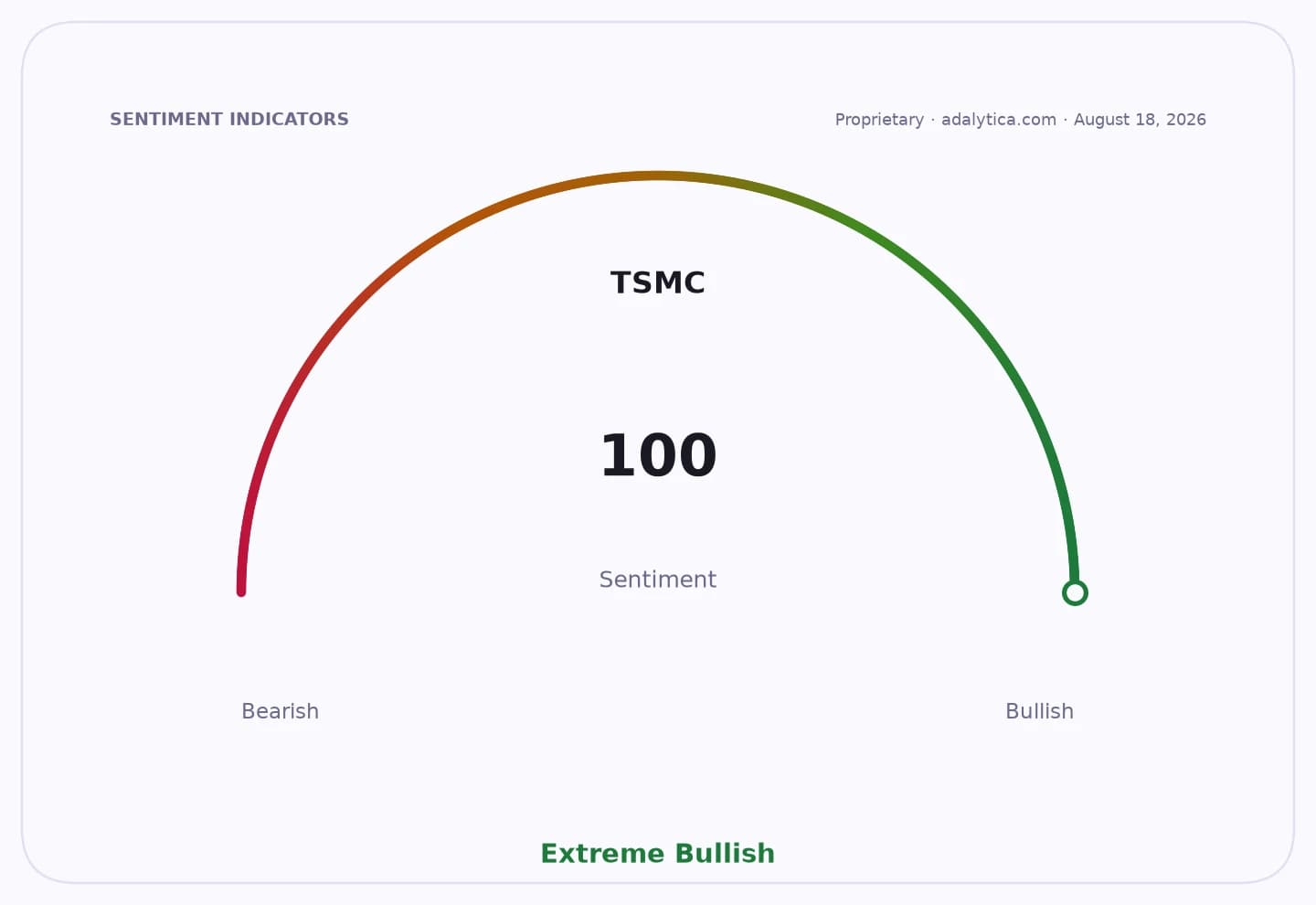
Sentiment IndicatorsⓘProprietary · adalytica.com · August 18, 2026
This is a snapshot — live sentiment, awareness and momentum for 130+ markets update continuously in the dashboard.Open AlphaPulse
That market position matters because image sensors sit at the center of smartphone cameras, automotive systems and increasingly AI-enabled devices. By pairing Sony’s sensor technology with TSMC’s manufacturing scale, the companies are trying to speed commercialization while also deepening Japan’s domestic semiconductor capacity — a strategic priority for Tokyo after years of supply-chain dependence on overseas fabs.
For investors, the deal extends TSMC’s reach beyond logic chips into a specialty category with attractive demand, while giving Sony a way to defend a high-margin franchise against rivals in Korea and China. It also adds another capital-intensive project to TSMC’s pipeline at a moment when the stock is trading well above its 200-day moving average and technical readings remain elevated, suggesting investors are still paying up for future capacity growth.
The timing fits a broader semiconductor upcycle driven by AI spending, even as the sector remains volatile. U.S. chip bellwether Nvidia continues to draw strong investor attention, while semiconductor shares in Europe were under pressure in the latest session, highlighting how uneven sentiment can be across the industry.
The Japanese venture still needs the remaining regulatory and closing steps, but it gives both companies another foothold in a market where manufacturing resilience, not just technology, is becoming a competitive advantage. Investors will now watch for execution risks, funding details and whether the partnership leads to more advanced sensor production in Japan.
| Entity | Gains | Losses |
|---|---|---|
| Sony Semiconductor Solutions | ▲More manufacturing scale | ▼Higher capital commitment |
| TSMC | ▲Deeper Japan foothold | ▼Added project complexity |
| Japan semiconductor supply chain | ▲More domestic capacity | ▼Continued reliance on foreign expertise |
| Rivals in image sensors | ▲None immediate | ▼Tighter competition from Sony-TSMC alliance |