Black Friday is still set to draw millions of Spanish shoppers, but this year’s campaign is losing momentum as inflation, higher import charges on low-value parcels and more deliberate spending curb the surge in orders.
Spain Black Friday Growth Slows on Inflation
That matters because Black Friday has become the opening bell for the country’s peak retail season, shaping logistics volumes, short-term employment and cash flow for retailers, delivery firms and banks. Yet the latest data point to a market that is growing more slowly, with households more price-sensitive and more selective about where they spend.
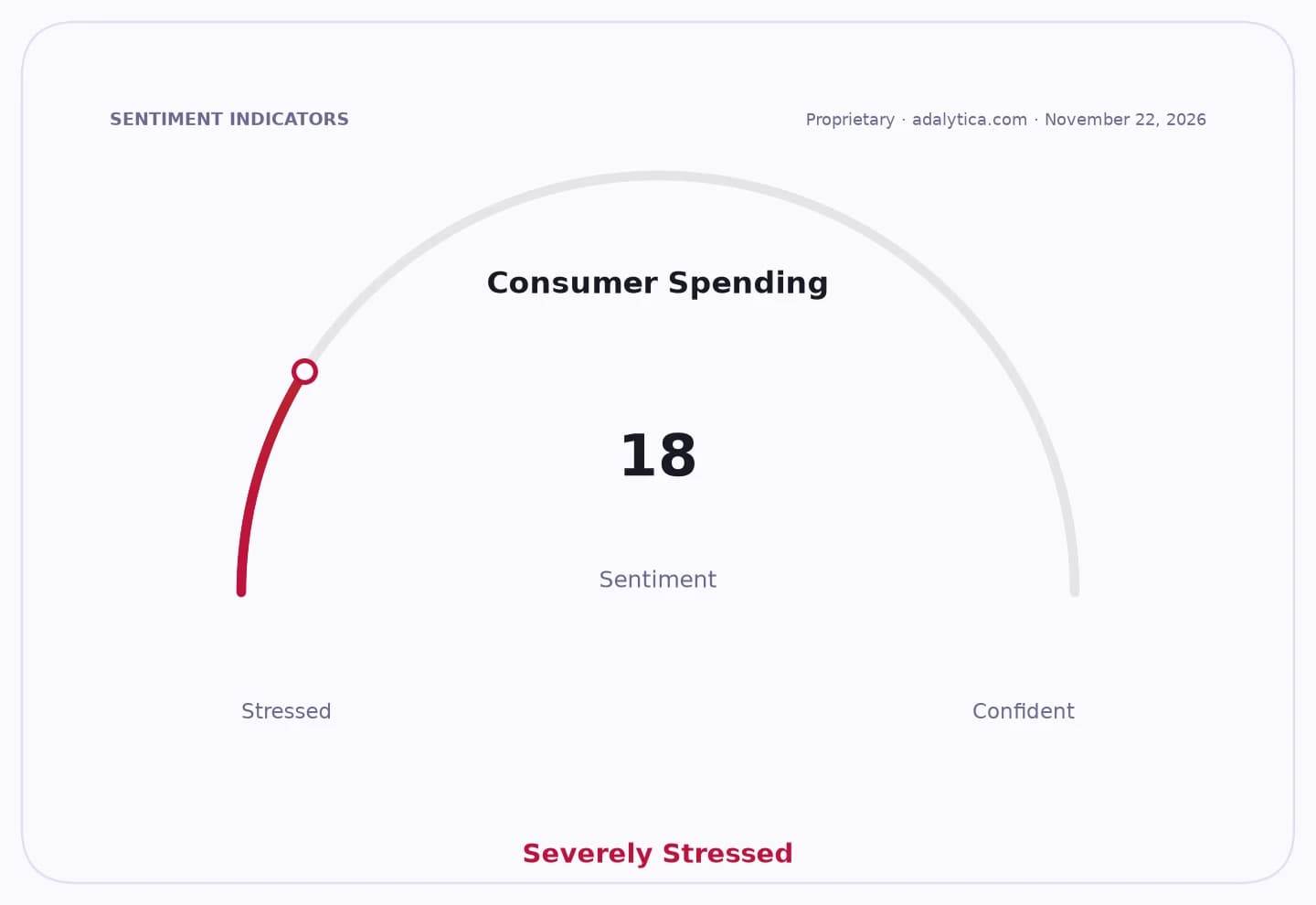
Sentiment Indicators
Spain’s logistics lobby UNO expects orders to rise just 2.4% during the campaign, the weakest increase in years and far below 2025’s 8.7% gain. Francisco Aranda, the group’s president, described the season as a “frenazo,” or brake, as consumers shift away from impulse buying and toward planned purchases and early gift purchases.
The slowdown is being amplified by what retailers and shoppers are calling the “Shein rate.” Since July, Spain has imposed a 3-euro tariff per product category on imports from non-EU countries for shipments under 150 euros, a charge that falls on consumers. Brussels added a customs handling fee in November of 2 euros per product, payable by sellers or importers. UNO says the volume of goods linked to this business model has already fallen 30% to 50% in Spain depending on the platform.
The measures hit a channel that had become central to online shopping. Last year, nearly 34% of online purchases in Spain went to Asian platforms, according to the source article. But some of that trade is already being rerouted through warehouses inside the European Union, allowing giants such as AliExpress and Shein to reduce the number of times they trigger the import levy. That may soften the immediate hit, but it also shows how quickly low-cost e-commerce can adapt to regulation, leaving a more fragmented and less predictable demand pattern for the holiday season.
For investors, the signal is mixed. Retailers are still expected to sell into a large event — 16 million Spaniards are forecast to take advantage of discounts — but the spending mix is becoming less supportive of volume growth. KPMG and Appinio’s “Golden Quarter” survey says Black Friday now outranks Christmas, with a 65% purchase intention rate, ahead of 50% for Christmas and 48% for January sales. Eight in 10 respondents plan to bring forward gift buying, and 40% expect to spend the most during Black Friday of any seasonal date.
But price inflation is doing much of the work. KPMG says average spending will rise to 416 euros per consumer, up 9.7% year on year, largely because prices are higher. Other surveys paint a weaker picture: NTT Data sees 175 euros, below 182 euros a year earlier, while the OCU estimates 196 euros. The spread underscores how uneven consumer behavior has become as households allocate more of their budget to essentials — now 65% of household spending, according to KPMG — leaving only 35% for non-essential purchases.
That shifts the battleground for retailers. Consumers are demanding deeper discounts, are less impulsive and are increasingly using generative AI as a shopping assistant rather than relying on influencers. In practical terms, that favors firms with strong pricing power, broad assortments and efficient fulfillment, while weaker merchants face margin pressure if they have to discount harder to win traffic.
The labor market impact is still significant. Randstad expects around 124,300 hires for the campaign, up 5.3% from last year, while Asempleo says temp agencies could place about 200,000 workers from November through January. Most of the seasonal hiring will be in logistics and transport, which accounts for 63.7% of new jobs, with commerce taking another 45,130 roles.
The biggest beneficiary remains the delivery and warehouse economy. Amazon and Walmart shares have both recently traded above their 50-day moving averages, while Target has also recovered from earlier weakness, suggesting investors are still willing to pay for exposed holiday-volume stories. But Black Friday’s evolution in Spain shows that higher traffic does not automatically translate into cleaner profits: when consumers are more cautious, sellers often buy growth with heavier promotions.
| Entity | Gains | Losses |
|---|---|---|
| Logistics firms | ▲Seasonal parcel demand | ▼Faster volume growth |
| Retailers with strong pricing power | ▲Higher ticket sizes | ▼Margin discipline |
| Low-cost Asian e-commerce platforms | ▲EU warehouse rerouting | ▼Cheap cross-border sales |
| Consumers | ▲More planned purchases | ▼Lower real purchasing power |