SPY closed at a record 769.77 on August 5 even as short-term gauges and sentiment data flashed a more uneven picture for consumer demand, setting up a market that is still being led by large-cap equities but is no longer advancing in a straight line.
SPY Hits 769.77 as XLP Outperforms XLY
That matters because the strongest part of this rally has been powered by the broad market’s ability to absorb slower growth fears without breaking trend. The S&P 500 ETF is now more than 10% above its 50-day moving average and sits well above its 200-day moving average, a sign that institutional money is still buying dips. But the latest technical readings suggest the advance is getting stretched: SPY’s RSI rose to 61.6 on August 5, while price is pressing near the upper Bollinger Band, a combination that often leaves less room for error.
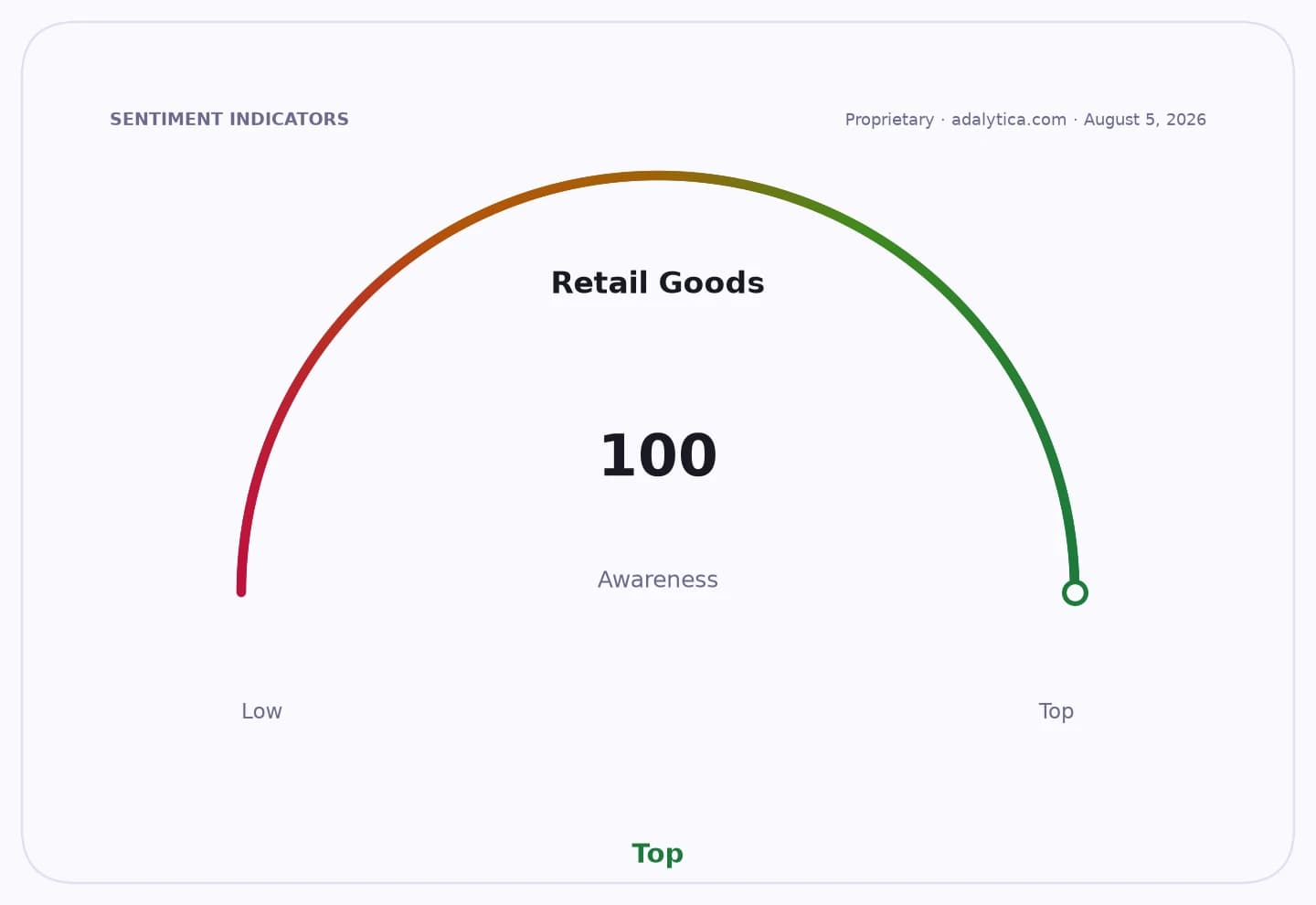
Sentiment IndicatorsⓘProprietary · adalytica.com · August 5, 2026
This is a snapshot — live sentiment, awareness and momentum for 130+ markets update continuously in the dashboard.Open AlphaPulse
The more investable story is beneath the surface. Consumer-discretionary ETF XLY has climbed back to 118.62, reclaiming ground after a sharp drawdown earlier this year, but it remains only modestly above its 50-day moving average and just under its long-term average. That says consumers are not in a full breakout phase yet. By contrast, consumer staples ETF XLP continues to outperform on a relative basis, trading at 85.32 and holding above both its 50-day and 200-day averages. When discretionary spending looks vulnerable and staples keep attracting flows, the market is signaling caution on big-ticket consumption.
Adalytica’s consumer spending gauge reinforced that split. Its Consumer Spending Sentiment snapshot was neutral at 50 on August 5 after a 39-point one-day swing, while Retail Goods Spending Sentiment sat in fear territory at 18 even after a small rebound. For investors, that combination points to selective spending rather than a broad consumer boom — exactly the kind of backdrop that can reward defensive names, private-label suppliers, discount retailers and staples over premium discretionary brands.
The zodiac forecast for August 6 fits the same market psychology, even if investors should treat it as a cultural headline rather than a trading signal. Taurus and Leo are said to be in line for “abundant profits,” while Pisces is told to rein in spending. Read through a market lens, that’s the same split Wall Street is pricing: winners will be the households and companies with room to spend, while the vulnerable are those with weaker balance sheets or lower pricing power. In a late-cycle environment, that kind of divergence matters more than broad optimism.
The next catalyst is whether the rally broadens out or narrows further. If SPY keeps climbing while XLY lags XLP, the market is telling investors to stay with quality balance-sheet compounders, staples and defensive cash generators. If discretionary strength finally accelerates, the consumer trade can re-rate quickly. For now, the highest-conviction move is to own resilience, not wish for a spending boom.
| Entity | Gains | Losses |
|---|---|---|
| SPY | ▲Record highs; trend momentum | ▼Late buyers if breadth weakens |
| XLP | ▲Defensive flow; relative outperformance | ▼Growth-sensitive retailers |
| XLY | ▲Rebound potential | ▼If spending stays selective |
| Pisces / weak spenders | ▲Budget discipline | ▼Discretionary purchases |