Sterling’s next leg higher may be less about Britain suddenly becoming spectacular and more about the U.S. losing its aura of exceptionalism. That is the key message behind UniCredit’s call for a “wind of change” in GBP/USD, and the market is beginning to price it in as Treasury yields stay elevated but the dollar’s momentum fades.
Sterling Poised to Benefit as Dollar Momentum Fades
The most important development is the shift in relative rate expectations. U.S. two-year yields are still high at about 4.16% and the 10-year is near 4.58%, but those levels no longer tell the whole story. The dollar has stopped acting like an all-weather refuge, and that matters because currency markets are driven by marginal changes in growth, inflation and policy credibility, not just headline yield differentials. In that environment, even a modest improvement in Britain’s perceived policy and macro stability can support sterling.
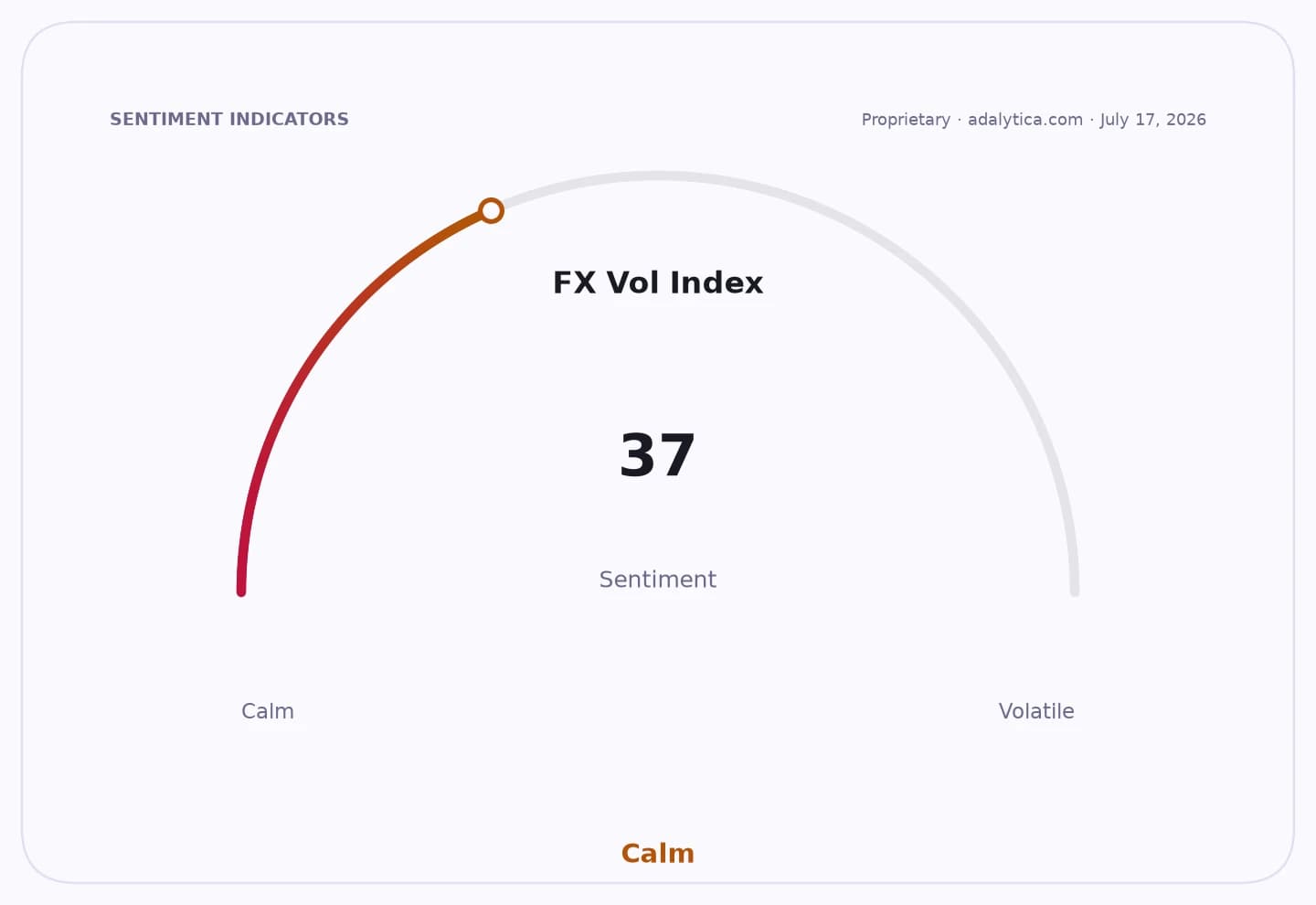
Sentiment IndicatorsⓘProprietary · adalytica.com · July 17, 2026
This is a snapshot — live sentiment, awareness and momentum for 130+ markets update continuously in the dashboard.Open AlphaPulse
That is why the current GBP/USD setup looks more interesting than it did earlier this year. The pound ETF FXB has climbed to 129.23 from 125.78 in October and is trading above both its 50-day and 200-day moving averages, a sign that the broader trend has turned firmer. Conventional momentum indicators are still strong: FXB’s RSI remains elevated at 71.6, while MACD is positive and above its signal line. The message is not that sterling is cheap in a conventional valuation sense; it is that the market is starting to treat the pound as a beneficiary of a changing macro regime.
UniCredit’s “wind of change” framing fits a broader thesis investors should not ignore: the dollar’s trade has become crowded, while sterling’s downside narrative has been largely priced in. The U.S. dollar ETF UUP still trades above its 50-day and 200-day averages, but at 28.35 it is no longer in the kind of breakout trend that makes shorting the greenback an immediate pain trade. Adalytica’s U.S. dollar trade signals show neutral sentiment, with 30-day change negative, suggesting the dollar is losing some of its prior momentum even if it has not rolled over decisively.
US Dollar — 30-day sentimentadalytica.com
Explore this data interactively — full history, time series and cross-market comparisons.Open AlphaPulse
That creates an asymmetric setup for GBP/USD. If U.S. data softens, or if the Federal Reserve signals a slower-for-longer but less hawkish posture, the dollar’s yield advantage can narrow without a dramatic collapse in rates. Sterling does not need a boom to outperform; it only needs the U.S. to disappoint relative to already elevated expectations. That is a classic second-order FX trade, and it tends to work when the market is overpaying for U.S. resilience.
The economic significance is bigger than a simple currency call. A firmer pound eases imported inflation pressure in Britain, which gives the Bank of England a little more room to avoid overtightening into weak domestic growth. It also improves the earnings backdrop for UK multinationals with dollar revenue, while putting pressure on importers and consumer-facing companies that rely on low-cost foreign inputs. In other words, a stronger pound redistributes winners and losers across the market, and that is exactly why it matters for investors.
The market is also telling us volatility is not yet screaming higher. Adalytica’s FX volatility signals remain neutral, with awareness in fear territory but sentiment still contained. That matters because currency moves are often most powerful when positioning is complacent. If the dollar continues to drift rather than surge, the path of least resistance for GBP/USD could be higher.
For investors, the trade is not to chase sterling blindly, but to recognize where the leverage sits. A constructive pound view favors UK domestically oriented assets less than it favors global earners that can benefit from translation effects, while it pressures companies exposed to foreign input costs. It also argues for watching the policy divergence between the Fed and the Bank of England more closely than the market has over the past year. If the U.S. starts to look less dominant on growth and rates, the pound does not need perfection to keep climbing.
My view: UniCredit may be early, but it is pointing at the right inflection point. The market underestimates how quickly currency leadership can change once the dollar’s momentum stalls. For now, GBP/USD looks like a candidate for a multi-month grind higher, and investors should position for a sterling uptrend before consensus catches up.
| Entity | Gains | Losses |
|---|---|---|
| British pound / FXB | ▲Breakout momentum | ▼Prior bearish positioning |
| U.K. importers | ▲Lower import costs | ▼Export pricing power |
| U.S. dollar / UUP | ▲— | ▼Crowded long trade |
| U.K. multinationals | ▲Translation tailwind | ▼Hedged dollar revenues |