The Swiss franc strengthened against the US dollar as investors pared bets on tighter Federal Reserve policy, with the dollar sliding after signals from New York Fed President John Williams and traders waiting for September inflation data to confirm the next move.
Swiss Franc Rises as Fed Tightening Bets Fade
The shift matters because currency markets are now reacting less to outright growth momentum and more to the trajectory of US rates. Even with Treasury yields still elevated, the dollar has struggled to hold gains as expectations for additional Fed tightening into 2027 have faded. That leaves the franc, traditionally favored in periods of policy uncertainty, better supported as investors look for relative safety and lower volatility.
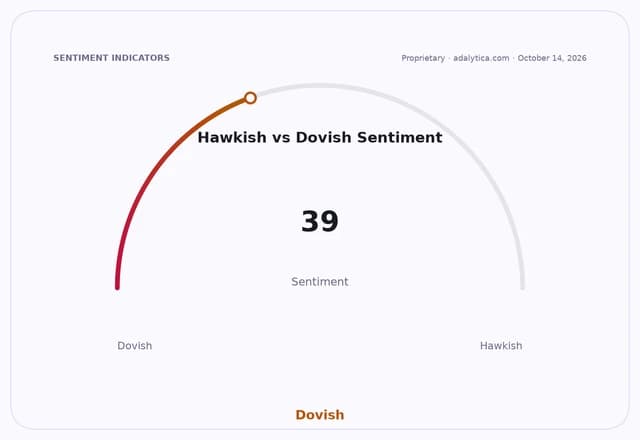
Sentiment IndicatorsⓘProprietary · adalytica.com · October 14, 2026
This is a snapshot — live sentiment, awareness and momentum for 130+ markets update continuously in the dashboard.Open AlphaPulse
The move comes against a backdrop of a still-nervous rates market. The US 2-year Treasury yield was around 4.75%, while the 10-year stood near 5.24%, both elevated by historical standards but no longer enough to underpin the dollar if markets believe the Fed is nearing the end of its hiking cycle. Fed funds futures pointed to an effective rate of about 3.73% next month, reinforcing the view that policy is restrictive and that the hurdle for more tightening is high.
For investors, the immediate implication is that dollar strength may be more fragile than it looked earlier this year. The Invesco DB US Dollar Index Bullish Fund, UUP, was trading around 29.14, above its 50-day moving average of 28.37 and 200-day average of 27.82, but its recent climb came alongside an overbought RSI reading of 68.0 and a positive MACD, suggesting momentum remains constructive but stretched. By contrast, the Invesco CurrencyShares Swiss Franc Trust, FXF, was at 105.46, below both its 50-day average of 107.73 and 200-day average of 110.68, even as its RSI at 39.5 pointed to room for further recovery if dollar weakness persists.
Hawkish vs Dovish Sentiment vs UUPadalytica.com
Explore this data interactively — full history, time series and cross-market comparisons.Open AlphaPulse

The policy narrative is being driven by a more dovish Federal Reserve tone rather than a clean deterioration in US data. Adalytica’s Fed guidance sentiment measure fell sharply over the past day, reflecting a softer market reading of the central bank’s stance, even though awareness remained subdued. Traders now want the consumer price report for September to settle whether the slowdown in tightening will be temporary or the start of a more durable shift toward rate cuts.
That matters well beyond the franc-dollar cross. A weaker dollar tends to ease financial conditions globally, supports risk assets outside the US and can help commodity-linked and emerging-market currencies. But for defensive havens such as the franc, it also revives demand as investors hedge against policy mistakes, sticky inflation or a later-than-expected US slowdown.
The near-term test is whether upcoming CPI data validate the market’s dovish read on the Fed. If inflation prints cooler than expected, the dollar could come under further pressure and the franc may extend gains. A hotter-than-expected report would likely reverse some of the move, but for now the balance of risk has shifted against the dollar.
| Entity | Gains | Losses |
|---|---|---|
| Swiss franc | ▲Safe-haven demand | ▼Export competitiveness |
| US dollar | ▲— | ▼Rate-cut expectations |
| UUP holders | ▲Prior momentum trade | ▼Further downside if Fed turns dovish |
| FXF holders | ▲Franc rebound | ▼None if move reverses |