Tesla’s case for bulls right now is no longer just about electric-vehicle sales — it is about whether the company can turn its autonomy stack into a platform business with far higher margins than auto manufacturing. A federal investigation clearing Full Self-Driving in a fatal crash has removed one of the biggest immediate legal overhangs on the technology, even as Europe remains more cautious, and that matters because Tesla’s next leg higher depends less on unit vehicle demand than on whether regulators, users and eventually insurers accept software revenue at scale.
Tesla Bulls Bet on Autonomy Re-rating
That is the core of the investment debate. The market knows how to value a car company. It is far less certain how to value a company that could monetize driver-assistance software, robotaxi services and robotics over many years. If Tesla proves it can keep advancing autonomy while surviving scrutiny, investors are no longer underwriting auto gross margins alone — they are buying optionality on a recurring, high-margin software layer that could re-rate the stock in a way traditional automakers never can.
The latest filing supports that narrative. Tesla said new products, production capacity, infrastructure investments and advances in autonomy and robotics position it for future growth. That is not a throwaway line. It is Tesla telling investors where the next earnings multiple expansion could come from: not just from more cars, but from a broader ecosystem built around software, charging, energy and automation. Automotive sales were still up sharply in the second quarter, but the bigger story is that the company is steadily shifting the center of gravity of the thesis away from cyclical vehicle demand and toward scalable technology.
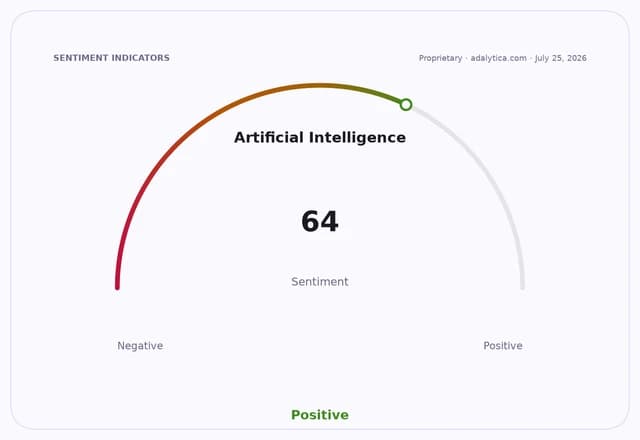
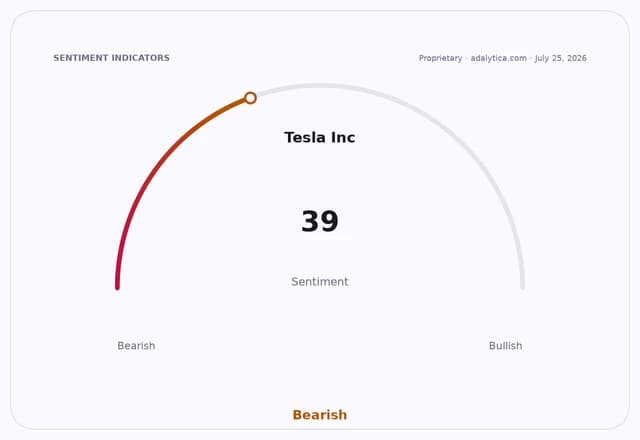
That helps explain why bulls remain willing to look through the volatility. Tesla shares have already moved violently, and the technical picture shows an overextended stock still trading far above its 50-day and 200-day moving averages in recent readings, with RSI levels at times flashing extreme momentum. That kind of setup tells you sentiment is driven by a story stock dynamic, not steady-state fundamentals. In this case, the story is autonomy: if Tesla can keep winning regulatory acceptance in the U.S. and, eventually, elsewhere, the market may assign it a software multiple that traditional auto investors still underestimate.
Tesla Inc — 30-day sentimentadalytica.com
Explore this data interactively — full history, time series and cross-market comparisons.Open AlphaPulse
The risk, of course, is that the path is uneven. France’s resistance to broader European approval of FSD is a reminder that Tesla’s global rollout will not be linear, and skepticism around safety remains real. But that tension is precisely why the opportunity may still be asymmetric. Investors are not paying for certainty. They are paying for the chance that Tesla’s autonomy platform becomes durable enough to change the company’s earnings power entirely.
For investors, the actionable takeaway is straightforward: Tesla is still best understood as a call option on autonomy and robotics, not merely a maker of electric cars. Bulls are betting that every regulatory win, every software improvement and every incremental approval compounds toward a much larger addressable market. If that thesis continues to gain traction, Tesla’s next big move may be driven less by vehicle deliveries than by the market finally agreeing to value it like an AI and autonomy infrastructure platform.
| Entity | Gains | Losses |
|---|---|---|
| Tesla bulls | ▲Higher software multiple | ▼Near-term valuation discipline |
| Tesla | ▲Autonomy monetization | ▼Auto-only valuation |
| Legacy automakers | ▲Slower benchmark pressure | ▼Competitive moat erosion |
| Short sellers | ▲Volatility trading opportunities | ▼Re-rating risk |