Elon Musk says Tesla is working on a Model Y variant with no steering wheel or pedals, the clearest sign yet that the company wants to bring its driverless ambitions out of the prototype phase and into a mass-market vehicle.
Tesla Model Y Without Steering Wheel or Pedals
Artificial Intelligence
That matters because a car sold without manual controls would depend on regulators accepting Tesla’s self-driving software as safe enough for ordinary roads, a hurdle that has already slowed the company’s autonomy timeline. If approved, it could open a new revenue stream from robotaxi-style vehicles and strengthen Tesla’s case that its future is less about selling cars and more about monetizing autonomous miles.
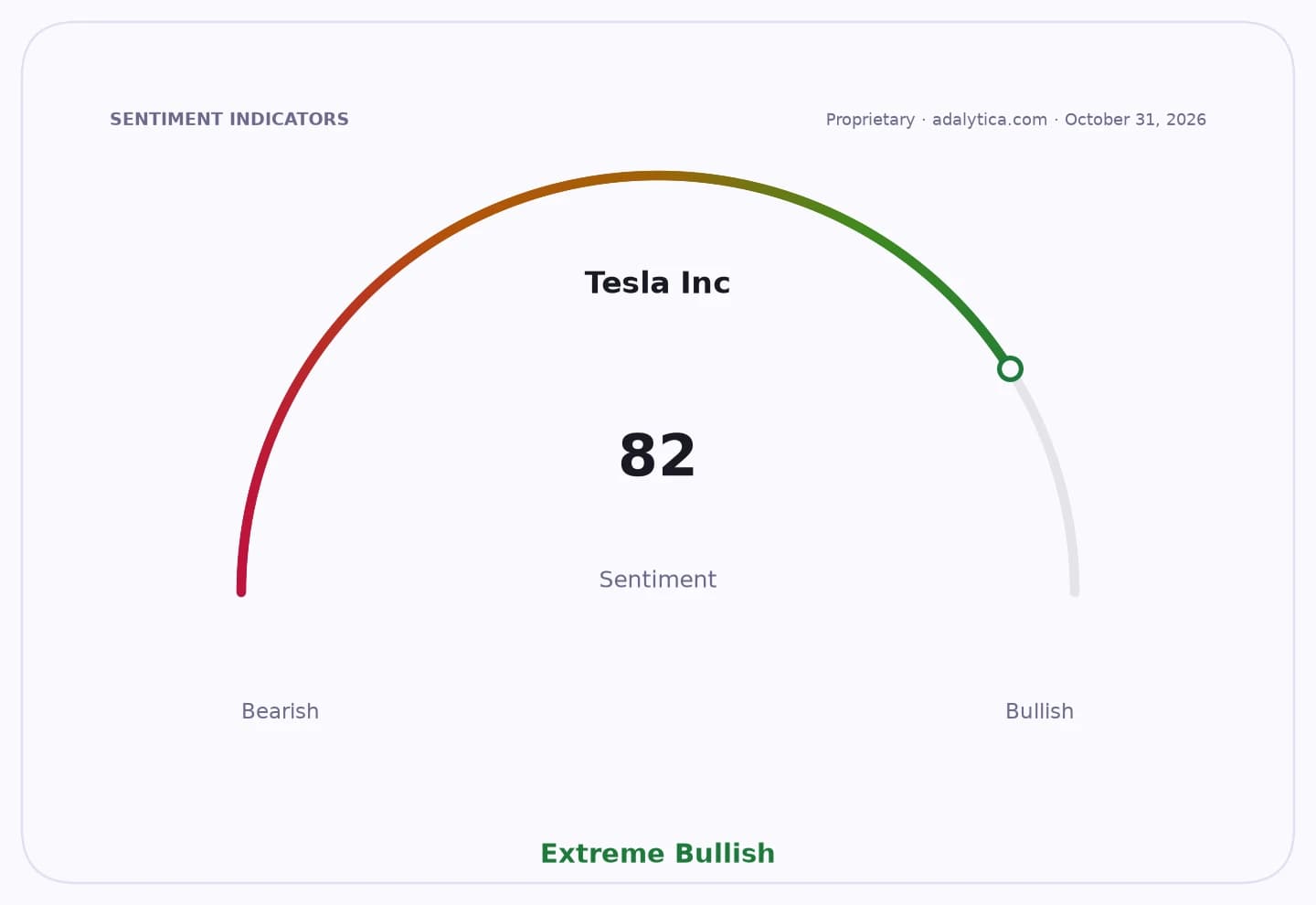
Sentiment Indicators
The comment also lands at a sensitive moment for Tesla investors. The stock has been volatile, and recent technical readings show it trading below its 50-day and 200-day moving averages, with momentum indicators still mixed despite a rebound in late November. Tesla shares closed at $374.41 on Nov. 19, well below the $489.88 peak seen in mid-December, underscoring how much of the autonomy story is already embedded in the valuation.
Musk’s remarks reinforce the company’s long-running pitch that Cybercab, Robotaxi and now a stripped-down Model Y are part of the same effort to shift Tesla from an automaker into an autonomous transport platform. Tesla’s latest filing said it launched Cybercab and the Tesla Semi this year while expanding battery and material production, but also warned that new technologies and concurrent projects bring execution risk.
The stakes extend beyond Tesla. Uber, whose shares have recently softened, has warned in filings that autonomous vehicle technologies could meaningfully reshape its business if rivals scale first. A production vehicle without steering wheel or pedals would also intensify competition with Waymo, Zoox and other self-driving developers by showing Tesla is aiming to commercialize autonomy at consumer scale, not just through a limited ride-hailing fleet.
For investors, the key question is whether the idea becomes a regulator-approved product or remains another ambitious Tesla concept. Near-term catalysts include further details on launch timing, federal and state safety approvals and whether Tesla can prove the software is reliable enough to remove the last human fallback.
| Entity | Gains | Losses |
|---|---|---|
| Tesla | ▲Autonomy narrative, new product optionality | ▼Execution risk, regulatory scrutiny |
| Uber | ▲None directly | ▼Competitive pressure from robotaxis |
| Waymo/Zoox | ▲Industry attention on autonomy | ▼Tesla may scale consumer AV faster |
| Long Tesla holders | ▲Upside from robotaxi repricing | ▼More volatility if timing slips |