Domestic gold prices in Thailand fell sharply at the open, with the country’s benchmark retail price for 96.5% gold dropping 500 baht per baht weight after a reversal in global bullion sentiment and a firmer U.S. dollar.
Thailand gold prices fall on firmer dollar

The Gold Traders Association said at 9:02 a.m. the buying price for gold bars was 65,700 baht per baht weight and the selling price was 65,900 baht, while jewellery gold was quoted at 64,384.52 baht to buy and 66,700 baht to sell. The move marks a steep pullback for Thai buyers after a recent run-up, underscoring how quickly local prices can reset when international gold weakens.
The decline matters because Thailand’s domestic gold market is tightly linked to overseas bullion and exchange-rate moves, so a drop of this size feeds through immediately to household demand, retail jewelers and traders who use gold as both a savings vehicle and a speculative asset. For consumers, lower prices can encourage buying on dips; for short-term holders, the slide cuts into mark-to-market gains and can trigger profit-taking.
The timing also reflects broader pressure across precious metals. The latest market data show GLD, the largest U.S.-listed gold ETF, closing at $380.14 on Oct. 2 after falling from $382.76 a day earlier and $398.55 on Aug. 18. GDX, the major gold miners ETF, ended at $87.78, still below its 50-day moving average and near its 200-day average, a sign that equities tied to bullion are losing momentum even after a strong year. RSI readings on both funds point to weakening near-term conditions rather than an overbought market.
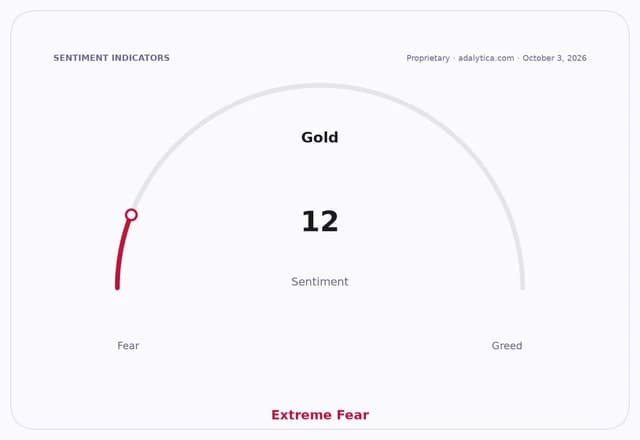
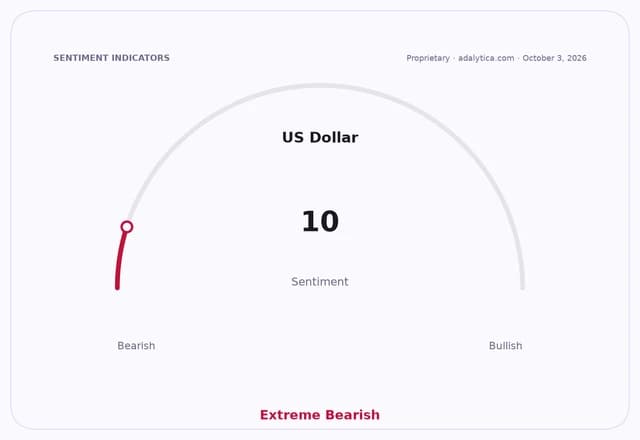
Adalytica’s Gold Fear & Greed Index was at 12, or “Extreme Fear,” on Oct. 2, while its U.S. dollar trade signals also showed “Extreme Fear” at 10, indicating nervous positioning rather than conviction buying. The combination suggests investors are not yet treating the decline as a structural break in the gold cycle, but they are unwinding some of the crowded bullish positioning that built up during the latest rally.
The macro backdrop is doing much of the work. U.S. 10-year Treasury yields were around 5.29%, keeping the opportunity cost of holding gold elevated, while oil prices remained firm, adding to the inflation and policy uncertainty that can move real yields and currency markets. A stronger dollar typically weighs on dollar-denominated bullion by making the metal more expensive for non-U.S. buyers, and that effect is feeding directly into local pricing in Bangkok.
For Thai investors, the key question is whether this is a brief correction after an outsized advance or the start of a deeper consolidation. Bullish buyers will argue that gold still has support as a hedge against policy uncertainty, geopolitical risk and volatile bond markets. Bears will point to technical weakness in bullion ETFs and the pressure from a resilient dollar and high yields as reasons the rally may need to cool further.
For now, the immediate takeaway is straightforward: Thailand’s gold market is repricing lower in step with the global market, and traders, retailers and savers will be watching whether the pullback extends or quickly draws dip buyers back into the market.
| Entity | Gains | Losses |
|---|---|---|
| Thai gold buyers | ▲Lower entry prices | ▼Less immediate paper gain |
| Thai gold sellers | ▲Inventory restocking chance | ▼Lower resale prices |
| Gold ETF holders (GLD, GDX) | ▲Potential dip-buying later | ▼Near-term mark-to-market losses |
| U.S. dollar / high-yield assets | ▲Relative appeal rises | ▼Gold demand faces pressure |