The U.S. Treasury has levied its first penalty under the outbound investment restrictions, fining Amidi LLC $200,000 for failing to disclose a stake in a Chinese robotics AI startup — a sign Washington is beginning to enforce a policy meant to keep American capital away from sensitive technologies tied to national security.
U.S. Treasury fines Amidi $200,000 over China stake
The case matters because it shows the program is no longer just a rule on paper. Treasury said the undisclosed investment was $92,478 in Shanghai Qiongche Intelligent Technology, or Noematrix, a Shanghai developer of AI systems that help robots interact with the physical world and perform tasks, the kind of technology the U.S. has singled out alongside advanced semiconductors and quantum computing.
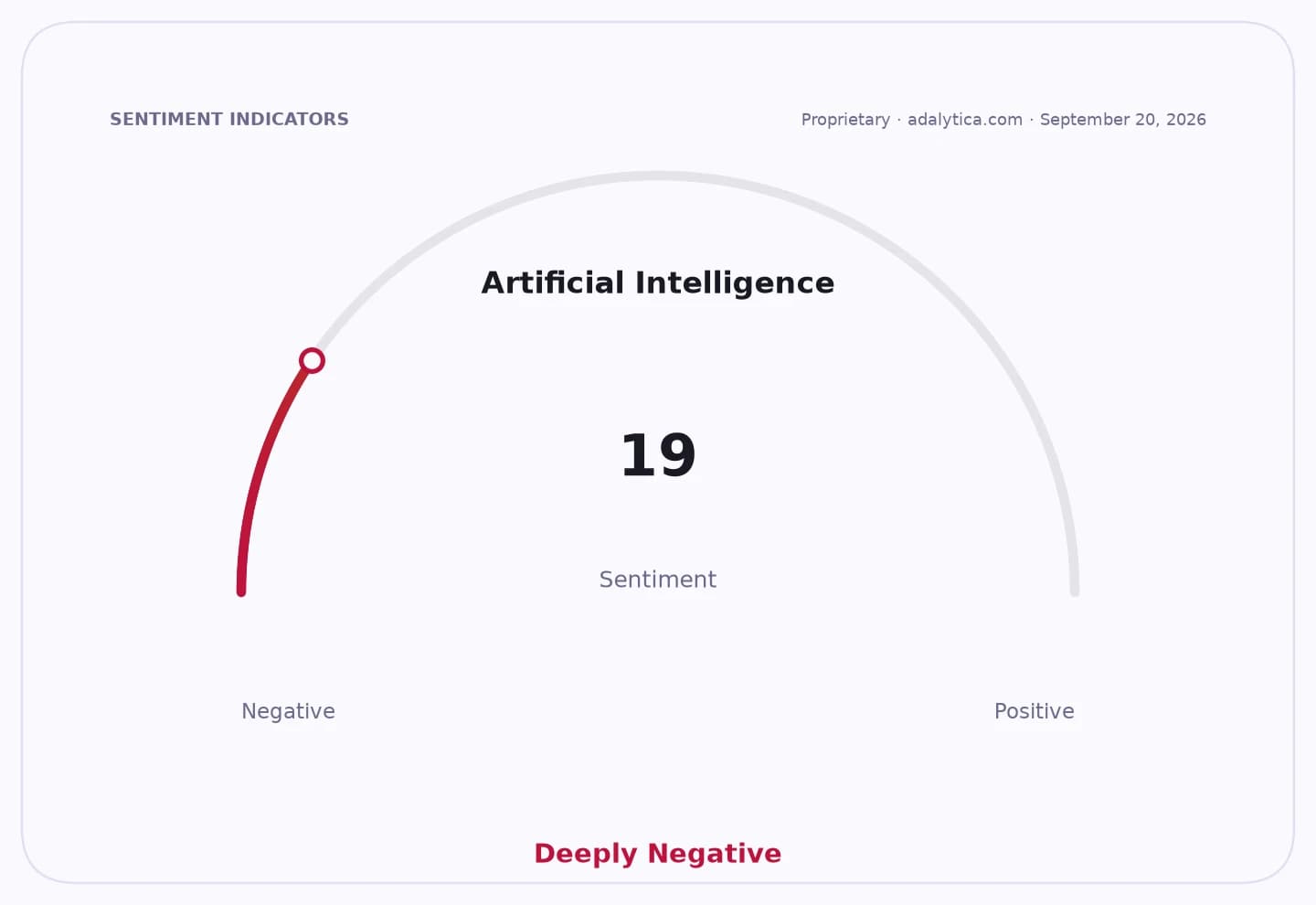
Sentiment IndicatorsⓘProprietary · adalytica.com · October 17, 2026
This is a snapshot — live sentiment, awareness and momentum for 130+ markets update continuously in the dashboard.Open AlphaPulse
Treasury did not say the investment itself was prohibited, only that Amidi failed to report it as required under the Outbound Investment Security Program, which took effect Jan. 2, 2025. That distinction is important for investors: the government is signaling that compliance failures can carry real costs even when the underlying transaction is still allowed.
Amidi is the parent of Plug and Play Tech Center, a California-based accelerator and venture investor with a China network that has repeatedly participated in Noematrix funding rounds. Noematrix named Plug and Play China in financings in September and December 2024 and again in April 2025, just nine days before the Treasury-identified transaction, though it is unclear whether the two were linked or whether the fund was the vehicle used by Plug and Play China.
The enforcement action raises the stakes for U.S. venture firms, accelerators and corporate investors with exposure to China-linked funds. The outbound rules also apply to certain investments made through foreign subsidiaries controlled by American companies, widening the compliance burden for groups that have long used overseas structures to stay active in Chinese tech.
The broader market implication is that capital flows into Chinese AI, semiconductors and quantum firms face a more intrusive regulatory regime just as Beijing-backed and university-linked investors continue to bankroll firms such as Noematrix. The company later said it had drawn funding from Shanghai Jiao Tong University’s AI Future Fund, Shanghai Chuangzhi Technology and Wuxi Data Group, underscoring how sensitive robotics AI has become in China’s industrial policy push.
For investors, the message is that outbound screening is becoming an operating risk, not a theoretical one. U.S. firms with China exposure will need tighter reporting controls, and any future deal involving robotics AI, advanced chips or quantum technology may face more scrutiny, more paperwork and potentially more penalties if disclosures are missed.
| Entity | Gains | Losses |
|---|---|---|
| U.S. Treasury | ▲Enforcement credibility | ▼Forbearance on compliance |
| American venture firms | ▲Clearer rule enforcement | ▼Higher reporting risk |
| Chinese AI startups | ▲Continued access to some capital | ▼Greater scrutiny and friction |
| Plug and Play/Amidi | ▲— | ▼$200,000 fine, reputational damage |