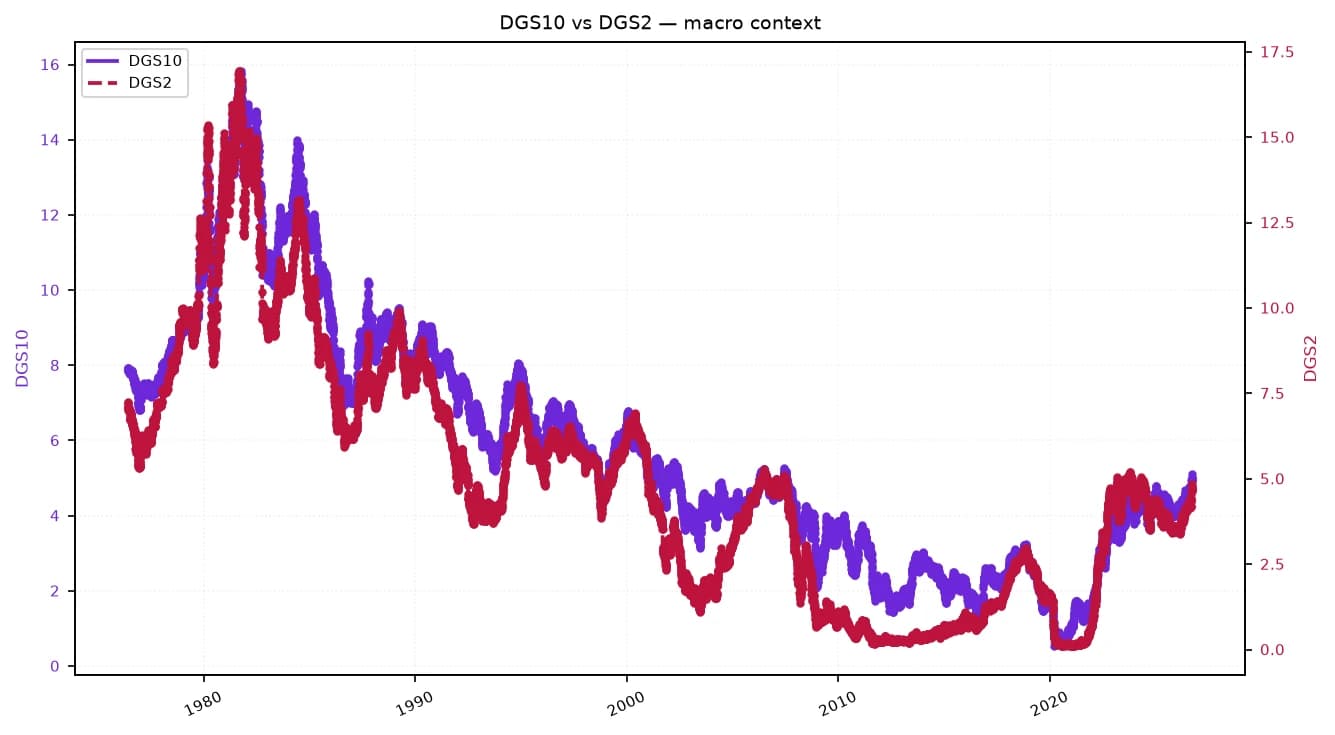
The bond market is sending a fresh warning that Washington’s efforts to steady Treasuries may not be enough, with the 10-year yield holding near 4.68% and long-duration bond prices sliding even as policymakers step up support.
Treasury yields near 4.68% pressure bonds

That matters because the pressure is not confined to one corner of fixed income. It is raising the cost of capital across the economy, reviving the old playbook where higher Treasury yields tighten financial conditions, squeeze equity valuations and make the dollar, credit and rate-sensitive sectors more volatile. When the benchmark 10-year stays pinned above 4.6%, the market is effectively saying inflation risk, fiscal supply and geopolitical uncertainty are still demanding a premium.
Sentiment IndicatorsⓘProprietary · adalytica.com · August 23, 2026
This is a snapshot — live sentiment, awareness and momentum for 130+ markets update continuously in the dashboard.Open AlphaPulse
The move has already started to ripple through assets. The iShares 20+ Year Treasury Bond ETF, TLT, fell to 82.05 on Aug. 21 from 83.02 two days earlier, extending a downtrend that has pushed the fund below its 200-day moving average of 85.10. The shorter-duration IEF is also drifting lower, closing at 92.82 and sitting just under its 50-day average, a sign that even intermediate Treasuries are struggling to attract durable demand. Adalytica’s U.S. Treasury Bonds Trade Signals show TLT sentiment at “Extreme Fear” while awareness is at “Extreme Greed,” a combination that suggests the trade is crowded, watched and increasingly fragile.
The stress is showing up in credit too. The ICE BofA U.S. High Yield index measures credit spreads at 2.75 percentage points, still contained but elevated enough to remind investors that the market is not pricing a benign backdrop. High yield remains below the spikes seen earlier this year, but the recent drift wider alongside Treasury weakness is exactly the kind of second-order move that can turn a rate shock into a broader risk-off episode.
DGS10 vs T10Y2Y — macro contextadalytica.com
Explore this data interactively — full history, time series and cross-market comparisons.Open AlphaPulse
The macro setup is what investors cannot ignore. A 10-year yield near 4.7% and a 2s/10s spread around 50 basis points mean the bond market is not buying the idea that policy easing or buyback activity will quickly reset longer-dated rates. Instead, the market is forcing investors to confront a more stubborn mix of fiscal supply, sticky inflation expectations and geopolitical risk. That is bad news for duration-heavy portfolios and a direct tailwind for cash-rich balance sheets, floating-rate lenders and shorter-duration credit.
For equity investors, the implication is clear: this is no time to chase the most rate-sensitive parts of the market. Utilities, real estate and unprofitable growth names remain vulnerable if the long end refuses to rally. By contrast, banks, insurers and selected energy and defense names can absorb higher discount rates and often benefit when capital becomes more expensive and geopolitics keeps pressure on yields and volatility.
Our thesis is that the market is still underestimating how persistent this bond-market repricing could be. If Washington cannot stabilize Treasuries with buybacks, then the next leg is likely to be driven by supply and credibility, not just sentiment. That argues for positioning away from long-duration risk and toward businesses that can thrive in a higher-for-longer world.
The best opportunity is to own the toll roads of this regime: short-duration fixed income, floating-rate cash flows and sectors that benefit from a steeper risk premium. Until Treasury yields retreat decisively, the bond market remains the signal, not the noise.
| Entity | Gains | Losses |
|---|---|---|
| Short-duration bonds | ▲Less price risk | ▼Less upside if yields fall |
| Banks and insurers | ▲Higher reinvestment yields | ▼Funding costs can rise |
| Long-duration Treasuries | ▲Defensive demand in panic | ▼Price pressure from higher yields |
| Rate-sensitive equities | ▲Cheaper financing if yields ease | ▼Valuation compression if yields stay high |