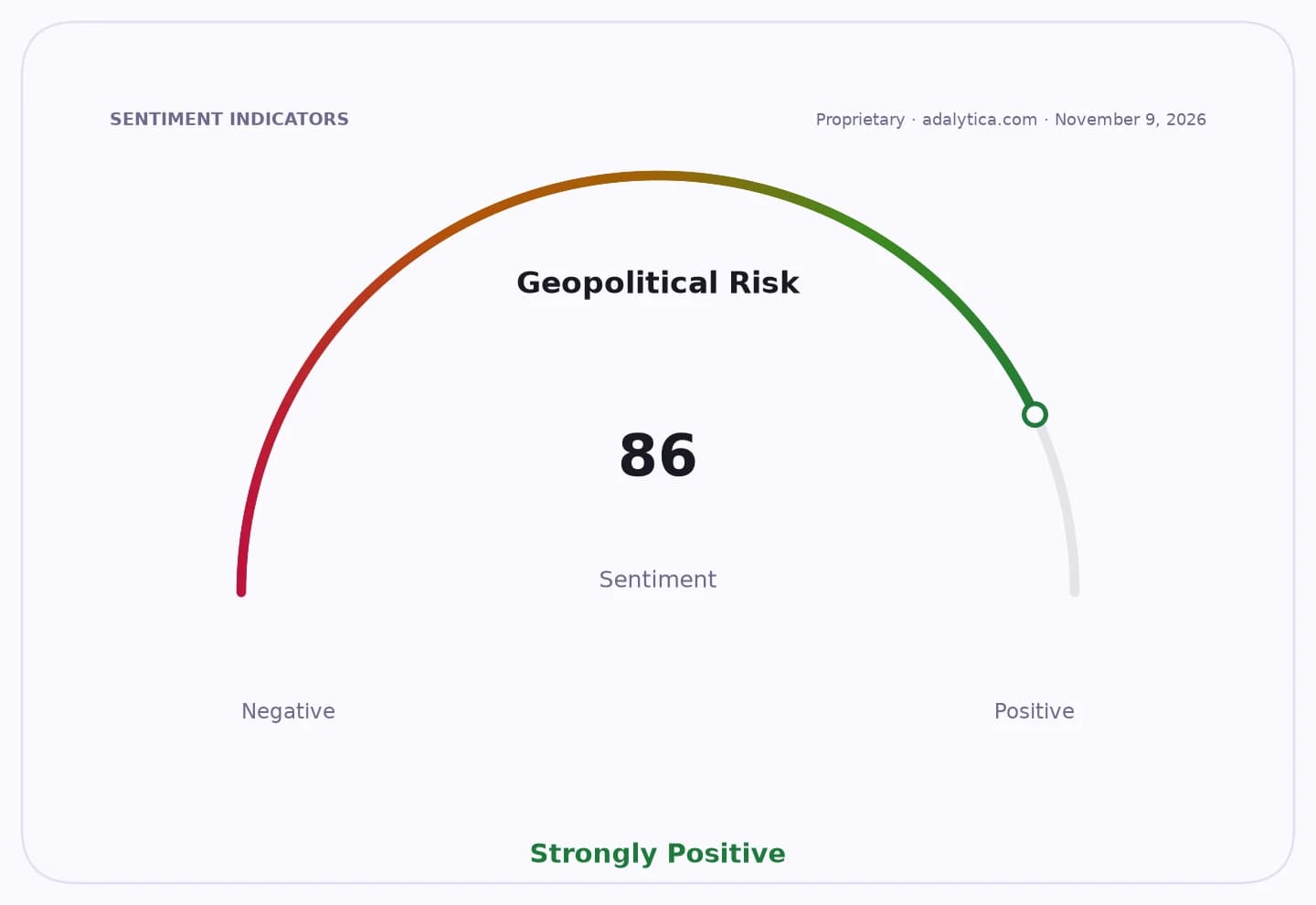
A world still defined by war, sticky inflation and heavier government debt is forcing markets into a new regime where capital is no longer cheap and investors have to discriminate hard between real growth and mere narrative.
Treasury yields rise as markets favor quality stocks

That is the core message from Banco Carregosa’s chief investment officer, Mário Carvalho Fernandes, and it is the right one for this market. The old playbook of buying duration, leaning on central-bank liquidity and assuming states can always backstop growth is giving way to a more demanding environment in which financing costs, fiscal discipline and earnings quality matter again.
Sentiment Indicators
The macro backdrop is more resilient than it looks, but also more fragile in the places that matter most to portfolios. Global growth has held up despite the Middle East conflict, higher energy prices and the interruption to the disinflation trend. Yet that resilience has been partly underwritten by public spending, defense outlays, energy transition investment and technology capex — support that has also swollen deficits and debt loads.
That matters because the fiscal cushion is getting thinner just as the cost of money is normalizing. The 10-year U.S. Treasury yield is around 4.85%, a level that restores positive real returns and competes directly with risk assets for capital. At the same time, U.S. inflation is still running above the pre-pandemic playbook, with the consumer price index at 336.3 in September, leaving policymakers less room to cut aggressively without risking credibility.
For investors, that combination changes everything. Cheap leverage no longer justifies weak balance sheets. In credit, the market is already demanding more compensation for risk, with the ICE BofA high-yield spread at 3.48 percentage points, while Treasuries are drawing strong demand as a relative safe haven. The moves in both TLT and gold show the new tension clearly: long-duration bonds are attracting heavy interest again, while gold remains supported by geopolitical anxiety even after a pullback.
The bigger investment implication is that markets will increasingly separate beneficiaries from pretenders. Artificial intelligence remains a genuine secular tailwind, but the next phase is not about simply owning anything with “AI” attached. It is about the companies that can convert infrastructure spending, software deployment and productivity gains into cash flow. In a world of positive real rates, the market will punish stories that cannot prove the math.
That is why the winners are likely to be the businesses with durable pricing power, strong balance sheets and direct exposure to the capex cycle in compute, cloud, defense, energy infrastructure and electrification. The losers are the highly leveraged, the policy-dependent and the firms whose valuations rest on the assumption that capital will stay abundant forever.
The market is not entering a recessionary phase so much as a sorting phase. That creates volatility, but it also creates opportunity. In our view, investors should lean into quality, duration discipline and secular capex beneficiaries, while avoiding the most debt-sensitive parts of the market. The next phase of uncertainty is not a reason to sit out — it is a reason to be selective before the crowd catches up.
| Entity | Gains | Losses |
|---|---|---|
| Quality equities | ▲Higher valuation discipline | ▼Weak balance-sheet firms |
| Treasury bonds | ▲Positive real yields | ▼Rate-sensitive growth stocks |
| AI infrastructure leaders | ▲Capex-driven demand | ▼Pure narrative AI names |
| Heavily indebted sovereigns | ▲— | ▼Fiscal flexibility |