Trump Media & Technology Group’s stock is back under heavy pressure, with DJT closing at $6.40 on Oct. 23, near its 52-week low and far below its 50-day moving average, as investors reassess a name long driven more by political momentum than fundamentals.
Trump Media (DJT) Falls Near 52-Week Low

The move matters because DJT remains one of the market’s purest sentiment trades: when the political narrative cools, the equity has little earnings support to cushion it. The shares are now roughly 37% below the 50-day moving average of $8.52 and nearly 33% below the 200-day average of $9.51, technical damage that points to persistent distribution rather than a routine pullback.
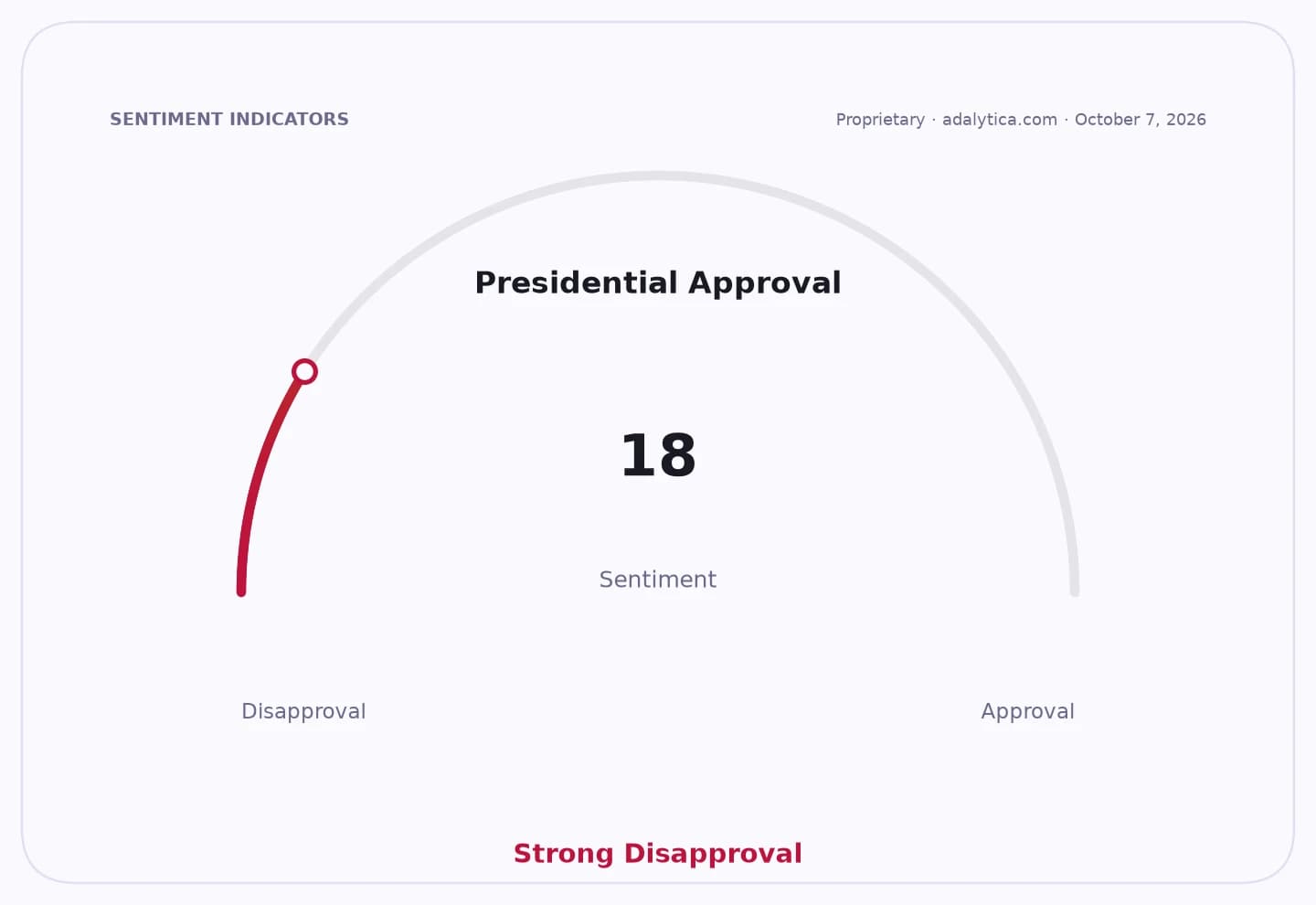
Sentiment IndicatorsⓘProprietary · adalytica.com · October 24, 2026
This is a snapshot — live sentiment, awareness and momentum for 130+ markets update continuously in the dashboard.Open AlphaPulse
Momentum indicators underscore the weakness. The stock’s RSI of 13.9 indicates deeply oversold conditions, but also reflects how abruptly buyers have disappeared. MACD remains negative, and the shares are trading close to the lower Bollinger Band, a sign the market is pricing in continued volatility rather than a quick mean reversion. Volume, at 3.68 million shares on Oct. 23, remains active but not enough to suggest capitulation has cleared the way for a durable rebound.
The slide also lands against a difficult political backdrop. Adalytica’s US White House Policy Direction Sentiment gauge is at 14, labeled “Extreme Fear,” while its global stability measure has weakened to 36. At the same time, presidential approval sentiment sits at 93, an “Extreme Greed” reading that suggests the market is sharply reweighting expectations around Trump’s standing even as broader policy and geopolitical confidence erode. For a stock tied so closely to the Trump brand, those swings matter more than they would for a conventional media company.
For investors, the key question is whether DJT is becoming a valuation trap or an oversold trade. Bulls may argue the stock is stretched far enough to attract short-covering if political headlines turn favorable. Bears will point to the gap between the company’s market value and its underlying business, which remains dependent on speculative positioning, event-driven trading and financing optionality rather than steady cash generation. The latest SEC filings, including a June-quarter results release and a September convertible note agreement, reinforce the impression of a company still leaning on capital-market maneuvers to fund growth.
If the stock loses the current support zone around $6.20 to $6.50, the next test could be psychological as much as technical, because there is little in the way of fundamental support below. Any rebound, meanwhile, will likely depend less on operating progress than on a renewed political bid for the Trump trade.
| Entity | Gains | Losses |
|---|---|---|
| Short sellers | ▲Momentum and weak technicals | ▼Sharp squeeze if headlines improve |
| Longs in DJT | ▲Possible oversold bounce | ▼Persistent drawdown and volatility |
| Trump-linked investors | ▲Political optionality | ▼Eroding market confidence |
| Broader market risk assets | ▲None | ▼Higher idiosyncratic risk from sentiment swings |