Donald Trump’s push to manage a war in the Middle East while fighting for political survival at home is creating a rare double risk for investors: policy instability and election uncertainty.
Trump Iran Policy Raises Oil and Market Risk
That matters because markets hate one thing more than almost anything else — a president making high-stakes foreign policy decisions with the clock ticking on domestic politics. When the White House appears to be weighing war, oil prices, alliances and election arithmetic at the same time, investors are left trying to price not just outcomes, but improvisation.
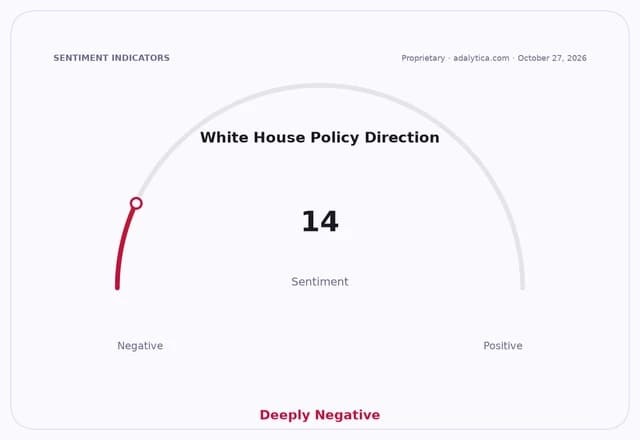
Sentiment IndicatorsⓘProprietary · adalytica.com · October 27, 2026
This is a snapshot — live sentiment, awareness and momentum for 130+ markets update continuously in the dashboard.Open AlphaPulse
The article’s core message is not simply that Trump is confronting Iran. It is that he is doing so in a way that raises questions about how durable any decision will be. The text describes a pattern of escalation, pause, threats and negotiation, with oil and gas prices never far from the calculation. For investors, that kind of policy lurching matters because it can ripple through energy markets, defense spending, inflation expectations and risk appetite in one sweep.
The economic stakes are especially clear in the energy channel. Any conflict that threatens the Strait of Hormuz, even rhetorically, can quickly unsettle global oil supply assumptions. That can lift fuel costs, pressure transport and industrial margins, and complicate the Federal Reserve’s job if inflation gets sticky again. The piece also points to Trump’s willingness to rethink sanctions and relationships if it helps domestic politics, including references to Europe and Russia. For long-term investors, that is a reminder that geopolitics can reshape commodity flows and capital allocation far beyond the immediate headlines.
There is also a broader strategic cost. The source argues that Trump has weakened the traditional U.S. model of alliances and partnerships, even as America faces coordinated pressure from China, Russia, Iran and North Korea. Whether or not every claim in the piece proves accurate, the market-relevant point is straightforward: if allies lose confidence in Washington’s consistency, global companies and investors face more uncertainty around trade, defense, energy security and currency stability. That uncertainty usually carries a valuation discount.
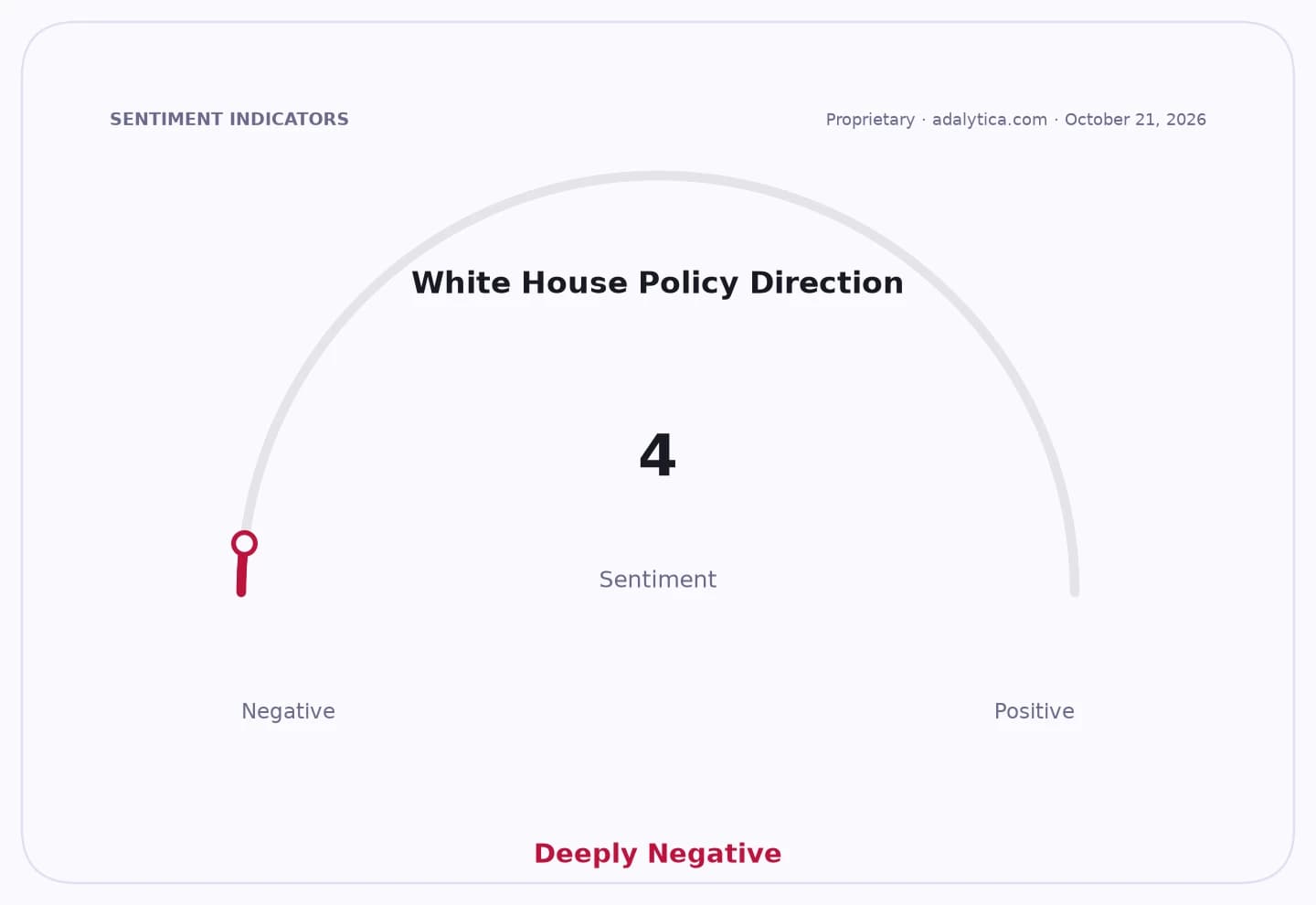
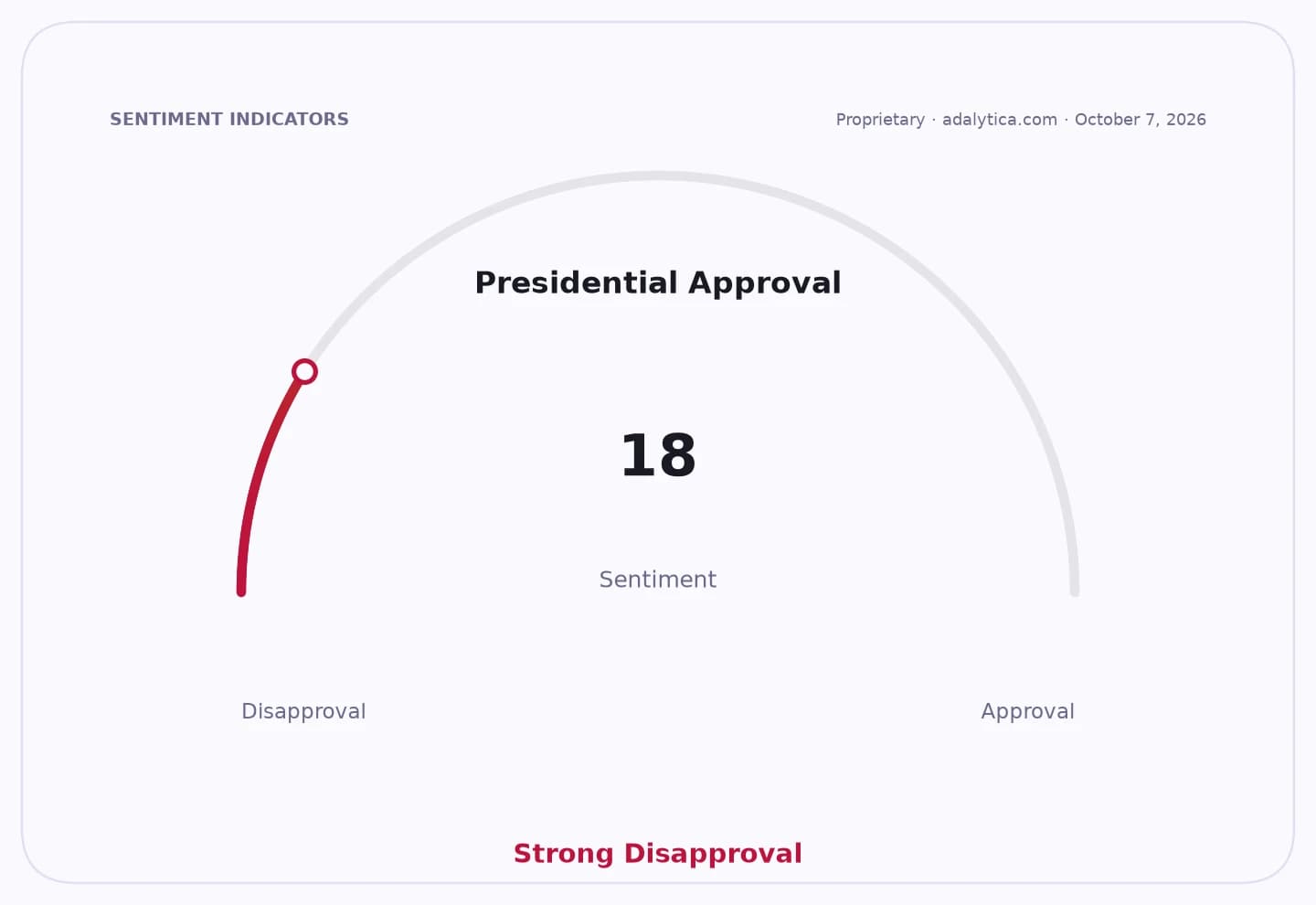
The sentiment data reinforces that tension. Adalytica’s U.S. White House Policy Direction Sentiment sits at an “Extreme Fear” reading of 14, while the U.S. presidential approval sentiment is at 100, or “Extreme Greed,” suggesting a highly polarized political environment with very little room for nuance. Global Stability Sentiment is still positive at 71, but the awareness metric remains low, a sign that investors may not fully appreciate how quickly geopolitical risk can reprice markets.
For investors, the takeaway is not to trade every headline. It is to recognize the kinds of sectors that tend to benefit when geopolitical risk rises and policy becomes less predictable: defense, cybersecurity, energy infrastructure and some commodity producers. At the same time, airlines, transport, consumer discretionary and highly leveraged companies can feel the pressure first if fuel costs jump or confidence sours.
In the end, this is a story about the price of uncertainty. If Trump’s electoral pressure intensifies, the temptation to use foreign policy as a domestic lever rises with it. That is exactly the kind of environment where patience, diversification and a long-term horizon matter most. Keep the strongest businesses on your watchlist, stay diversified, and don’t underestimate how quickly politics can move markets.
| Entity | Gains | Losses |
|---|---|---|
| Defense contractors | ▲Higher demand | ▼Policy whiplash risk |
| Energy producers | ▲Potential price spikes | ▼Supply disruption fear |
| Consumers and transport firms | ▲Lower fuel costs if tensions ease | ▼Higher input costs |
| Long-term investors | ▲Buying opportunities | ▼Short-term volatility |