TSMC’s slide this week looks more like profit-taking in the strongest name in AI manufacturing than a fundamental reset in demand, even as the broader chip trade stays volatile.
TSMC Pullback Looks Like Rotation, Not Demand Break
The stock has fallen to 398.37 from 477.57 on June 30, a drop of about 17% in barely three weeks, while Nvidia has declined far less sharply and Advanced Micro Devices has also eased off recent highs. That divergence matters because TSMC sits at the center of the AI supply chain: it makes the advanced chips that power the sector’s biggest winners, and its business tends to reflect actual foundry demand rather than the more exuberant narratives that can drive chip designers’ valuations.
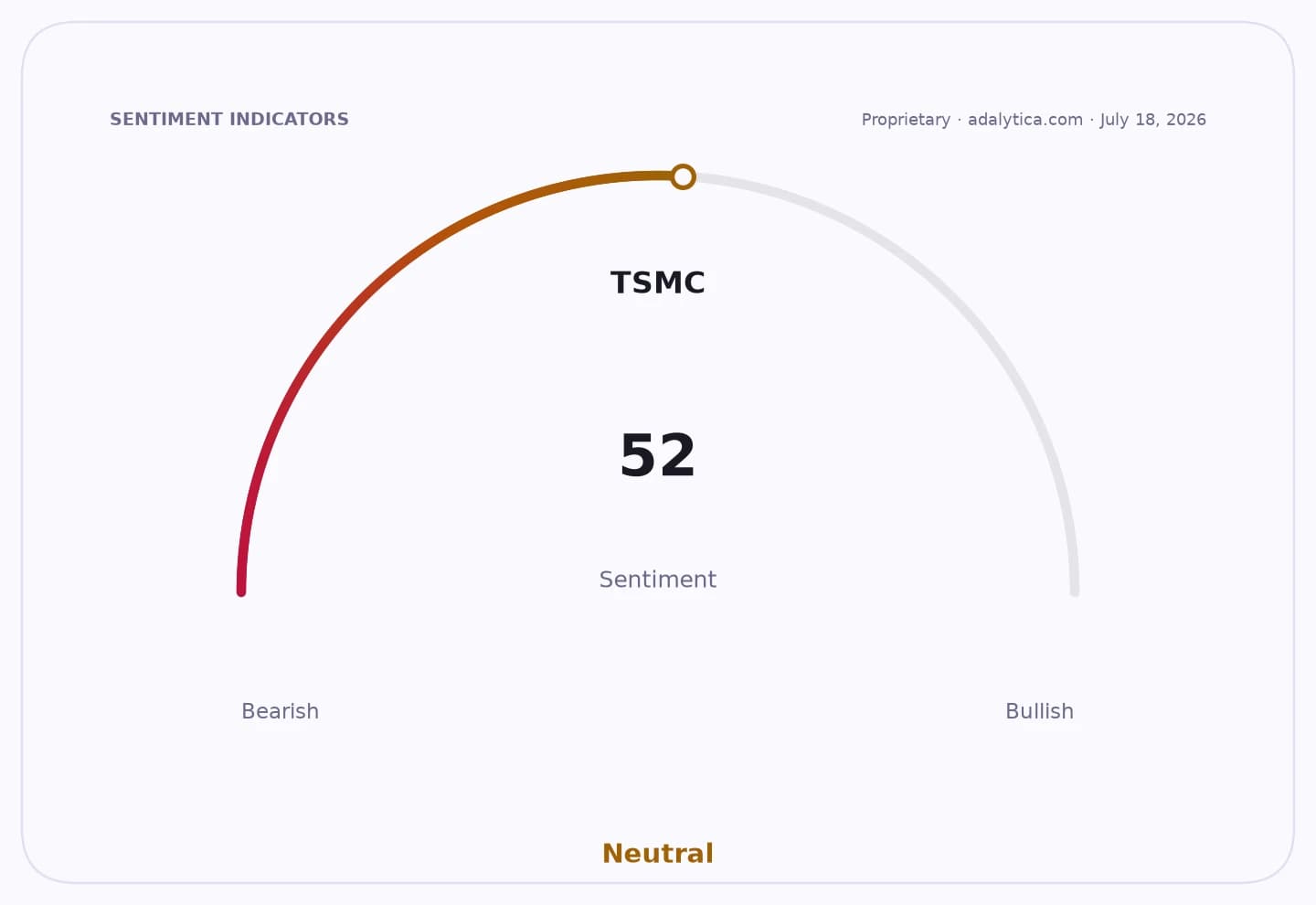
Sentiment IndicatorsⓘProprietary · adalytica.com · July 18, 2026
This is a snapshot — live sentiment, awareness and momentum for 130+ markets update continuously in the dashboard.Open AlphaPulse
The market action suggests investors are mixing up near-term positioning with the underlying earnings power of the semiconductor cycle. TSMC’s retreat has come alongside a sharp deterioration in standard technical indicators: the stock is now below its 50-day moving average, with RSI in the high-30s, while momentum has turned negative. But that looks more like a momentum unwind than a thesis-breaker. TSMC is still trading well above its 200-day moving average, which typically points to a longer-term uptrend remaining intact, even if the near-term chart has weakened.
That distinction is important for investors because TSMC is the clearest monetization point in the AI buildout. Unlike Nvidia, which carries a premium for future growth and market leadership, TSMC earns money by manufacturing the underlying hardware and therefore benefits from rising wafer demand across multiple AI chipmakers. If hyperscalers such as Meta keep increasing capital spending and internal chip development, as recent reports suggest, TSMC remains one of the few companies positioned to capture that demand regardless of which architecture wins.
TSMC — 30-day sentimentadalytica.com
Explore this data interactively — full history, time series and cross-market comparisons.Open AlphaPulse
The comparison with Nvidia is also instructive. Nvidia has held up better recently, rising to 202.81 from 170.07 in September before easing in the latest sessions, while sentiment around the stock remains far more euphoric than around TSMC. That can leave the market overpaying for the most visible AI beneficiary while underestimating the steadier, less narrative-driven cash generator. In that sense, TSMC’s weakness may reflect a rotation away from suppliers tied to the physical buildout of AI infrastructure, even though those suppliers are often the ones with the most direct exposure to volume growth.
The bearish case is that TSMC’s run had become stretched and the stock needed to cool after a powerful advance. The shares had pushed into overbought territory earlier in the year, and the recent breakdown in momentum could signal that investors are reassessing how much AI demand is already priced in. If chip orders normalize or if customer concentration becomes a concern, the valuation multiple could compress further.
But the bull case remains stronger on fundamentals. AI demand is still driving capex across the industry, foundry capacity remains strategically scarce, and TSMC’s role as the manufacturing bottleneck gives it pricing power that most semiconductor names lack. For investors, the key question is not whether AI spending slows at the margin, but whether TSMC’s business model is better insulated from hype cycles than the chip stocks that tend to move first and most violently.
If that holds, the recent selloff may be less a warning on AI demand than an opportunity to distinguish between the market’s favorite AI story and the company most directly paid to make it real.
| Entity | Gains | Losses |
|---|---|---|
| Long-term TSMC holders | ▲Better entry point | ▼Near-term volatility |
| Nvidia momentum traders | ▲Relative strength | ▼Chasing valuation |
| AMD shareholders | ▲Peer rotation support | ▼Sector de-risking |
| AI infrastructure buyers | ▲More supply focus | ▼Higher scrutiny on spending |