Sony and Taiwan Semiconductor Manufacturing Co. are preparing to begin mass production of next-generation chips at their joint Japanese plant, a move that deepens Asia’s semiconductor buildout just as AI-related demand keeps pressure on advanced manufacturing capacity.
TSMC, Sony Japan plant to begin mass chip production
The project matters because it adds more leading-edge supply outside Taiwan at a time when customers across the chip stack are racing to secure wafers for AI accelerators, smartphones and industrial sensors. For Sony, the venture broadens its chip footprint beyond consumer electronics and imaging into higher-value semiconductor manufacturing. For TSMC, it extends its global production network and strengthens ties with a major Japanese customer and strategic partner.
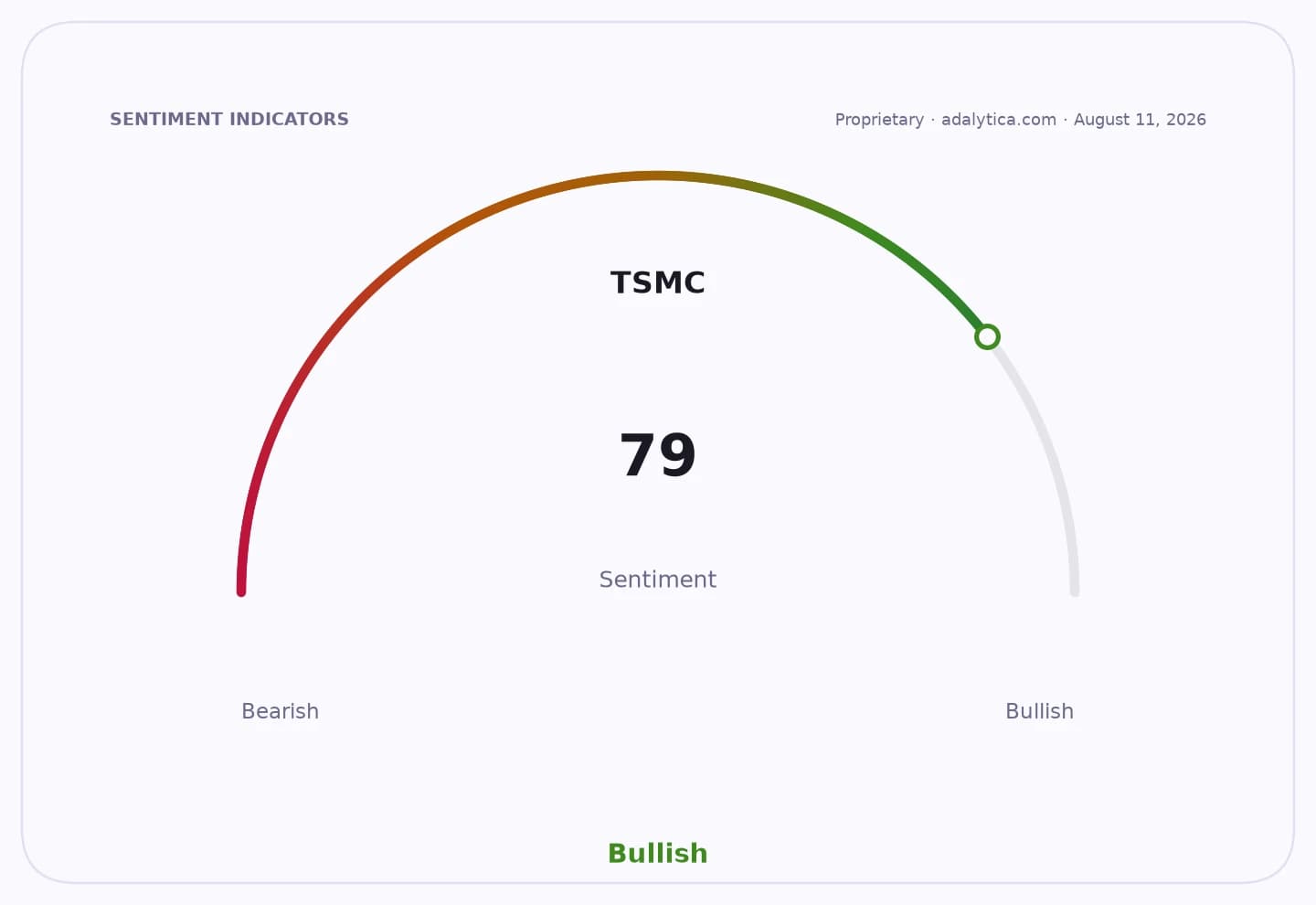
Sentiment IndicatorsⓘProprietary · adalytica.com · August 11, 2026
This is a snapshot — live sentiment, awareness and momentum for 130+ markets update continuously in the dashboard.Open AlphaPulse
TSMC shares have climbed to about $418.47, near their 50-day moving average of $425.57, after a volatile summer that included a sharp pullback and recovery. The stock remains well above its 200-day average of $359.60, while recent technical readings show momentum cooling from overbought levels, with RSI at 47.0 and MACD still below its signal line.
The company’s July revenue rose 44.7% from a year earlier, underscoring how demand for advanced nodes remains strong even as investors monitor whether the growth pace can be sustained through the second half. TSMC’s latest earnings sentiment gauge on Adalytica stands at 79, labeled “Greed,” with awareness at 100, reflecting the market’s focus on the company’s role in the AI supply chain.
Sony shares have also edged higher, recently trading at $23.82, above both their 50-day and 200-day moving averages, with RSI at 72.3. That suggests investors are already starting to price in the strategic value of the semiconductor expansion, even as the company remains better known for entertainment, gaming and consumer hardware.
The broader takeaway is that the semiconductor industry is still in capacity-expansion mode, not just for AI servers but for the sensors and advanced components used in autos and connected devices. The Japan plant gives both companies a way to participate in that cycle while reducing some geographic concentration risk.
Investors will now watch for more detail on the plant’s ramp, capital spending and customer mix, along with any impact on margins and cash flow as the partners move from planning to commercial output.
| Entity | Gains | Losses |
|---|---|---|
| TSMC | ▲More global capacity; closer Japan ties | ▼Higher capex burden |
| Sony | ▲Bigger chip role; sensor manufacturing upside | ▼More execution risk |
| AI and device customers | ▲Added advanced supply | ▼Less bargaining power |
| Existing capacity-constrained rivals | ▲None | ▼More competition for orders |