UK businesses reported a further cooling in their own price pressures in August even as wage growth stayed firm at 4%, reinforcing the case that inflation is easing without an abrupt deterioration in the labour market.
UK firms' price growth cools as wage growth holds at 4%

The Bank of England’s Decision Maker Panel showed realised annual own-price growth slipping to 3.7% in the three months to August from 3.8% in the three months to July, while firms’ 12-month pricing expectations eased to 3.8% from 3.9%. Expectations for consumer price inflation fell more sharply, with year-ahead CPI expectations dropping to 3.1% from 3.4%, and three-year expectations holding at 2.8%.
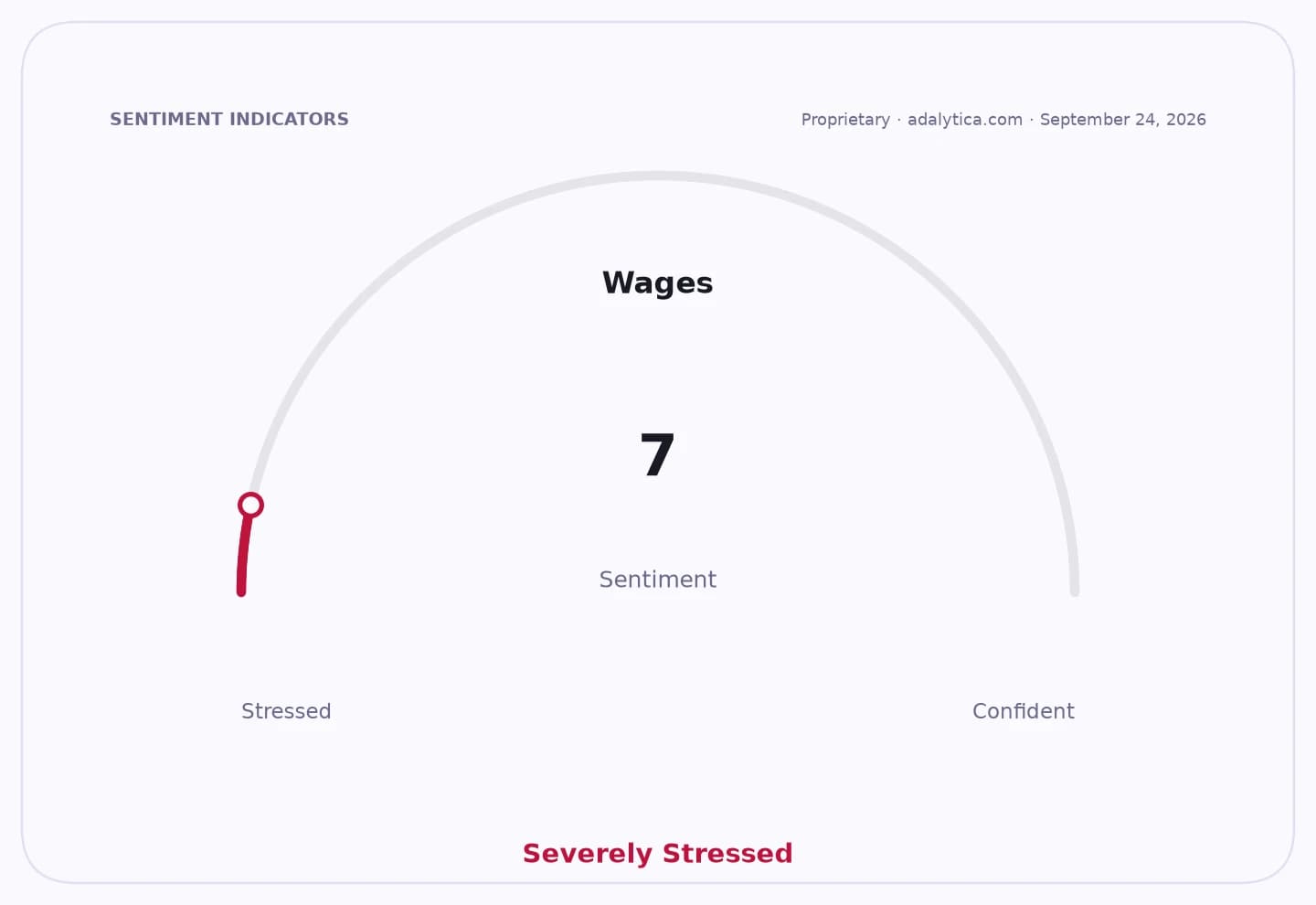
Sentiment IndicatorsⓘProprietary · adalytica.com · September 5, 2026
This is a snapshot — live sentiment, awareness and momentum for 130+ markets update continuously in the dashboard.Open AlphaPulse

For the Bank of England, the combination matters because it points to a more benign inflation backdrop without the kind of wage acceleration that would normally keep policymakers wary of cutting rates too quickly. Annual wage growth held steady at 4.0%, and firms still expect pay growth to slow to 3.4% over the next year. That suggests labour cost pressure remains elevated, but not worsening.
The survey also showed the labour market stabilising at the margin. Realised annual employment growth improved to -0.2% from -0.4%, while expected employment growth over the next year moved into positive territory at 0.1% from -0.1%. That is consistent with an economy that is still soft, but not deteriorating as fast as many companies feared earlier in the year.
For investors, the message is that the disinflation story is gaining some traction, but it is not yet clean enough to force a rapid rethink of rate expectations. Sticky wage growth means the BoE is unlikely to declare victory on services inflation, yet softer pricing intentions reduce the risk of renewed upside surprises in the Consumer Price Index. That combination tends to support gilts at the margin, while capping the probability of aggressive easing.
Companies are also sounding more cautious on margins. The share of firms expecting to raise prices in response to the recent energy shock fell to 59% in August from 64% in April, while 61% expected lower profit margins, down from 68% in April. In other words, businesses are seeing less need to pass on shocks, but many still expect profitability to be squeezed.
The broader narrative is one of slow normalization: price pressure is easing, wage growth is holding steady, and employment is stabilizing rather than collapsing. That leaves the Bank of England with room to stay patient, but not enough comfort to cut quickly unless wages start to cool more decisively in the months ahead.
| Entity | Gains | Losses |
|---|---|---|
| Bank of England | ▲More room to wait | ▼Urgency for rate cuts |
| UK consumers | ▲Lower inflation pressure | ▼Still-sticky wage costs |
| UK employers | ▲Less pricing strain | ▼Margin pressure |
| UK gilt investors | ▲Better disinflation outlook | ▼Faster easing bets |