Certainty in wartime is no longer something companies can buy from the outside — they have to build it themselves.
Ukraine Businesses Adopt OKR for Wartime Planning
That is the central lesson emerging from Ukraine’s business community, where long-range planning has become brittle and managers are increasingly using short-cycle goal systems such as OKR, or Objectives and Key Results, to keep teams aligned while the external environment remains unstable. In a war economy, the biggest advantage is not predicting the next shock perfectly. It is building an organization that can absorb shocks, re-rank priorities fast and keep executing without losing direction.
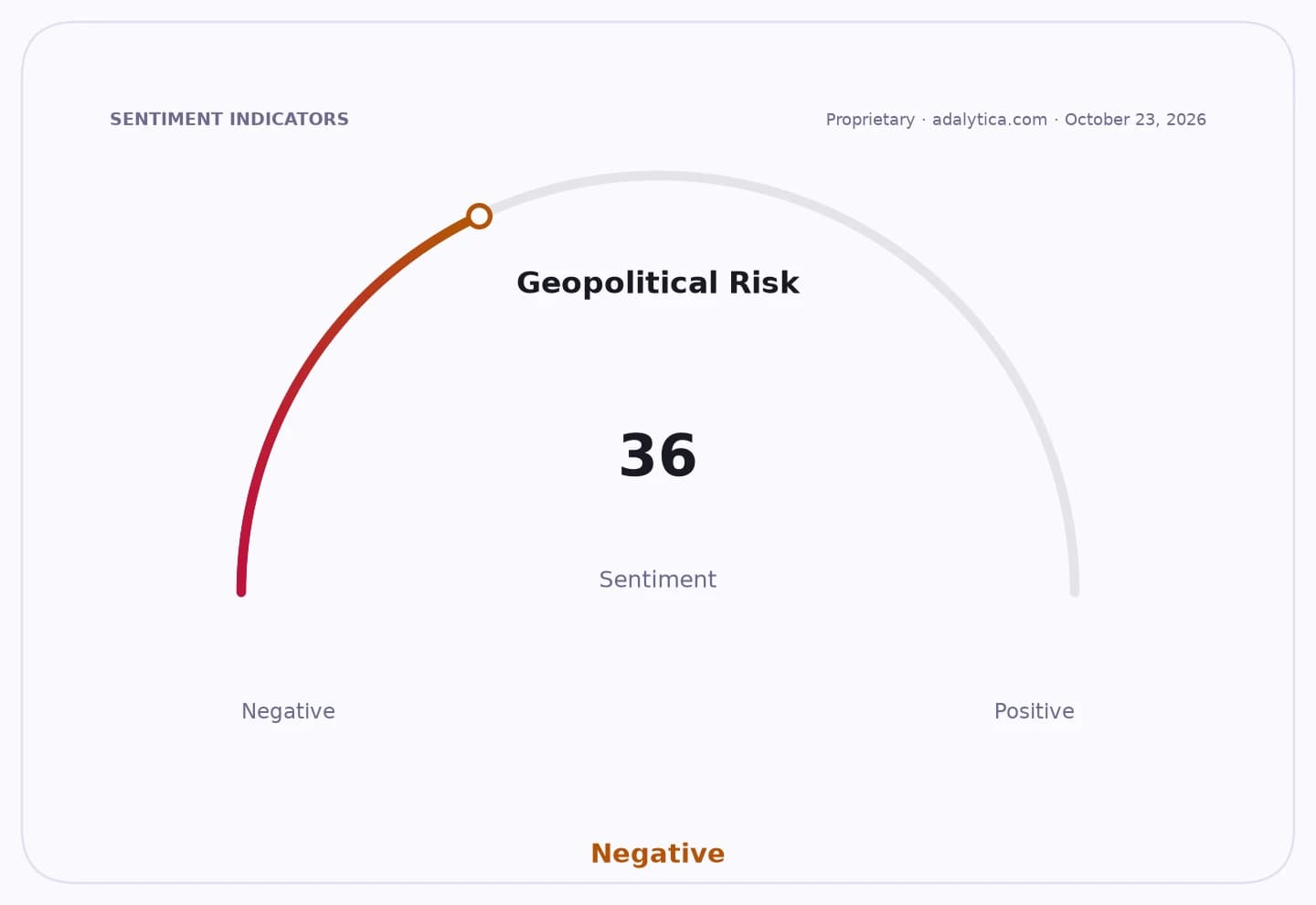
Sentiment IndicatorsⓘProprietary · adalytica.com · September 26, 2026
This is a snapshot — live sentiment, awareness and momentum for 130+ markets update continuously in the dashboard.Open AlphaPulse
That matters economically because war punishes waste. When budgets, road maps and three- to five-year plans can become obsolete before they are approved, companies cannot afford sprawling priority lists or slow decision chains. The OKR approach forces management to choose a few measurable outcomes, review them quarterly and use weekly check-ins to spot what is working and what is not. In practice, that means less time spent on internal noise and more capital, labor and attention directed toward the handful of initiatives that actually preserve revenue and resilience.
The appeal is obvious in Ukraine, where businesses and state institutions are trying to operate with a level of coordination that would normally come from stable politics and predictable demand. The article says OKR usage correlates with alignment between teams rising to about 80% to 90%, a meaningful gain when a company’s real challenge is not just surviving a quarter but retaining the ability to function if the next quarter looks very different. That kind of operating discipline can be worth more than a glossy strategy deck, because it helps management detect problems earlier, kill weak projects faster and keep the organization from fragmenting under stress.
It also helps explain why the model has spread beyond private companies. Ukrainian names cited include defence-tech firm General Chereshnya, Fedoriv Group, EURO5 and KIDDISVIT, while state bodies such as the Digital Transformation Ministry, the Ministry of Culture, the Ministry of Veterans, the statistical service and the securities regulator have adopted the same language of results. For investors, that is important because war-tested management systems often become exportable capabilities. Companies that learn to operate with clarity under fire can emerge with stronger execution, faster product cycles and better capital discipline than peers that only know how to function in calm conditions.
For long-term investors, the broader takeaway is that management quality is not a soft factor in a crisis — it is the operating system. In sectors exposed to policy shifts, supply disruptions or military risk, the best-run companies are usually the ones that can narrow their focus, measure progress quickly and make decisions without waiting for perfect certainty. That is especially relevant for businesses tied to Ukraine’s rebuilding, digitalization and defense ecosystem, where adaptability can be as valuable as scale.
The risk, of course, is treating OKR as a fashionable management tool rather than a real change in behavior. If leadership keeps too many priorities, hides trade-offs or uses the framework as a reporting exercise, it will not create any certainty at all. But when it is used to clarify what to stop doing as much as what to pursue, it can become a genuine competitive advantage.
For investors thinking in years, not weeks, the message is straightforward: in war and in volatile markets, certainty is built through discipline, focus and repeatable execution. That makes management systems like OKR worth watching closely, especially in companies and institutions that have had to learn resilience the hard way.
| Entity | Gains | Losses |
|---|---|---|
| OKR-led companies | ▲faster alignment | ▼management sprawl |
| Ukrainian state bodies | ▲clearer priorities | ▼bureaucratic drift |
| Investors in resilient operators | ▲better execution visibility | ▼uncertain, unfocused teams |
| Rival firms without discipline | ▲— | ▼competitiveness |