A 10-year Treasury yield above 5% has sharpened the case for bonds over many dividend stocks, forcing income investors to weigh guaranteed cash flow against the prospect of dividend growth and capital gains.
U.S. 10-Year Yield Tops 5% vs Dividend Stocks

That is the core shift behind the latest debate in income investing: fixed income is suddenly offering returns that, in many cases, look competitive with blue-chip equities without the same earnings or valuation risk. The 10-year note was last around 5.28%, the highest since 2007, after the Federal Reserve lifted its benchmark rate to 3.75%-4% and inflation pressures persisted. For retirees and other yield-focused investors, that changes the relative pricing of everything from Treasury notes to consumer staples.
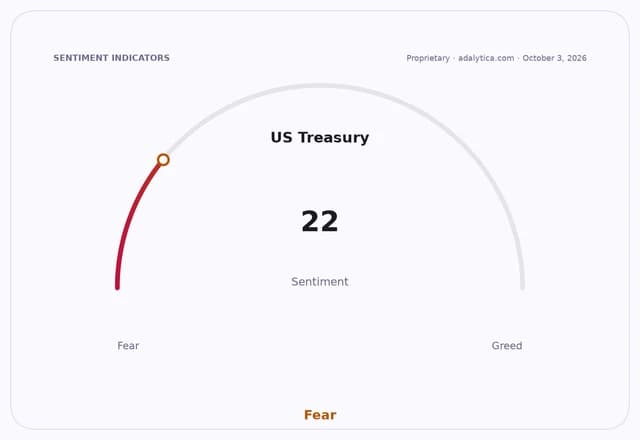
Sentiment IndicatorsⓘProprietary · adalytica.com · October 3, 2026
This is a snapshot — live sentiment, awareness and momentum for 130+ markets update continuously in the dashboard.Open AlphaPulse
The jump in yields matters economically because it raises borrowing costs across the economy and tightens financial conditions. Mortgage and corporate loan rates are often tied to the 10-year Treasury, so a move to this level can cool demand and slow price growth even as it improves the return available on cash-like government debt. It also increases the government’s financing burden at a time when U.S. debt has climbed above $40 trillion and the federal deficit remains wide, at $1.78 trillion in 2025.
For investors, the comparison is not as simple as “Treasuries versus stocks,” but the hurdle rate for owning dividend shares is clearly higher. Coca-Cola, often the kind of defensive income stock investors reach for, yields about 2.5% versus roughly 5.3% on the 10-year note. That means KO needs to offer not just a dividend but enough earnings growth and share-price appreciation to justify taking equity risk. Coke’s case is that it has raised its dividend for 64 straight years and has historically delivered mid-single-digit earnings growth, helped by pricing power and a global brand portfolio.
The market is already reflecting that tension. Coca-Cola shares have been volatile even as they remain above both their 50-day and 200-day moving averages, but the recent pullback has left the stock just under $86, with momentum indicators softening. Procter & Gamble, another classic dividend name, is also trading only modestly above its longer-term trend line. Those are not signs of distress, but they do show that investors are no longer willing to pay any price for yield when Treasuries offer a 5%-plus floor.
There is a second layer to the story: bond investors are not buying a static product. If yields keep rising, existing Treasuries fall in price, which is a problem for anyone who may need to sell before maturity. Long-duration bond funds such as the iShares 20+ Year Treasury Bond ETF have been especially vulnerable, even though they now offer higher yields than in recent years. But for investors who can hold individual notes to maturity, the appeal is straightforward: principal repayment is contractual, while dividend growth is not.
The bull case for dividend stocks is that inflation can be passed through over time. Companies like Coca-Cola and Procter & Gamble can raise prices, grow cash flow and lift payouts, so the initial yield understates long-run income potential. The bear case is that a 5.3% Treasury yield raises the bar so much that many mature dividend names must now compete not just on stability, but on growth, valuation and inflation protection.
That is why the next move in Treasury yields will be so important. Recent data showing slower job growth helped pull yields back from their highs, but the market is still focused on whether the Fed needs to keep policy restrictive for longer. If yields remain elevated, the pressure on dividend equities to prove their worth will persist. If yields retreat, the relative case for blue-chip stocks strengthens quickly again.
| Entity | Gains | Losses |
|---|---|---|
| U.S. Treasury buyers | ▲Higher income, capital preservation at maturity | ▼Price losses if yields rise further |
| Dividend stock investors | ▲Potential dividend growth, inflation pass-through | ▼Lower relative yield vs Treasuries |
| Coca-Cola and peers | ▲Support from brand power and payout growth | ▼Valuation pressure from bond competition |
| Federal government | ▲None on financing costs | ▼Higher borrowing and refinancing costs |