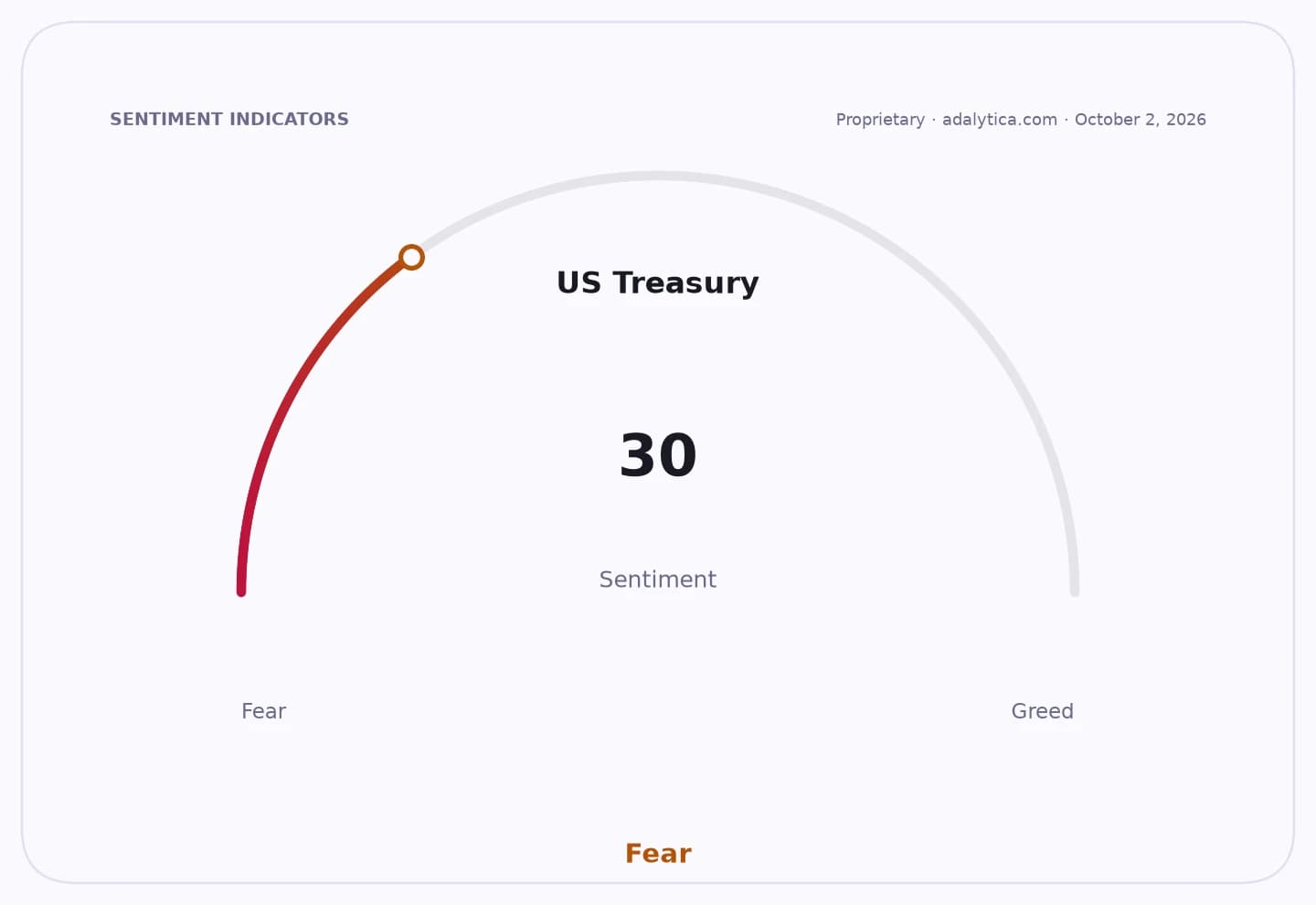
Wall Street’s latest rotation is favoring “quality” stocks over small caps and lower-rated credit as rising U.S. interest rates keep pressure on the most rate-sensitive corners of the market.
Quality stocks gain as rates pressure small caps

The move matters because higher borrowing costs usually hit smaller companies first: they depend more on floating-rate debt, have thinner margins and less room to absorb slower growth. Low-grade bonds also become less attractive as Treasury yields climb, pushing investors toward companies with stronger balance sheets and steadier cash flow.
Sentiment IndicatorsⓘProprietary · adalytica.com · October 3, 2026
This is a snapshot — live sentiment, awareness and momentum for 130+ markets update continuously in the dashboard.Open AlphaPulse
That preference showed up in recent trading. The iShares Russell 2000 ETF, a proxy for small-cap stocks, slipped to 281.52 on Oct. 2 from 289.81 on Sept. 1, while the iShares iBoxx $ High Yield Corporate Bond ETF held at 76.91, just above its recent lows after falling from 78.2 in mid-June. By contrast, the iShares MSCI USA Quality Factor ETF rose to 224.48 on Oct. 2 from 222.24 on Sept. 30, extending a steady bid for companies viewed as more resilient in a tighter-money environment.
The backdrop is a firmer Treasury market. The U.S. 10-year yield forecast in the data points to 5.297%, up from 5.24% on Oct. 1, underscoring the pressure on valuations for longer-duration assets and weaker borrowers. Investors are also digesting a softer September U.S. jobs report, which missed expectations and led markets to trim bets on consecutive Federal Reserve rate increases, even as policy uncertainty remains elevated.
For investors, the trade is less about chasing cyclicals and more about owning earnings durability. Quality factors tend to outperform when funding costs rise because strong cash generation, lower leverage and pricing power become more valuable than aggressive growth assumptions. That leaves small-cap equities and junk bonds vulnerable if rates stay high, credit spreads widen or the economy slows further.
The divergence also fits the broader AI-era market setup, where investors are widening the hunt beyond semiconductors to energy and infrastructure names tied to power demand, while avoiding weaker balance sheets in rate-sensitive sectors. The next big test is whether the Fed and labor data keep bond yields pinned near cycle highs, or whether a softer macro backdrop gives small caps and high yield room to rebound.
| Entity | Gains | Losses |
|---|---|---|
| Quality stocks | ▲Stronger relative demand | ▼Growth-at-any-price names |
| Small-cap stocks | ▲— | ▼Higher borrowing costs |
| High-yield bonds | ▲— | ▼Wider credit risk premium |
| Treasury holders | ▲Higher yields | ▼Rate-sensitive borrowers |