Lower-rated U.S. credit is weakening again even as the broader high-yield market and small-cap stocks still look relatively orderly, leaving investors with a split-screen view of risk: distressed borrowers are being repriced, but the rest of the market is not flashing panic.
CCC Credit Weakens as HYG and IWM Hold
The clearest stress is in the weakest rung of the credit stack. CCC-and-below spreads have detached sharply from investment grade and broad high yield, suggesting lenders are demanding a bigger premium from borrowers with the least cushion against higher funding costs and slower growth.
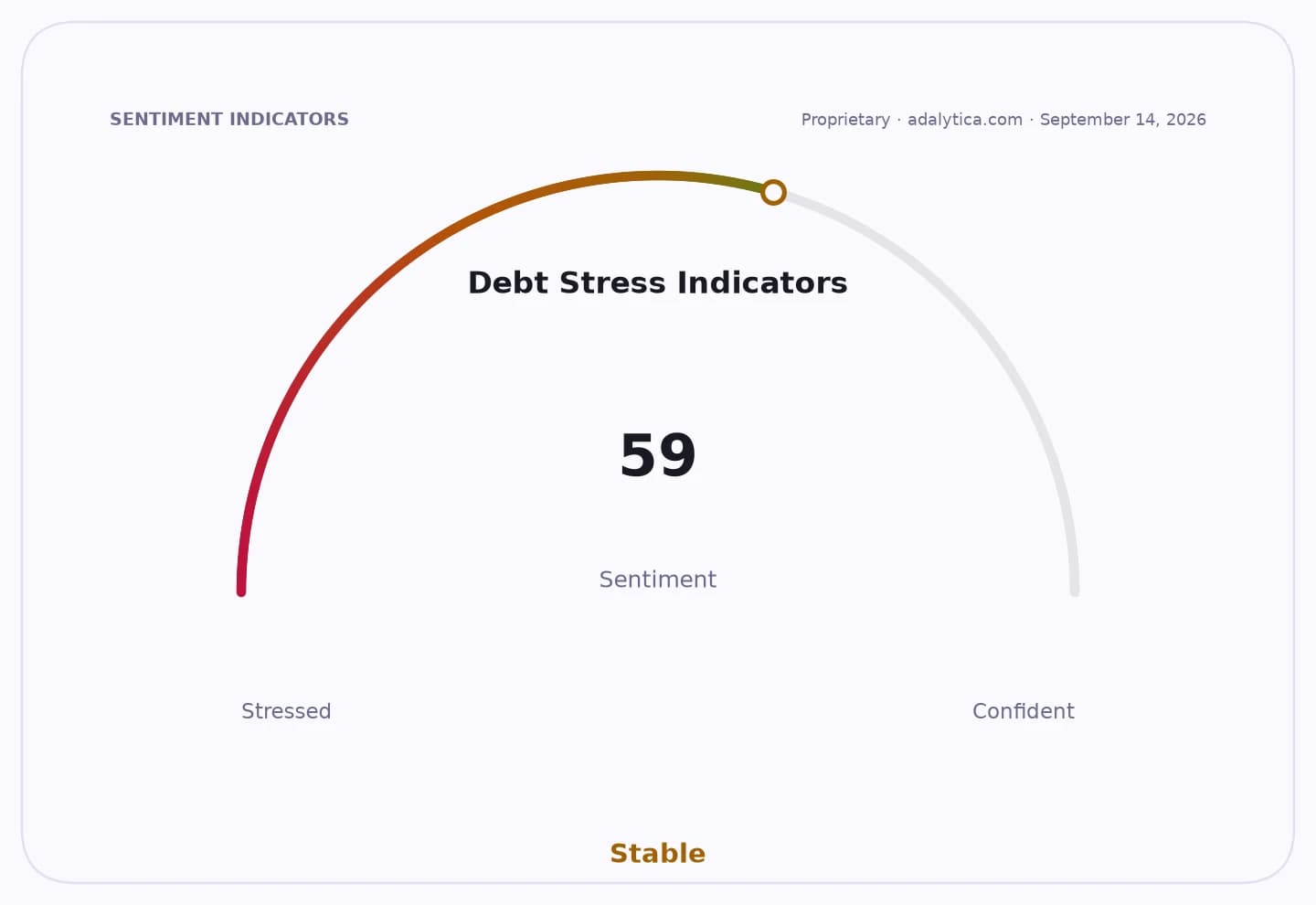
Sentiment IndicatorsⓘProprietary · adalytica.com · September 25, 2026
This is a snapshot — live sentiment, awareness and momentum for 130+ markets update continuously in the dashboard.Open AlphaPulse
That matters because the cost of money is still high. The 2-year Treasury yield is around 4.84%, while the 10-year is near 5.08%, levels that keep refinancing pressure on weaker credits and raise the risk that a narrow problem becomes a default cycle if earnings soften further.
By contrast, the big liquid proxies for risk are not yet confirming a full break. The HYG high-yield ETF is trading around 77.83, roughly in line with recent levels, even though its relative strength index has fallen to 21.3, a sign of heavy short-term selling. The LQD investment-grade ETF is holding near 103.18, while the small-cap Russell 2000 ETF, IWM, closed at 282.31 after sliding below its 50-day moving average, but without the kind of capitulation that usually accompanies a broad credit event.
That divergence is important for investors because it says the market is still discriminating. It is not pricing a system-wide credit shock; it is isolating the weakest borrowers, which can keep financing conditions manageable for higher-quality issuers while making life harder for highly levered companies, private credit names and late-cycle refinancers.
It also helps explain why equity traders have not reacted more violently. Adalytica’s S&P 500 trade signal shows neutral sentiment, while credit-card usage sentiment remains mixed, pointing to caution rather than outright stress in consumer spending. But the warning from the bottom of credit is that liquidity can disappear fast once refinancing windows close.
For now, the story is less about contagion than selection. If Treasury yields stay near current levels and earnings expectations drift lower, CCC spreads are likely to remain the first place where investors see the strain — and the first place where defaults could begin to rise.
| Entity | Gains | Losses |
|---|---|---|
| Higher-quality issuers | ▲Stable funding access | ▼Little |
| CCC-and-below borrowers | ▲None | ▼Wider spreads, tougher refinancing |
| HYG/LQD holders | ▲Relative resilience | ▼Mark-to-market pressure |
| Small-cap equity investors | ▲No immediate credit panic | ▼Rising financing risk |