US homebuilders are being forced to rewrite their business models as higher borrowing costs and weak affordability crush sales, and the survivors are increasingly the ones willing to cut prices, offer financing help and shift toward less saturated markets.
US Homebuilders Cut Prices as Sales Slow

That is the clearest message from the latest earnings and market data: home sales have cooled enough that builders can no longer rely on volume growth or pricing power. Yet the industry is not collapsing. Instead, it is adapting — and that adaptation will determine which names keep margins intact and which ones lose share in the next phase of the housing cycle.
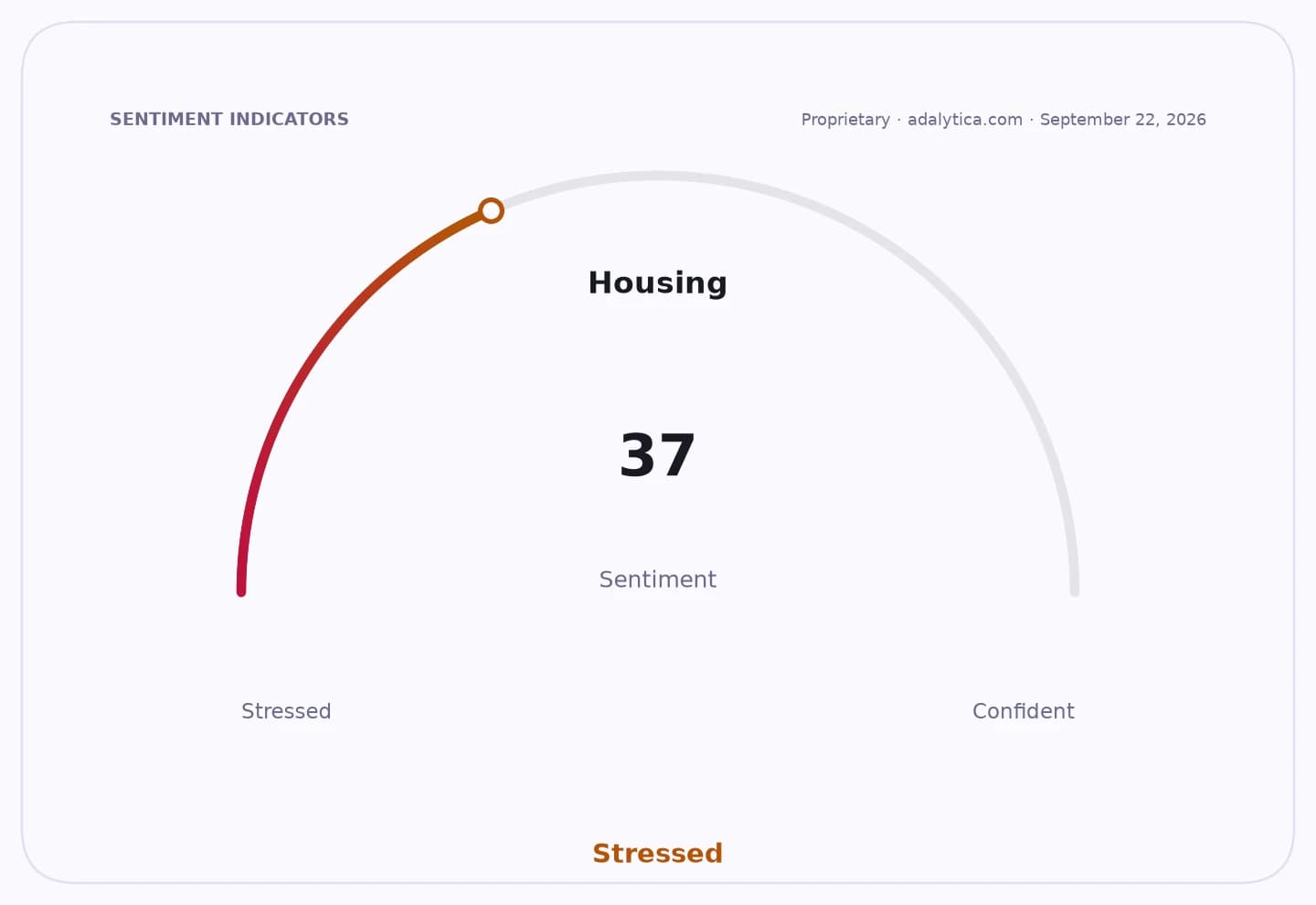
Sentiment IndicatorsⓘProprietary · adalytica.com · September 26, 2026
This is a snapshot — live sentiment, awareness and momentum for 130+ markets update continuously in the dashboard.Open AlphaPulse
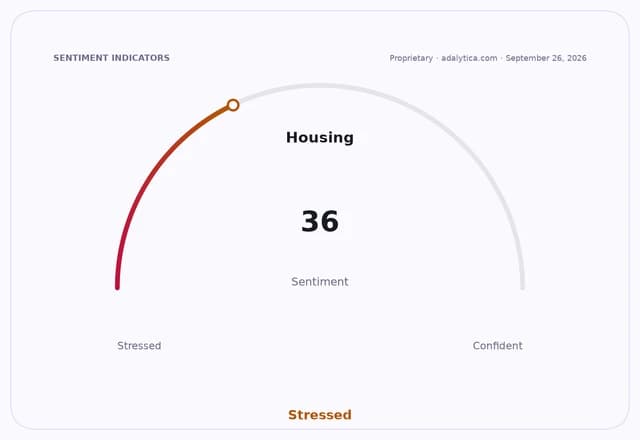
The pressure is visible in the numbers. Revenue at Russia’s residential developers fell more than 7% in the year through the first eight months of 2026, while developers in major cities took in 1.79 trillion rubles, down 142.7 billion rubles from a year earlier. The broader US housing backdrop is also still soft, with the S&P CoreLogic Case-Shiller index showing home prices at 336.663 in June, barely above May’s 335.43, underscoring how little pricing momentum remains. A separate housing gauge tracked by Adalytica shows sentiment around housing and rent inflation still neutral, reinforcing the message that demand is stabilizing only at a subdued level.
For builders, that means the old model of simply passing along higher costs is over. Public filings from Lennar, PulteGroup and Toll Brothers show the industry leaning harder on incentives, discounts on spec inventory, closing-cost help and mortgage rate buydowns to move homes. Lennar has said average selling prices fell partly because of heavier incentives, while Pulte and Toll have both pointed to slower sales paces and softer demand. In other words, the market is working — but only because builders are paying to make it work.
HOUST vs CSUSHPINSA — macro contextadalytica.com
Explore this data interactively — full history, time series and cross-market comparisons.Open AlphaPulse

That shift matters economically because housing is not just another sector; it is a transmission mechanism for the entire consumer economy. When builders sacrifice price in exchange for sales, they pressure margins, land values and contractor demand. They also create a second-order effect: buyers who can afford a home become more selective, favoring affordability, smaller footprints and financing structures that reduce the upfront burden. That is why lenders have recently cut rates on the most competitive home loans to below 6%, and why more buyers are turning to shared-equity and low-deposit schemes even as those products carry more risk if prices weaken further.
The investment implication is straightforward: the market underestimates how much operational discipline will separate the winners from the laggards. Builders with strong balance sheets, land optionality and the ability to fine-tune pricing community by community can survive a prolonged slowdown. Those reliant on fast turnover, stretched margins or overheated metro markets will feel the squeeze. The move into less crowded geographies is especially important, because it suggests capital is chasing pockets of affordability rather than waiting for a broad housing rebound that may take much longer to arrive.
That is where the opportunity lies for investors. The builders most willing to trade short-term margin for long-term share may emerge stronger once financing conditions ease, but the near-term setup still favors caution. The more compelling trade is in the picks-and-shovels around housing affordability — lenders, mortgage insurers, select home-improvement names and regional builders positioned in lower-cost markets — rather than assuming a straight-line recovery in national home sales.
The next catalyst will be whether lower mortgage rates can generate enough traffic to restore volume without forcing another round of aggressive discounting. Until then, homebuilders are not exiting the downturn — they are surviving it by changing the rules. Investors who want exposure should favor the names that can adapt fastest, because in this market flexibility is the real moat.
| Entity | Gains | Losses |
|---|---|---|
| Agile homebuilders | ▲Share gains | ▼Near-term margins |
| Buyers | ▲Lower prices, incentives | ▼Less choice in weak markets |
| Lenders offering cheap loans | ▲More originations | ▼Tighter credit risk |
| High-cost metro developers | ▲Pricing pressure relief absent | ▼Slower sales, weaker returns |