US inflation is moving back to the center of the investing conversation, and that matters because even a modest pickup is enough to revive the case for another Federal Reserve rate hike in October.
US inflation, Treasury yields and TLT

For long-term investors, the key issue is not one month’s price data on its own. It is what that data does to the bond market, borrowing costs and the earnings outlook for rate-sensitive sectors. When inflation stops easing, the market quickly moves from assuming the Fed is done to wondering whether policy still needs to get tighter.
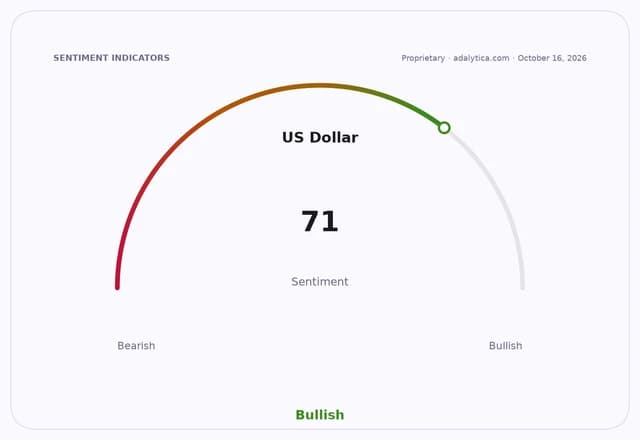
Sentiment IndicatorsⓘProprietary · adalytica.com · October 16, 2026
This is a snapshot — live sentiment, awareness and momentum for 130+ markets update continuously in the dashboard.Open AlphaPulse
That is exactly the shift showing up in markets. The US 2-year Treasury yield has climbed to 4.828%, a level that reflects renewed pressure on short-dated rates as traders reassess the policy path. The iShares 20+ Year Treasury Bond ETF, TLT, has bounced to $79.97, but it remains below its 50-day moving average of about $80.41 and well under its 200-day average near $83.43, a reminder that long-duration bonds are still fighting a difficult macro backdrop. The move in the 2-year, which is most sensitive to Fed expectations, tells you investors are no longer treating a hold as the default assumption.
The bond market reaction is important for the broader economy. Higher short-term rates filter through mortgages, credit cards, corporate loans and capital spending plans. They also make it harder for businesses to count on an easy-financing backdrop to support expansion. If inflation remains sticky, the Fed has less room to ease financial conditions, and that keeps pressure on consumer spending and margin-sensitive sectors.
CPIAUCSL vs FEDFUNDS — macro contextadalytica.com
Explore this data interactively — full history, time series and cross-market comparisons.Open AlphaPulse
Equities are already showing the consequences. The Financial Select Sector SPDR Fund, XLF, finished at $55.27, and while that is above its 200-day moving average of roughly $53.33, it is still below its 50-day average near $56.20. Banks can benefit from higher yields if lending demand holds up, but the trade is less straightforward when markets start pricing the possibility of an additional hike. Higher rates can support net interest income, yet they also raise credit risk and can eventually crimp loan growth.
Treasury sentiment is also turning more constructive in the near term. Adalytica’s US Treasury Bonds Trade Signals show a sentiment reading of 76, labeled “Greed,” even as awareness remains at “Extreme Fear.” That combination suggests investors are leaning into the idea that yields may have gone far enough in the short run, but they have not fully shaken the larger inflation concern.
The inflation story matters most because it keeps the Fed’s next move alive as a market variable. Forecasts that had settled around no further tightening are now being challenged, and that alone can move dollars, bonds and financial stocks. The US dollar trade signals sit at 71, also labeled “Greed,” underscoring how quickly the currency can firm when rate-hike odds rise.
For investors, the lesson is simple: inflation that reaccelerates, even slightly, can extend the life of a higher-rate environment. That is usually a headwind for long-duration bonds and a mixed bag for banks, but it can also create better entry points for patient investors willing to think in years, not days. If the data keeps pushing the Fed toward one more hike, expect more volatility — and more opportunities — across rates-sensitive assets.
| Entity | Gains | Losses |
|---|---|---|
| Federal Reserve | ▲More room to stay restrictive | ▼Rate-cut hopes |
| Banks and lenders | ▲Wider loan yields | ▼Credit-sensitive borrowers |
| Treasury bond investors | ▲Short-term trading swings | ▼Long-duration bond holders |
| US dollar bulls | ▲Firmer rate expectations | ▼Importers and foreign borrowers |