The world is moving into a higher interest rate regime because inflation is not fading the way policymakers once hoped, and the market’s newest growth engine — AI — is adding fresh price pressure just as central banks are running out of room to look through it.
Higher rates, AI capex pressure Treasury yields
That is the core message from S&P Global chief economist Paul Grunwald, who said the U.S.-led bond market is being shaped by sticky inflation, rising Treasury yields and an unprecedented surge in private-sector capital spending by hyperscalers. He estimated debt issuance tied to those companies’ AI investment wave at about $800 billion this year, with the total heading toward well over $1 trillion annually. That matters because it is not just a technology story: it is a macro story about capital demand, higher long-end yields and a cost of money that is likely to stay structurally higher.
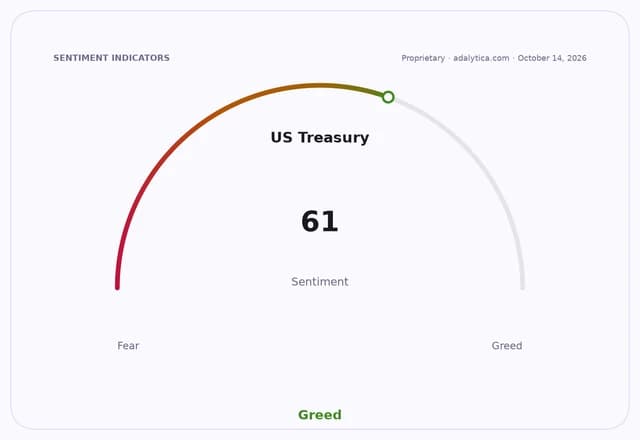
Sentiment IndicatorsⓘProprietary · adalytica.com · October 14, 2026
This is a snapshot — live sentiment, awareness and momentum for 130+ markets update continuously in the dashboard.Open AlphaPulse

The economic significance is hard to miss. For decades, government borrowing was seen as the main force crowding out private capital. Now the reverse is emerging, with AI infrastructure spending soaking up financing capacity just as inflation stays sticky in the United States and energy costs continue to leak into producer prices. Grunwald said crude may have eased from $120 a barrel, but diesel, gasoline and U.S. jet fuel remain elevated, which means firms are still facing input-cost pressure that either squeezes margins or gets passed through to consumers.
That is exactly the kind of backdrop that keeps central banks cautious. It also helps explain why the 10-year Treasury yield is still above 5%, after touching 5.28% this month, while the iShares 20+ Year Treasury Bond ETF, TLT, has been knocked down to the high-70s and is trading well below its 50-day and 200-day moving averages. Its RSI near 22 points to a market that has been persistently leaning against duration. In plain English, bond investors are not pricing a quick return to the low-rate era.
For investors, the opportunity is to stop treating higher rates as a temporary shock and start treating them as the operating environment. That is bullish for banks, insurers and cash-generating companies with pricing power, and hostile to long-duration assets that need low discount rates to justify rich valuations. It is also a major tailwind for sectors tied to the AI buildout itself: semiconductors, cloud infrastructure, power generation, grid equipment, data-center cooling and industrials that supply the real economy behind the digital one.
The deeper narrative is that AI is not disinflationary in the short run; it is capital-intensive first and productivity-enhancing later. That sequence matters. If hyperscalers are issuing debt on a trillion-dollar trajectory, they are effectively competing with governments for capital while driving demand for electricity, chips, land, construction and transmission. That is why yields can stay elevated even if headline inflation looks contained: the price of capital is being pulled higher by both persistent inflation and a historic investment cycle.
The market is missing the second-order effects. A higher-rate world does not just punish bond proxies; it changes who captures the next leg of returns. The winners are lenders, infrastructure suppliers and select industrial monopolies. The losers are duration-heavy growth stocks, rate-sensitive real estate and any balance sheet that depended on cheap refinancing. If this regime persists, the next big alpha will come from owning the toll roads of the AI economy, not the glamour names alone.
| Entity | Gains | Losses |
|---|---|---|
| Banks and lenders | ▲Wider lending spreads | ▼Rate-sensitive borrowers |
| AI infrastructure suppliers | ▲More capex demand | ▼Long-duration bond assets |
| Treasury bondholders | ▲Higher yields on new debt | ▼Price declines in existing bonds |
| Consumers and importers | ▲None | ▼Higher fuel and input costs |