The best response to America’s fiscal strain is not to bet on one dramatic outcome, but to own the assets that keep working across several of them.
U.S. fiscal strain lifts dollar, gold, and short bonds

That is the central message for investors after another reminder that the U.S. is living with three forces that rarely stay aligned for long: heavy debt issuance, sticky inflation and a dollar that can still rally even as confidence in long-duration nominal assets erodes. The market is not being asked to choose between “America up” or “America down.” It is being asked to price a range of regimes — and that is exactly why a diversified, barbell-style portfolio looks more compelling than a single macro wager.
Sentiment IndicatorsⓘProprietary · adalytica.com · October 12, 2026
This is a snapshot — live sentiment, awareness and momentum for 130+ markets update continuously in the dashboard.Open AlphaPulse

The backdrop matters because the numbers are not trivial. U.S. debt is still heading toward the kind of scale that can distort rate policy, while inflation remains well above the Fed’s 2% target in market psychology even if the monthly prints have cooled. The 10-year Treasury yield is sitting around 5.2%, a level that forces investors to rethink the old assumption that government bonds automatically protect capital. At the same time, the Fed funds rate is still forecast near 3.7% this month, which leaves policymakers boxed in: cut too fast and inflation may re-accelerate; hold too high and the economy takes the hit.
That is why long-duration Treasuries have become a trade, not a certainty. The TLT ETF has slid to about $77.97, well below its 50-day moving average near $80.59 and its 200-day average around $83.52. Its RSI near 20.9 shows the fund is deeply oversold by conventional technical measures, but oversold does not mean safe. It means the bond market is already pricing a world where yields stay elevated longer than many investors expected. For those worried about a renewed inflation pulse or fiscal pressure on term premia, short duration still makes the most sense. For those convinced recession is coming, duration may yet pay off — but that is a call on timing, not a structural edge.
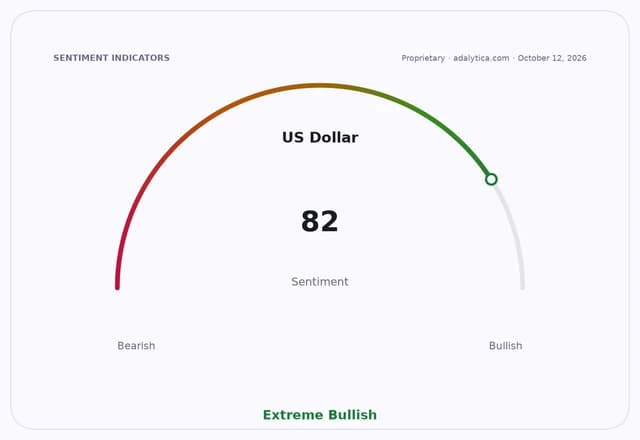
The dollar is telling a different story. The U.S. dollar ETF, UUP, has climbed to $29.14, above both its 50-day and 200-day moving averages, with an RSI in the mid-70s that suggests strong momentum by standard technical indicators. Adalytica’s U.S. dollar trade signals also show “greed” at 82, underscoring how quickly investors can crowd into the greenback when uncertainty rises. That matters because dollar strength can be both a symptom and a cause of tighter global financial conditions, hurting importers, emerging markets and any asset priced off cheaper liquidity assumptions.
Gold remains the cleanest hedge in this setup. GLD trades around $381.82, still below its 50-day average near $397.23 and its 200-day average near $415.50, but the broader message is not about the latest pullback. It is about function. Gold is insurance against a policy regime where fiscal pressure, inflation and geopolitical risk all coexist. Adalytica’s gold fear-and-greed gauge is also flashing “greed,” showing how fast investors are rediscovering the metal when faith in nominal assets wobbles. This is why the market underestimates gold’s role: it is not a return engine, it is a portfolio shock absorber.
Equities still belong in the portfolio, but only selectively. Stocks can be an inflation hedge when companies have pricing power, real assets, or monopoly-like economics. They can also be the first place valuation pain shows up when discount rates rise and long-duration growth gets repriced. That means the real opportunity is not “buy the market.” It is to own businesses that can pass through costs, benefit from capex cycles or sell picks-and-shovels into structural spending trends such as AI infrastructure, power, grids, defense and industrial reshoring. Those are the assets that can keep compounding even if the macro picture stays messy.
Bitcoin, by contrast, still belongs in the speculative sleeve rather than the defensive core. It can benefit from scarcity narratives and distrust in fiat money, but its volatility makes it a poor substitute for gold when the goal is ballast. In a world where the dollar can strengthen even amid fiscal anxiety, a highly volatile digital asset is not the same kind of hedge.
The investment takeaway is simple: stop trying to guess the next Fed move or the next bond-market tantrum. Build around regimes, not predictions. Favor short-duration fixed income for resilience, keep selective exposure to equities with real pricing power, hold gold as insurance, and use any dollar strength to stay disciplined rather than chase long-duration nominal risk. The market is underestimating how long this inflation-fiscal-dollar tension can persist — and that is exactly where the asymmetric opportunity lies.
| Entity | Gains | Losses |
|---|---|---|
| Short-duration bonds | ▲Less rate sensitivity | ▼Reinvestment risk |
| Gold | ▲Hedge demand | ▼Real yield headwinds |
| Dollar bulls | ▲Safe-haven flows | ▼Global liquidity borrowers |
| Long-duration Treasuries | ▲Recession rallies | ▼Higher-for-longer yields |