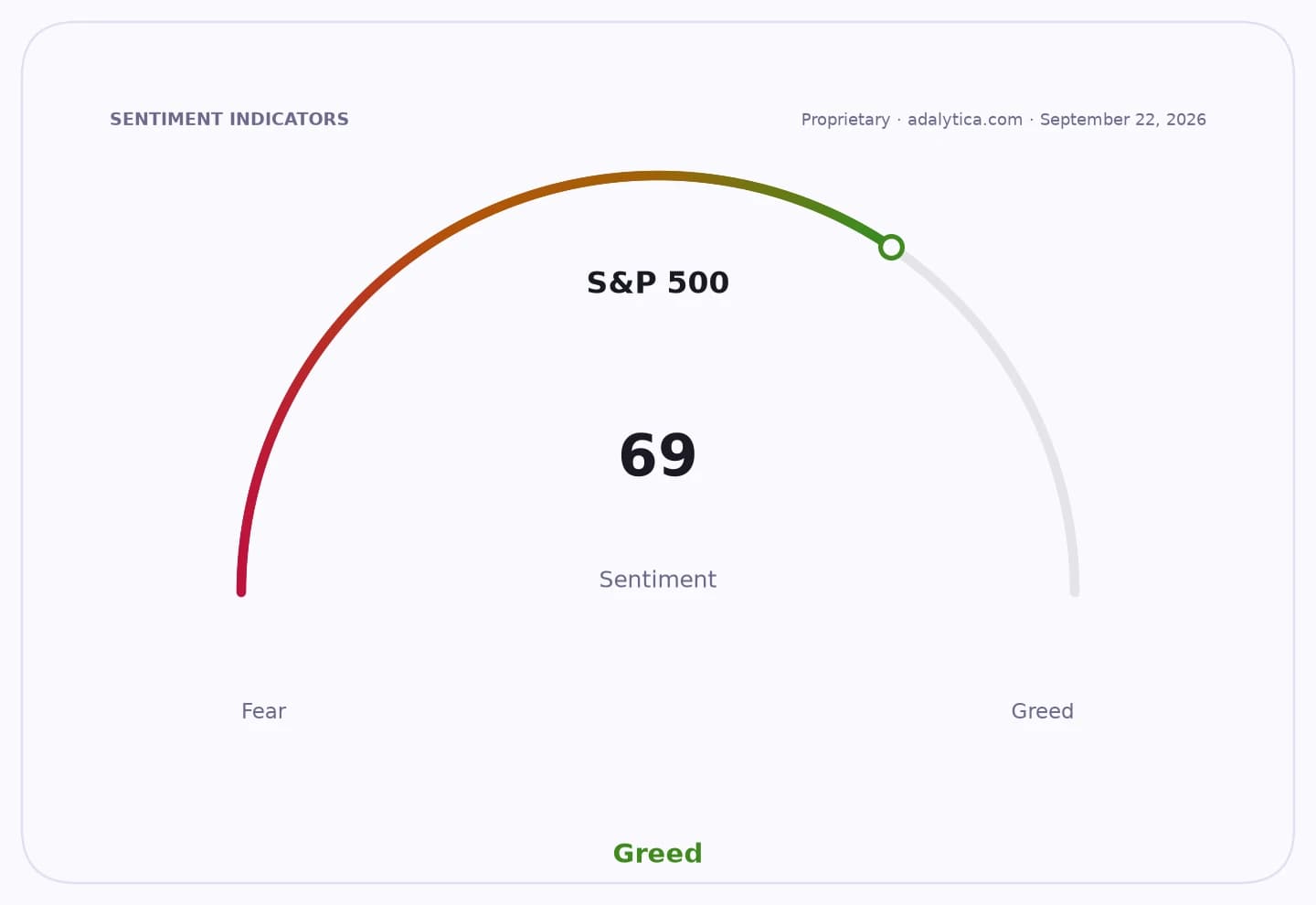
The US labor market is losing momentum even as payrolls continue to edge higher, and that combination matters because it points to a softer economy without yet delivering the kind of sharp deterioration that forces an immediate policy response.
US Labor Market Softens Ahead of Payrolls

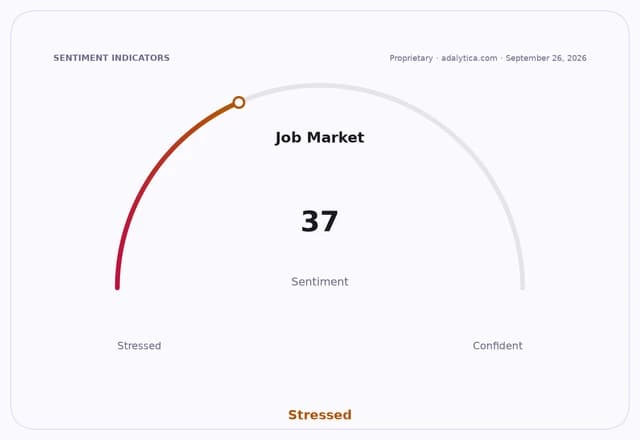
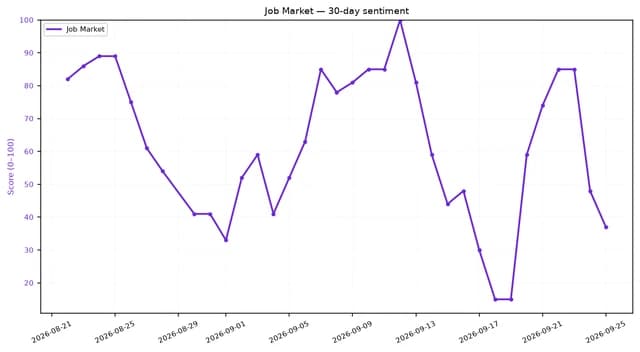
Nonfarm payrolls are forecast to rise just 14,600 in September, barely above August’s 159,075, while the unemployment rate is seen ticking down to 4.02% from 4.1%, according to the data context. On the surface, that looks like a labor market that is still generating jobs. But the broader picture is one of fragility: job-market sentiment from Adalytica sits at 37, in neutral territory, while its awareness gauge is in “extreme fear” at 15. Payroll sentiment is even weaker at 7, or “extreme fear,” suggesting investors and workers alike are bracing for a more pronounced slowdown.
Sentiment IndicatorsⓘProprietary · adalytica.com · September 26, 2026
This is a snapshot — live sentiment, awareness and momentum for 130+ markets update continuously in the dashboard.Open AlphaPulse
That matters economically because employment is the main transmission channel from policy to spending. When hiring slows, wage growth typically moderates, household income gains cool and consumer demand follows. The University of Michigan’s consumer confidence proxy in the data remains elevated at 93, but that reading contrasts sharply with weakening labor-market signals and leaves the economy vulnerable if hiring starts to roll over more decisively. The risk is not just a slower economy; it is a more uneven one, with sectors still adding jobs while others cut deeply.
The latest market action reflects that tension. SPY has rebounded to 771.35, above both its 50-day moving average of 759.91 and its 200-day moving average of 714.84, with RSI readings in the low-50s and MACD still positive. That says equity investors are not pricing an outright labor-market collapse. But the Treasury market is telling a different story. TLT has fallen to 79.32, below both its 50-day average of 81.97 and its 200-day average of 84.24, with RSI at 27.5, a level that typically signals oversold conditions. The message is that bond investors remain cautious on growth and rates even as stocks stay resilient.
The dollar proxy also points to shifting expectations. The USD measure has climbed to 95.52 from 94.69 on Sept. 23, moving above its 50-day average and toward the upper end of its recent range. A firmer dollar often accompanies a more defensive macro backdrop or reduced expectations for aggressive easing, though in this case the move may also reflect positioning around labor and inflation data.
For investors, the key question is whether this is a benign normalization or the first stage of a more meaningful slowdown. A softer payroll print with a stable unemployment rate would support the idea that the labor market is cooling gradually, which could help the Federal Reserve keep policy restrictive for longer while still allowing equities to hold up. But if hiring momentum weakens further, bond yields could fall, cyclicals could underperform and earnings estimates would come under pressure, especially in consumer, industrial and small-cap segments.
That makes the upcoming labor data a pivotal check on the current “soft landing” narrative. Bulls will argue that unemployment near 4% and continued payroll gains point to resilience, not recession. Bears will focus on the sharp deterioration in job sentiment and the narrowing margin between steady employment and outright weakness. For now, the market is split between those two stories — and the next payroll report will help decide which one wins.
| Entity | Gains | Losses |
|---|---|---|
| Bond bulls | ▲Lower-yield hopes | ▼Growth optimism |
| Equity bulls | ▲Soft-landing narrative | ▼Recession fears |
| Job seekers | ▲Slower wage competition | ▼Fewer openings |
| Fed hawks | ▲Sticky-policy cover | ▼Pressure to cut faster |