Vietnam is preparing to raise the minimum wage by 7.8% from Jan. 1, 2027, a move that will lift pay for millions of workers but also add pressure to employers already balancing higher labor costs against soft margins and the risk of more off-the-books hiring.
Vietnam minimum wage to rise 7.8% in 2027
The Ministry of Home Affairs has proposed the change in a draft decree that would replace the current pay framework and is now under review by the Justice Ministry. If approved, the monthly minimum wage would rise across all four regions, with the top tier increasing to 5.7 million dong and the lowest to 4.04 million dong. Hourly minimum wages would also move higher, with the highest region set at 27,400 dong an hour.
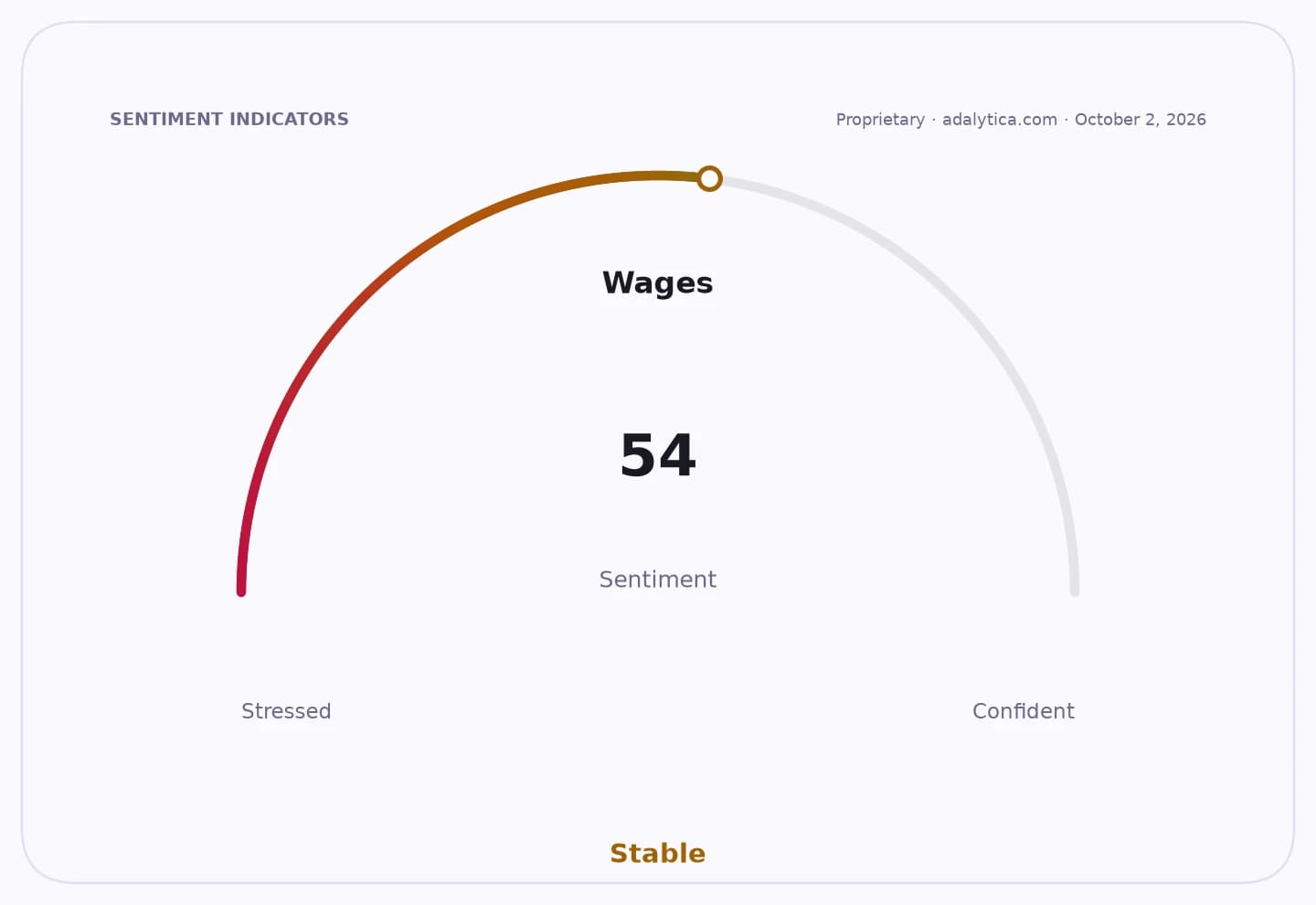
Sentiment IndicatorsⓘProprietary · adalytica.com · October 2, 2026
This is a snapshot — live sentiment, awareness and momentum for 130+ markets update continuously in the dashboard.Open AlphaPulse
This matters because minimum wage policy is never just about wages. In a fast-growing economy like Vietnam, it influences household spending power, business costs, formal employment and inflation expectations all at once. The ministry says the increase would average 7.8%, or roughly 310,000 to 390,000 dong a month, and still leave the new floor about 3.7% above the estimated minimum living standard for workers through the end of 2027. That suggests Hanoi is trying to strike a familiar balance: support workers without jarring manufacturers, retailers and service businesses that rely on low-cost labor.
For investors, the immediate question is which companies can absorb the higher pay bill and which cannot. Labor-intensive employers — especially in apparel, consumer goods, logistics and food service — may see margin pressure if they cannot pass through costs. At the same time, better wage growth can support consumption over time, which is positive for domestic-demand names and for the broader economy if it is not accompanied by a rise in informality.
That last risk is real. Vietnam’s draft decree explicitly preserves overtime, night-shift and in-kind benefits, but higher mandated wages can still push some employers toward informal payroll arrangements if enforcement is weak. That would blunt the policy’s benefit for workers and complicate the outlook for tax collection, social insurance and corporate transparency.
The government also signaled that regional wage zones may be adjusted, with proposals to move up wage brackets in Ho Chi Minh City, Gia Lai, Hung Yen and Da Nang. That is a reminder that Vietnam’s labor market is increasingly being redrawn by development, infrastructure and urbanization, not just by administrative rules.
For long-term investors, the key takeaway is that this is a modest but meaningful wage step rather than a shock. It should support spending power, but it will also reward businesses with pricing power, automation, efficient supply chains and stronger balance sheets. Those are the companies most likely to turn higher labor costs into a manageable line item rather than a lasting drag.
| Entity | Gains | Losses |
|---|---|---|
| Workers | ▲Higher pay floor | ▼Small real-wage risks if inflation rises |
| Employers | ▲Predictable wage framework | ▼Higher labor costs |
| Domestic retailers/consumer firms | ▲Stronger household spending | ▼Margin pressure if costs pass through slowly |
| Informal labor market | ▲Short-term workarounds | ▼Formal payroll compliance |