The next phase of artificial intelligence on Wall Street is being defined less by chat windows than by voice, as Microsoft, Alphabet and Apple race to make AI assistants the default interface for computing.
Microsoft, Alphabet, Apple Race to Make Voice AI Default

That shift matters because voice could move AI from a novelty layered on top of software into a more habitual, high-frequency service embedded in phones, PCs and productivity tools. If users can speak requests rather than type prompts, AI becomes easier to use, more personal and potentially more pervasive — a change that could expand engagement, strengthen ecosystem lock-in and open new monetization opportunities around assistants, subscriptions and commerce.
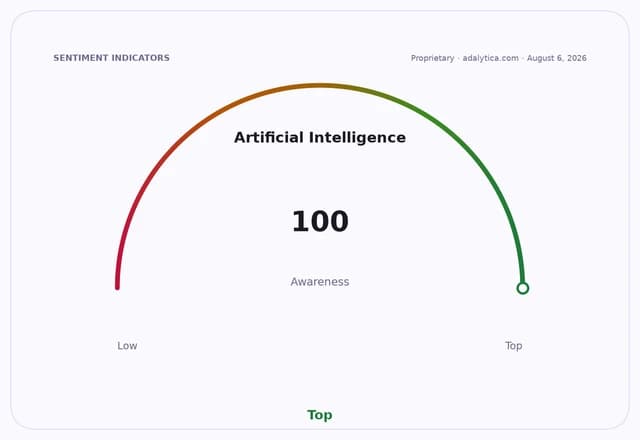
Sentiment IndicatorsⓘProprietary · adalytica.com · August 6, 2026
This is a snapshot — live sentiment, awareness and momentum for 130+ markets update continuously in the dashboard.Open AlphaPulse

For investors, the story is less about the technology itself than about where value accrues. Companies that own the operating system, cloud stack or assistant layer have the best chance of capturing usage, while app makers and standalone voice tools risk getting squeezed into the background. The stakes are particularly high for Microsoft and Alphabet, which are trying to convert heavy AI spending into products people use repeatedly enough to justify the cost.
Microsoft’s shares have rallied sharply, with the stock closing at $487.46 on Aug. 5 after plunging to $352.83 in late June. The rebound has pushed the price well above its 50-day moving average of $403.59, while the 200-day moving average stands at $431.95, underscoring the strength of the recent recovery even after a volatile stretch. The conventional technical picture remains stretched — the 14-day RSI was 77.2 and the MACD stayed positive — suggesting traders have already priced in a strong AI narrative and are now waiting for execution.
Artificial Intelligence vs MSFTadalytica.com
Explore this data interactively — full history, time series and cross-market comparisons.Open AlphaPulse
Alphabet is showing a similar pattern. The stock ended Aug. 3 at $373.51, above both its 50-day moving average of $358.38 and 200-day average of $326.62, after rebounding from a June selloff that briefly pushed it to $337.39. Apple, meanwhile, has lagged. Its shares closed at $303.42 on Aug. 3, below the 50-day moving average of $309.52, reflecting a more cautious market view on whether its AI push can match the pace of rivals.
The strategic attraction of voice is obvious. It lowers friction, especially on mobile devices and in cars, and it fits the long-touted vision of an AI companion that can listen, remember and act. It also plays to the strengths of Big Tech, which controls distribution and has the data, devices and cloud infrastructure to build speech into existing workflows.
But the bear case is that voice AI is still far from a clean commercial breakthrough. It remains prone to errors, latency and trust issues, and the more human it sounds, the more it raises concerns around deception, identity and misuse. That tension is already showing up in the broader AI debate, where voice cloning has raised alarm over job losses for voice actors and the risk of impersonation.
That risk is not just reputational. Microsoft’s latest annual filing said its AI solutions can produce unintended consequences or be used in unforeseen ways by customers or partners, while Alphabet and Apple have both warned in recent disclosures that AI investment is costly and uncertain. Those filings underscore the same point: Big Tech is spending heavily to make AI feel natural, but the payoff will depend on whether spoken interaction becomes an everyday behavior rather than a flashy feature.
The market reaction suggests investors are willing to reward companies that can turn voice into a sticky interface. The next test is whether the technology can work reliably across devices, languages and use cases without eroding trust. If it can, the winners will be the platforms that control the conversation. If it cannot, the current enthusiasm may prove another expensive step in the long race to make AI indispensable.
| Entity | Gains | Losses |
|---|---|---|
| Microsoft | ▲More Windows/Copilot usage | ▼Standalone voice apps |
| Alphabet | ▲Search and Assistant engagement | ▼Text-only interfaces |
| Apple | ▲Device ecosystem stickiness | ▼Rival assistant platforms |
| Voice actors | ▲Limited gains from new demand | ▼AI voice cloning disruption |