Walmart is leaning harder on promotions just as consumer-spending sentiment weakens and its stock loses altitude, underscoring how even the retail giant is competing for a cautious shopper with a summer sale that includes a 50% discount on a 2-in-1 robot vacuum.
Walmart leans on promotions as consumer caution rises

That matters because Walmart’s biggest advantage has always been traffic from value-seeking households, and the latest Adalytica Consumer Spending Sentiment snapshot shows neutral readings but “extreme fear” on awareness, with the gauge falling sharply over the past week. For investors, the message is that discounting can still drive volume, but it also reflects a more defensive consumer backdrop heading into the second half of the year.
Sentiment IndicatorsⓘProprietary · adalytica.com · July 23, 2026
This is a snapshot — live sentiment, awareness and momentum for 130+ markets update continuously in the dashboard.Open AlphaPulse
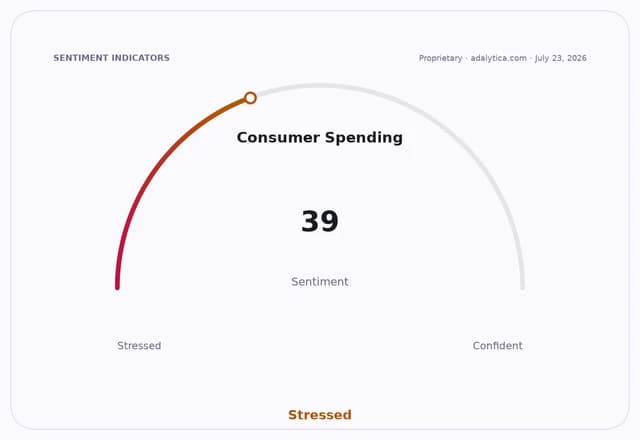
Walmart shares fell to $108.11 on Thursday, down from $109.33 a day earlier and well below the recent $131.78 peak in late April. The stock remains above both its 50-day moving average of $118.08 and 200-day average of $117.37, but the trend has weakened: the relative strength index is 40.0, near oversold territory, while the MACD remains negative, suggesting momentum has cooled after a strong run earlier this year.
The promotion itself is a small-ticket item, but it is strategically important. Home cleaning products and small appliances are high-visibility deal categories that can pull in shoppers without forcing Walmart to sacrifice its core grocery and consumables business, where price comparisons are constant and basket-building matters most. A deep discount on a robot vacuum also fits a broader sector pattern in which retailers are using targeted markdowns to defend share as households stay selective.
The wider retail backdrop is mixed. Action, the discount chain, said first-half net sales rose 14% to 8.3 billion euros, helped by 121 new stores and 3.6% like-for-like growth, showing that off-price and value-led formats continue to win traffic. That reinforces the idea that Walmart’s promotional cadence is not just a marketing tactic but a response to a competitive market where consumers are still trading down.
For investors, the key risk is that more aggressive deal activity supports sales growth but pressures margins if inventory has to be cleared at a deeper discount. The next catalyst is Walmart’s upcoming earnings update, which will show whether summer promotions are enough to sustain traffic without denting profitability, and whether consumer caution is easing or becoming the new normal.
| Entity | Gains | Losses |
|---|---|---|
| Walmart shoppers | ▲Cheaper household goods | ▼Less pricing leverage |
| Walmart | ▲Higher traffic and basket size | ▼Margin pressure |
| Discount rivals | ▲Broader value-seeking demand | ▼More promotional competition |
| WMT bears | ▲Evidence of cautious consumer | ▼Stock still above long-term average |