The 30-year Treasury is once again offering a yield premium over large-cap dividend stocks, and that matters because it changes the arithmetic of income investing in a market that has spent years forcing investors into equities to find cash flow.
30-Year Treasury Yield Tops Dividend ETF Yields

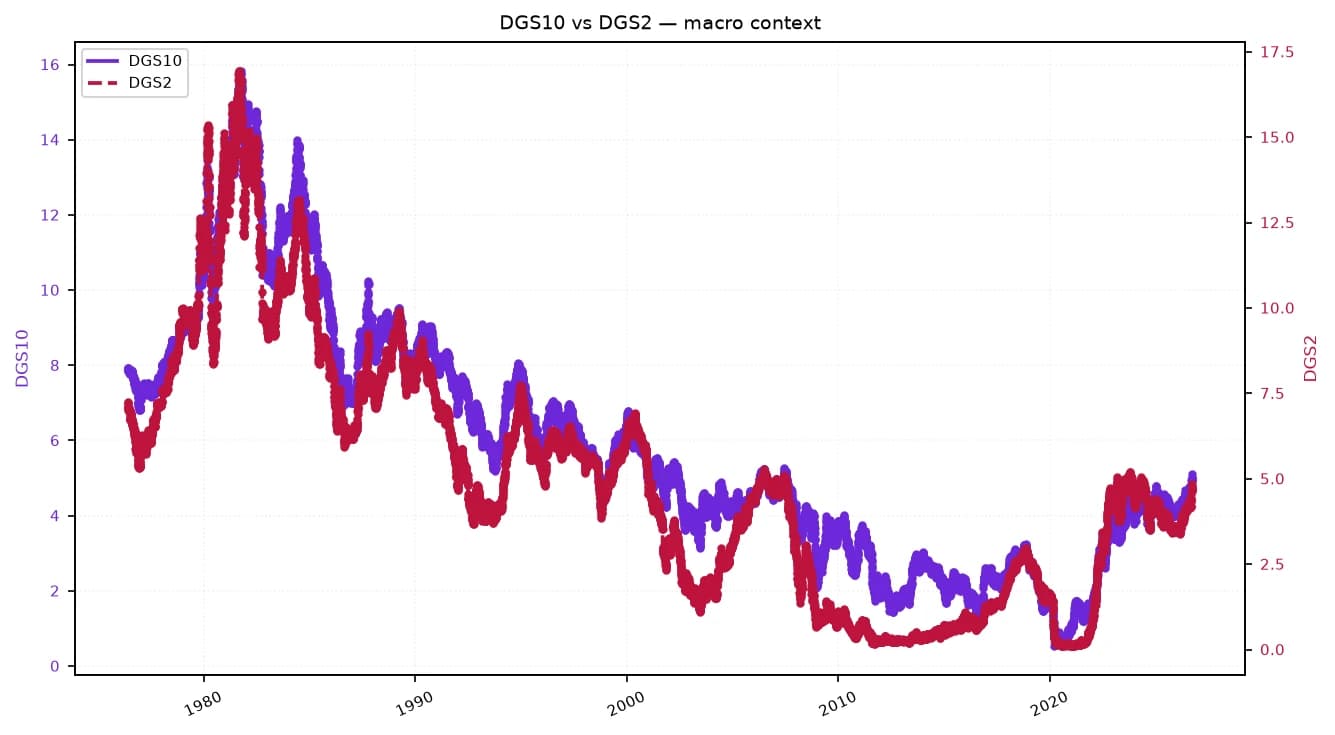
The long bond’s yield has climbed to about 4.7%, while the 10-year Treasury sits near 4.2%, leaving the curve only modestly steeper at roughly 50 basis points. But the bigger shift is relative to dividend equities: the 30-year is now yielding about 2.2 percentage points more than broad dividend funds such as SCHD, whose recent payout yield sits near 2.5%, and about 1.5 points more than VYM, near 3.2%. That is the widest advantage for government debt over dividend equities in nearly two decades, and history suggests it can draw capital away from income stocks.
Sentiment IndicatorsⓘProprietary · adalytica.com · August 22, 2026
This is a snapshot — live sentiment, awareness and momentum for 130+ markets update continuously in the dashboard.Open AlphaPulse
The reason matters goes beyond a simple yield comparison. When investors can buy long-dated U.S. government debt and receive more cash income than from dividend shares, they no longer need to pay up for equity beta, earnings risk and dividend-policy uncertainty to generate income. That is especially relevant after a long stretch in which low rates made dividend stocks a substitute for bonds. Now the substitution is reversing.
The market evidence is already showing the stress. Treasury prices have been sliding, with the iShares 20+ Year Treasury Bond ETF, TLT, falling to about $82.05, below both its 50-day and 200-day moving averages, while its RSI reading near 49 points to a market that is no longer oversold but still lacks upward momentum. By contrast, dividend funds have held up better: SCHD closed around $35.11 and VYM near $164.97, both above their longer-term averages. That relative strength does not eliminate the valuation problem, but it suggests investors are still willing to own dividend payers for growth and payout stability even as the bond market offers a higher starting yield.
Adalytica’s US Treasury Bonds Trade Signals snapshot points to the same tension: extreme fear in the Treasury trade alongside extreme awareness. In plain terms, investors are highly focused on the bond market, but not with confidence. The dollar trade signals also show extreme fear, underscoring how rate moves are rippling through broader asset allocation.
The macro backdrop explains why this is happening now. The 10-year yield at roughly 4.7% is far above the sub-1% levels seen in 2020 and above the roughly 3.6% level seen during the 2008 financial crisis. Inflation has cooled from its peaks, but not enough to force a return to the ultra-low-rate regime that made dividend stocks a premium substitute for cash. Instead, investors face a world where real returns on Treasuries are once again credible and duration risk still commands a premium.
That is important for investors because the most vulnerable dividend stocks are not the highest-quality cash generators, but the ones bought mainly for yield. Utilities, tobacco, staples and telecoms typically trade partly on income appeal; if Treasuries out-yield them by more than two points, the relative valuation case gets harder unless payout growth is robust. The stronger names can still compete. Procter & Gamble has paid a dividend for 136 consecutive years and has raised it for 70 straight years, while Coca-Cola and Altria continue to return large amounts of cash. But those companies now have to justify their premiums against a risk-free alternative that is paying more up front.
The last time the 30-year Treasury yield moved above dividend stock yields, the broad lesson was that income equity multiples became more fragile, especially for slower-growing payers. The current setup does not automatically mean a selloff in dividend ETFs, but it does raise the bar for total return. Investors may increasingly prefer companies with durable dividend growth rather than simply high yields, and they may also reweight toward bonds for capital preservation if recession risk rises.
For markets, the next catalyst will be whether the long end of the curve stays elevated or begins to ease. If the 30-year yield remains near current levels, dividend ETFs may continue to face competition from government debt. If yields fall on slower growth or a softer inflation profile, the dividend trade could regain some of its relative appeal. For now, though, the message is clear: income investors can once again get paid more by the U.S. government than by many of the market’s traditional dividend favorites.
| Entity | Gains | Losses |
|---|---|---|
| 30-Year Treasury | ▲Higher relative yield | ▼Bond holders if yields keep rising |
| Dividend ETFs (SCHD, VYM) | ▲Still offer equity growth | ▼Income appeal vs Treasuries |
| Treasury buyers | ▲Stronger starting income | ▼Duration risk |
| Dividend-heavy stocks | ▲Defensive cash flow story | ▼Yield premium over bonds |