ADP’s shares have climbed back near record territory as investors increasingly reward payroll and human-capital software providers that can help employers navigate a workplace where AI is changing the value of HR talent, not eliminating it.
ADP Shares Near Record on AI-Driven HR Demand

The stock closed at $277.62 on Sept. 4, up more than 33% from late June and above both its 50-day and 200-day moving averages, a sign the market is treating ADP as a relative winner in a labor market being reshaped by automation. The move comes as sentiment around artificial intelligence remains euphoric, with Adalytica’s AI gauge at 93, even as Microsoft’s earnings sentiment is at 22, underscoring how investors are still sorting winners from laggards in the AI trade.
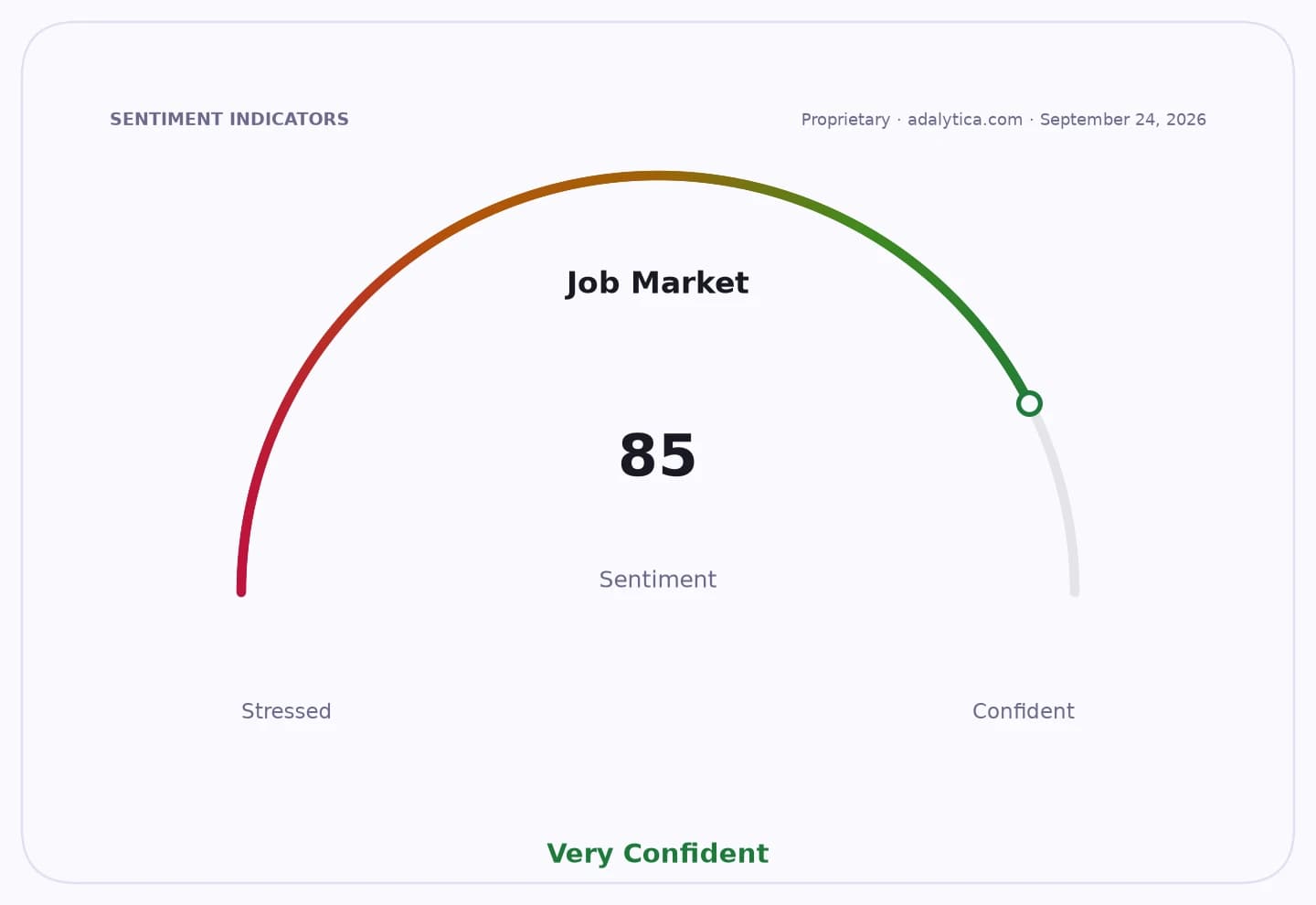
Sentiment IndicatorsⓘProprietary · adalytica.com · September 8, 2026
This is a snapshot — live sentiment, awareness and momentum for 130+ markets update continuously in the dashboard.Open AlphaPulse

For ADP, the more important point is that AI is raising the bar for HR managers rather than making them obsolete. Companies still need payroll accuracy, compliance, workforce planning and retention tools, but they also need managers who can interpret AI output, screen candidates more effectively and use data without losing the human judgment that hiring and employee relations require. That shift supports demand for software that makes HR teams more productive while protecting employers from the costs of bad decisions.
The market is reflecting that view. ADP’s latest trading pattern shows strong momentum: on Sept. 3 it touched $283.53 intraday, after a sharp advance from $216.31 in late June and $187.37 in April. The stock’s 50-day average has risen to $262.00, while the 200-day average sits at $234.91, indicating a durable uptrend even after a mild pullback. Technical indicators remain constructive despite some cooling from overbought levels, with RSI easing from the high 70s in mid-July to 64.7, still consistent with sustained institutional demand.
The broader economic backdrop matters. Employers are under pressure to do more with leaner teams, but they are also becoming more wary of over-automating people decisions after reports that job seekers are embedding AI-generated material into résumés and applications. That raises the value of HR systems that can verify, sort and analyze at scale without replacing the human oversight needed for sensitive hiring, compensation and performance calls. It also plays to ADP’s core pitch: software and data tools that sit in the middle of workforce administration rather than at the edges.
ADP’s advantage is scale. In its latest filing, the company said it serves more than 1.1 million clients and 42 million workers, giving it a large data set to improve products in payroll, time tracking, performance management and compensation. The company has also been pushing AI agents and other tools designed to automate routine tasks, which could help defend pricing and deepen client relationships if adoption continues.
The bull case is that AI increases demand for trusted workforce infrastructure, and ADP benefits as employers seek systems that combine automation with compliance and human judgment. The bear case is that if companies move faster than expected to commoditize routine HR work, software spending could shift to lower-cost point solutions, putting pressure on margins and growth. For now, the stock’s resilience suggests investors are leaning toward the first view.
The next test will be whether ADP can keep translating AI-related product innovation into sustained bookings and margin stability. If it does, the company stands to remain a beneficiary of the same workforce disruption that is challenging HR teams without AI skills.
| Entity | Gains | Losses |
|---|---|---|
| ADP | ▲Higher demand for HR tools | ▼Risk of software commoditization |
| Skilled HR managers | ▲Better decision support | ▼Less leverage without AI fluency |
| Employers | ▲More efficient hiring/payroll | ▼Higher implementation complexity |
| Pure manual HR workflows | ▲Less relevance | ▼Automation pressure |