AI is starting to redraw the invisible borders inside companies, and that matters because the first big economic effect may not be layoffs so much as role compression, productivity gains and a shake-up in who captures the value of work.
Microsoft, Salesforce, Oracle on AI workflow shift
The new narrative emerging across offices is not just about machines replacing people, but workers using AI to move into one another’s lanes — writing, summarizing, coding, analyzing and automating pieces of jobs that used to be tightly guarded. That is the “turf raiding” Sarah O’Connor describes, and it is an important second-order shift. If AI can let employees do more of what another department once owned, companies can potentially produce more output without proportional headcount growth, while managers get pressure to redefine roles, pay and promotion paths.
Sentiment IndicatorsⓘProprietary · adalytica.com · September 25, 2026
This is a snapshot — live sentiment, awareness and momentum for 130+ markets update continuously in the dashboard.Open AlphaPulse
Investors should care because this is where AI moves from hype to margins. The beneficiaries are the software and cloud platforms that sit underneath enterprise adoption, along with companies able to squeeze more revenue out of the same labor base. The losers are firms whose business models depend on scarce specialist labor or on charging for fragmented human workflows. Microsoft, Salesforce and Oracle all sit inside that transition. Microsoft shares have ripped back to around $516.89 after a brutal midyear washout, while Salesforce remains far below last year’s levels near $235.19 and Oracle, despite its rebound, is still working to recover from a deep drawdown. Those price swings tell you the market is still debating where AI monetization lands: infrastructure, application software, or labor substitution.
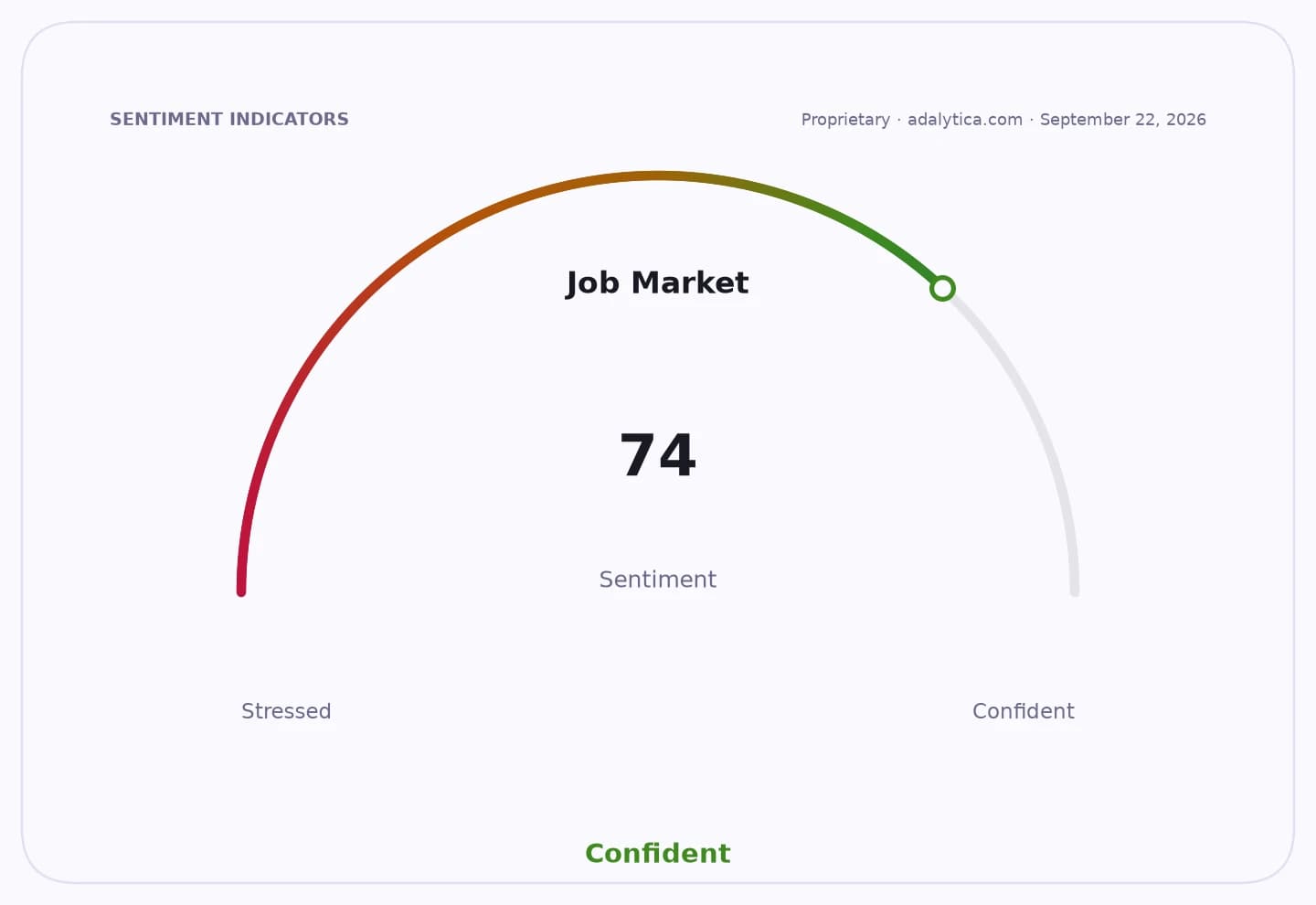
The macro backdrop reinforces the story. U.S. unemployment is expected around 4.02% for September, a sign the labor market is still relatively tight, while job openings are projected at about 7.4 million, suggesting employers are not yet facing a collapse in demand for workers. That combination is exactly why AI “turf raiding” matters now: companies are looking for a way to preserve growth without bidding up payrolls, and employees are using AI to become more versatile inside the same organization. In practical terms, that can slow hiring, flatten organizational charts and increase the return on software spending.
For the market, the real opportunity is in the picks-and-shovels. Microsoft’s AI and cloud stack, Oracle’s enterprise database and infrastructure push, and Salesforce’s attempt to embed AI into workflows all stand to benefit if companies continue decentralizing AI use across the workforce. But the competitive pressure is just as real. If AI lowers switching costs and lets staff assemble more of a workflow on their own, software vendors will need to defend pricing power and prove that their platforms are not just tools, but control points.
That is why the market underestimates this theme. The first wave of AI investment was about models and chips. The next wave is about workplace power: who owns the workflow, who gets automated, and which companies become the toll roads for an AI-enabled office. I believe the best way to play it is to own the platforms that help employees do more, faster — while avoiding businesses whose value depends on keeping work siloed and labor-intensive. The AI arms race is no longer just about better software; it is about who gets to do whose job.
| Entity | Gains | Losses |
|---|---|---|
| Microsoft | ▲More Azure and AI adoption | ▼Commodity workflow vendors |
| Salesforce | ▲AI-driven CRM stickiness | ▼Manual sales ops labor |
| Oracle | ▲Enterprise AI infrastructure demand | ▼Legacy software margins |
| Workers with AI access | ▲More cross-functional leverage | ▼Rigid job boundaries |