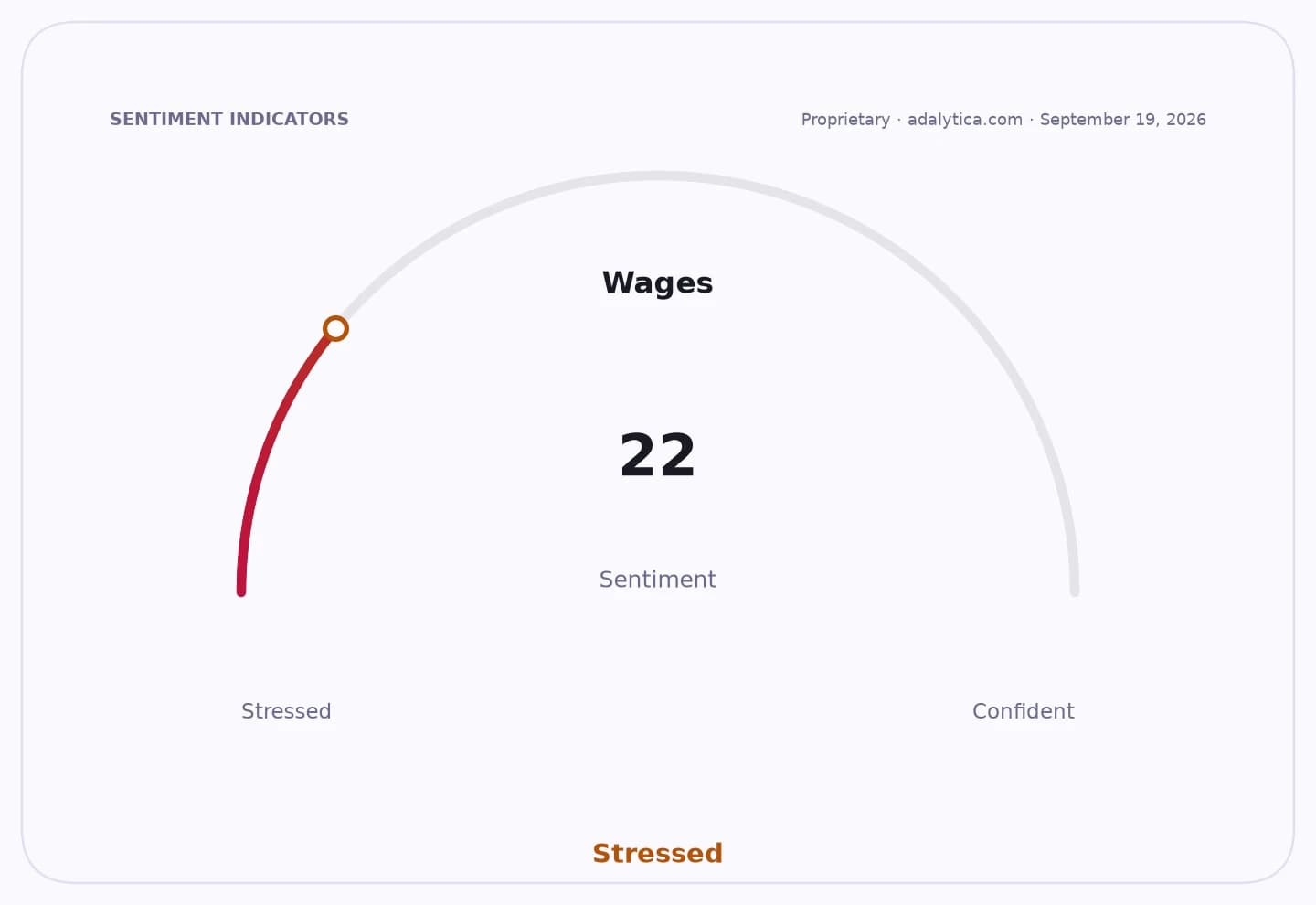
The European Union’s wage transparency rules are set to make salary secrecy harder to defend, a shift that could reshape hiring, tighten labor-market pricing and reward payroll and human-capital software providers that help employers comply.
ADP, Paychex Gain From EU Pay Transparency Rules
That matters because pay has long been one of the least efficient parts of the labor market. When job ads leave compensation vague, workers waste time applying, employers face more mismatched candidates and wage negotiations skew toward whoever has the better information. By pushing salaries into postings, Brussels is trying to make hiring more efficient and reduce persistent pay gaps — a change with real economic consequences for labor mobility, wage-setting and productivity.
Sentiment IndicatorsⓘProprietary · adalytica.com · September 8, 2026
This is a snapshot — live sentiment, awareness and momentum for 130+ markets update continuously in the dashboard.Open AlphaPulse
For investors, the winners are not just employers that can use transparency to attract candidates faster, but the infrastructure companies that sit behind compensation administration, compliance and payroll processing. ADP and Paychex are the clearest public-market proxies for a world in which pay practices become more standardized, auditable and regulated. Their software and services become more valuable when companies need to document pay bands, track equity, and manage a more rules-heavy hiring process across borders.
The market is already telling part of that story. ADP shares have surged to roughly $271 from lows near $187 in April, trading above both the 50-day and 200-day moving averages, while Paychex has climbed back toward $119 after a spring selloff. That resilience suggests investors are beginning to price in a steadier demand backdrop for payroll and workforce compliance, even as traditional cyclical labor indicators remain mixed.
The macro backdrop supports the case. U.S. unemployment sits near 4.1%, a historically tight level by long-run standards, while job openings remain elevated at around 7.3 million, leaving employers with little room to be sloppy about recruiting. In that environment, pay transparency can become a competitive tool rather than just a regulatory burden: companies that post clearer salaries may fill roles faster, while those that lag could face higher churn and slower hiring.
There is also a second-order effect the market may be underestimating. Once salary disclosure becomes normal, it can compress the informational advantage that has long favored employers in wage negotiations. That does not necessarily mean higher wages across the board, but it does mean more visible wage dispersion, more pressure on laggards and more demand for analytics that help companies justify pay structures. ADP’s own emphasis on pay equity and governance, alongside the growing compliance footprint around labor rules, points to a longer runway for firms that can package transparency into workflow software.
The most investable takeaway is that wage transparency in the EU is not just a labor-policy headline. It is a structural tailwind for payroll, HR software and compliance vendors, and a gradual headwind for employers that rely on opaque compensation to manage labor costs. For long-term investors, the opportunity lies in the picks-and-shovels layer: companies that make pay disclosure, compliance and workforce administration easier will likely capture a larger share of enterprise spending as the rules tighten.
| Entity | Gains | Losses |
|---|---|---|
| ADP | ▲Compliance demand | ▼Secrecy-based employers |
| Paychex | ▲Payroll workflow growth | ▼Opaque hiring practices |
| EU job seekers | ▲Better pay visibility | ▼Firms with weak pay bands |
| Employers | ▲Faster matching if adapted | ▼Higher disclosure pressure |