Antonio Guterres’ warning that a U.S.-China race to build AI-enabled weapons could have “absolutely devastating” consequences lands at a moment when the defense sector is already being repriced for a world of faster, more automated warfare.
AI arms race boosts Lockheed, Northrop, RTX

For investors, the bigger message is not just geopolitical caution. It is that military AI is moving from theory to procurement, testing and industrial planning, and that shift is likely to reward the companies building the underlying hardware, sensors, software and missile-defense systems while raising the odds of tighter oversight, export controls and ethical scrutiny.
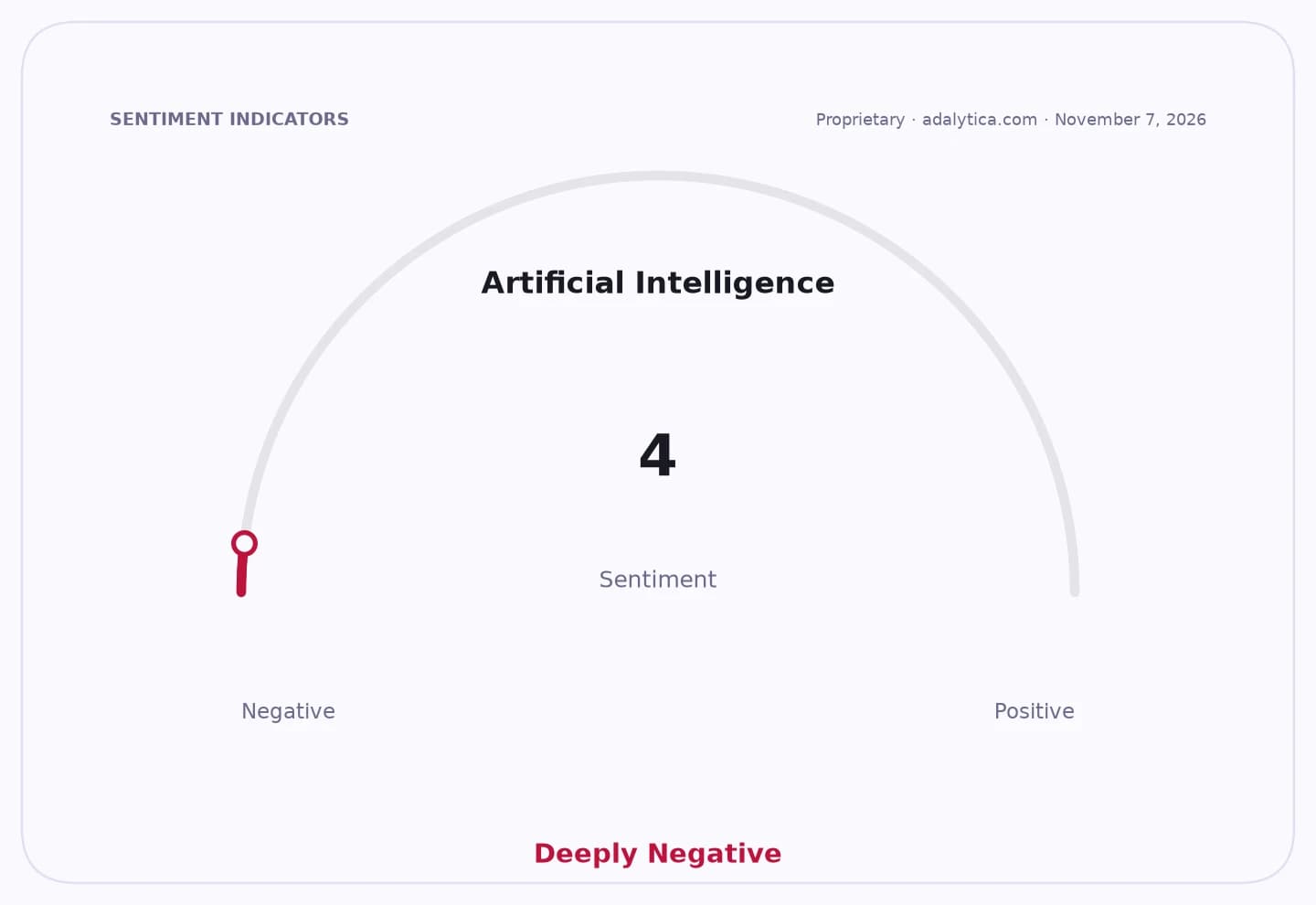
Sentiment Indicators
The UN secretary-general said the greatest danger would be a concentration of AI capability in the United States and China, arguing that the world needs the kind of crisis communication channels that helped reduce nuclear risk during the Cold War. That matters economically because once AI becomes embedded in command, control, targeting and autonomous systems, defense spending stops being cyclical and starts looking structural. Governments will not wait for perfect rules before spending on deterrence.
The market is already telling part of that story. Lockheed Martin has rallied sharply this year even after a recent pullback, with shares still trading well above their 200-day moving average, while Northrop Grumman has also held onto gains despite volatility. Raytheon parent RTX has been more range-bound, but its shares remain close to long-term support and have stabilized after a steep spring selloff. The message is clear: investors continue to buy the picks-and-shovels of the AI-security trade even when the broader market treats “AI” as a pure commercial-tech theme.
That is where the opportunity is hiding. The market still tends to think about AI through chips, software and cloud. But the next major capex cycle may be in defense modernization — autonomous drones, electronic warfare, missile defense, secure communications and battlefield decision systems. Lockheed and Northrop are obvious beneficiaries if Pentagon budgets keep tilting toward integrated air and missile defense. RTX, with its exposure to sensors, engines and defense electronics, remains levered to the same theme. If militaries accelerate AI adoption, contractors with deep government relationships and large installed bases should see longer contract duration, not just bigger headlines.
There is also a second-order trade here. The more AI becomes central to warfare, the more pressure will build for sovereign AI stacks, hardened cloud infrastructure and trusted domestic suppliers. That creates an asymmetry for companies positioned as national-security infrastructure rather than generic AI vendors. The losers are easier to identify too: firms dependent on open, low-friction global AI deployment, and any defense contractor that cannot prove its systems are compliant, secure and interoperable enough for government use.
Guterres is right that the risk is not simply faster weapons. It is faster escalation. But for investors, that same risk is what keeps defense spending sticky and raises the value of companies that can industrialize AI for military use at scale. Our thesis is straightforward: the AI arms race is not just a warning to policymakers — it is a long-duration tailwind for defense primes, autonomy specialists and the security layer around the AI economy. Position early.
| Entity | Gains | Losses |
|---|---|---|
| Lockheed Martin | ▲missile-defense demand | ▼budget uncertainty |
| Northrop Grumman | ▲autonomous systems spending | ▼export scrutiny |
| RTX | ▲sensors and electronics orders | ▼policy-driven delays |
| Generic AI vendors | ▲none | ▼tougher regulation |