AI systems are increasingly being judged not just on how well they work in English, but on whether their safety layers still hold when they are deployed in local languages and cultural contexts.
AI Safety Testing Expands to Local Languages
That warning from Firly Hanggodo Ganinduto, head of the digital ecosystem agency at Indonesia’s Chamber of Commerce and Industry, lands at a moment when governments are tightening oversight of AI security and incident reporting after a string of model vulnerabilities and misuse cases. His point is economically important because language coverage is becoming a real product risk: companies that train and red-team systems mainly on English data may be leaving large populations exposed to weaker guardrails, higher compliance risk and possible reputational damage.
Sentiment IndicatorsⓘProprietary · adalytica.com · October 13, 2026
This is a snapshot — live sentiment, awareness and momentum for 130+ markets update continuously in the dashboard.Open AlphaPulse
For investors, the issue reaches beyond ethics into monetization and liability. The largest AI platforms — including Microsoft, Nvidia and Alphabet-linked models and tooling — are being pushed to serve users in more markets, more languages and more regulated environments. If safety testing does not extend beyond the biggest digital languages, adoption in emerging markets could face slower rollout, heavier moderation costs, and more legal scrutiny. Microsoft’s stock has rallied to $541.15, above its 50-day moving average of $501.73, while Nvidia and Alphabet have also recovered, but the broader AI complex remains sensitive to any sign that growth assumptions outpace controllable risk.
Ganinduto said AI should be tested, secured and evaluated in the language and cultural setting where it will actually be used, warning that safeguards built and verified mostly in English cannot be assumed to perform the same way in lower-resource languages. That is the core asymmetry: English-language systems benefit from deeper data, more red-teaming and more mature tooling, while many local-language deployments still rely on safety mechanisms tuned elsewhere.
The timing matters because the policy backdrop is shifting. U.S. authorities have already required AI companies to report security incidents and respond to them, reflecting growing concern about fake content, hacking and model abuse. That regulatory direction strengthens the case for language-specific assurance standards, especially in markets where governments are trying to balance AI adoption with consumer protection, election integrity and cybersecurity.
The investment angle is two-sided. The bull case is that companies able to build multilingual safety layers, localized moderation and stronger model evaluation can widen their addressable market and win enterprise contracts in Asia, the Middle East and Latin America. The bear case is that the cost of localization will rise, deployment timelines may lengthen, and firms could face a patchwork of national rules that makes one-size-fits-all model release strategies less viable.
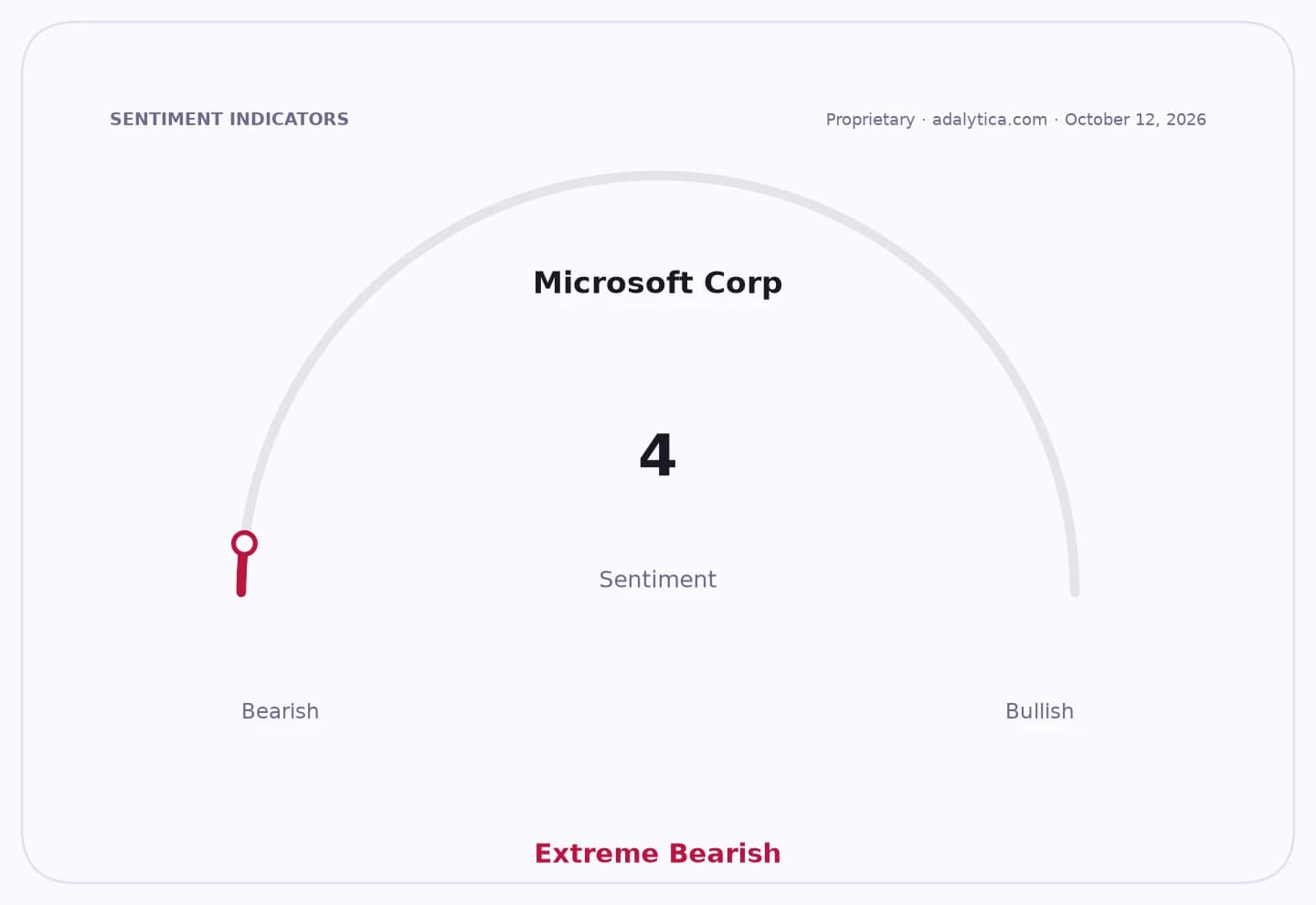
Technically, the big AI names are not signaling panic: Microsoft’s RSI of 77.9 points to strong momentum, while Nvidia’s 46.4 and Alphabet’s 51.6 suggest more mixed trading conditions. But sentiment data from Adalytica.com show how quickly attitudes can shift: Microsoft earnings sentiment sits in “Extreme Fear” at 4, while broader AI sentiment is still in “Greed” at 71, underscoring that the market is enthusiastic about the sector even as it remains vulnerable to trust and governance shocks.
The bigger narrative is that AI safety is fragmenting along linguistic lines just as adoption is globalizing. For developers, that means multilingual testing may become a non-negotiable cost of doing business. For investors, it means the next phase of AI growth will likely favor firms that can prove their systems are safe not only in the largest markets, but in the smallest ones too.
| Entity | Gains | Losses |
|---|---|---|
| Multilingual AI vendors | ▲Broader market access | ▼Higher compliance costs |
| English-first model providers | ▲Existing data advantage | ▼Reputational risk |
| Regulators and policymakers | ▲Stronger oversight leverage | ▼Slower rollout pressure |
| Users in local-language markets | ▲Better safety standards | ▼Delayed product availability |